
The Archaeological Mission
The Sapienza Archaeological Mission to Çuka e Ajtoit (ancient Kestría) in southern Albania was launched in 2021 thanks to a research agreement between the SARAS Department of Sapienza University of Rome and the Institute of Archaeology of Tirana, part of the Academy of Sciences of Albania. The mission, directed by Julian Bogdani (Sapienza, Rome) and, since 2025, by Nevila Molla (IA, Tirana; for the period 2021-2024 by Albana Meta), has operated since 2022 with official recognition and, since 2023, with the financial support of the Ministry of Foreign Affairs and International Cooperation. Since 2025 the project has been funded by the Bando Grandi Scavi programme of Sapienza University of Rome.
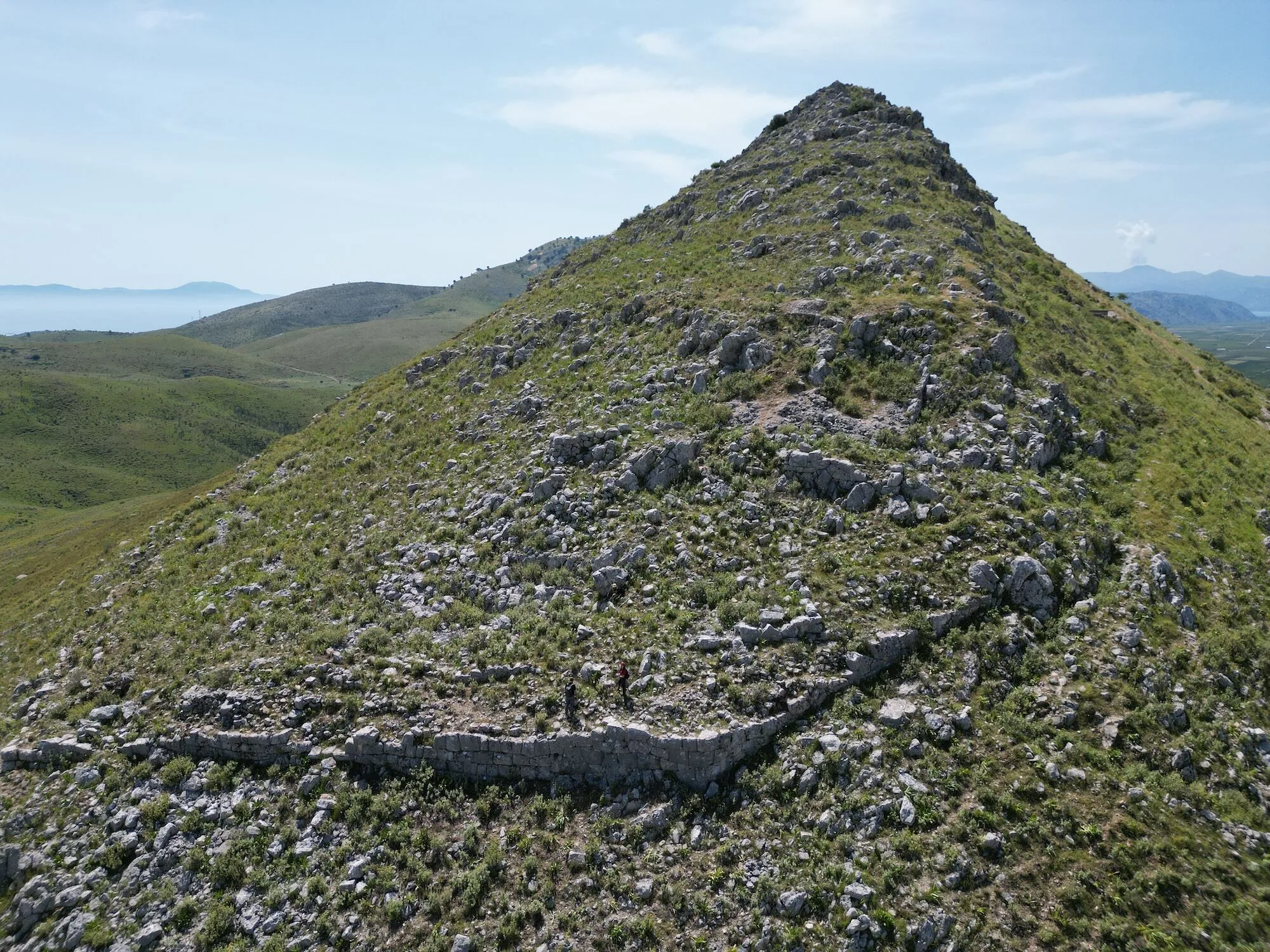
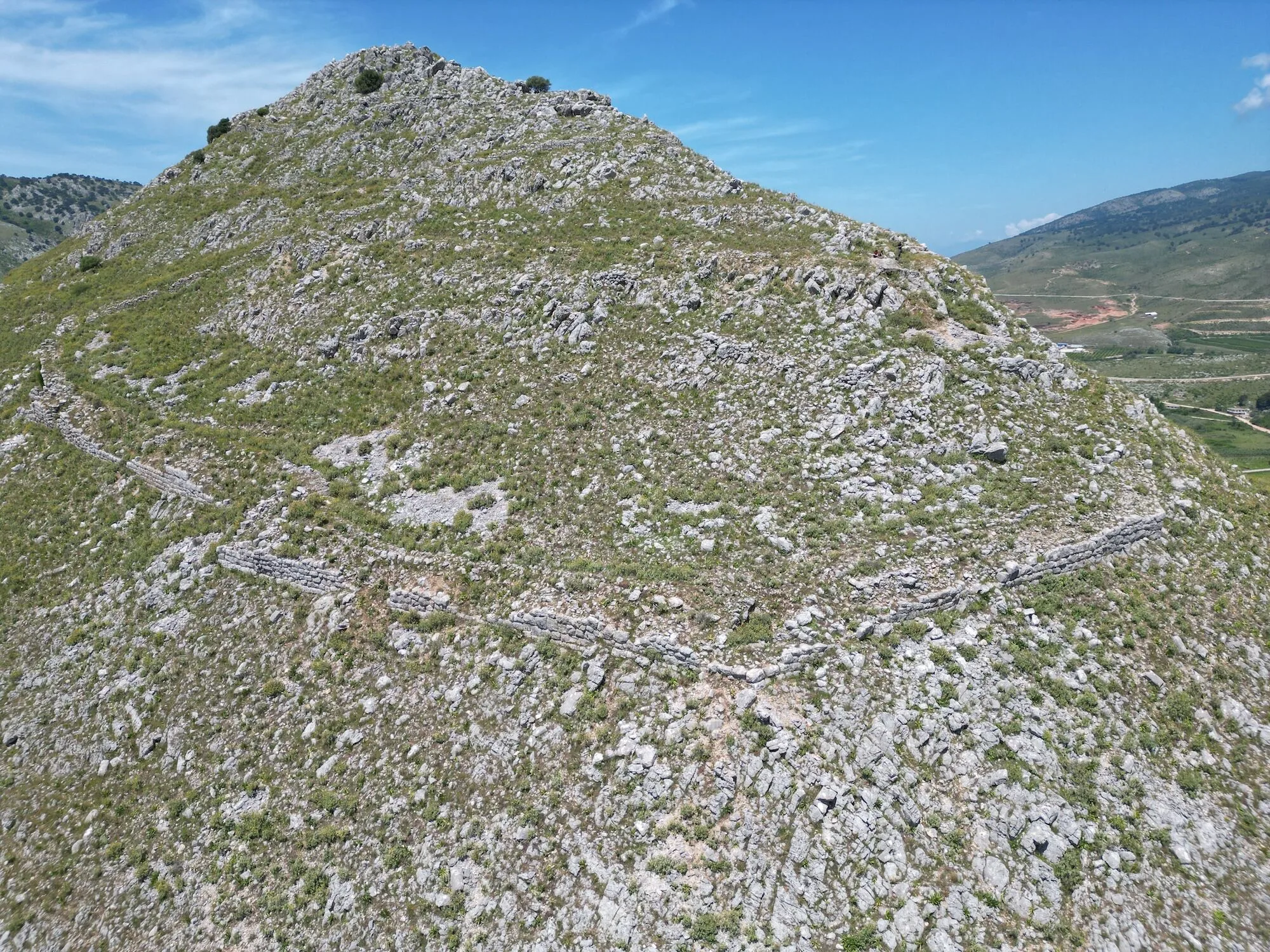
The project aims at the documentation, excavation and historical-archaeological study of the fortified Hellenistic centre of Kestría, located on the hill of Çuka e Ajtoit, in southern Albania, and of its territory.
Introduction to the site
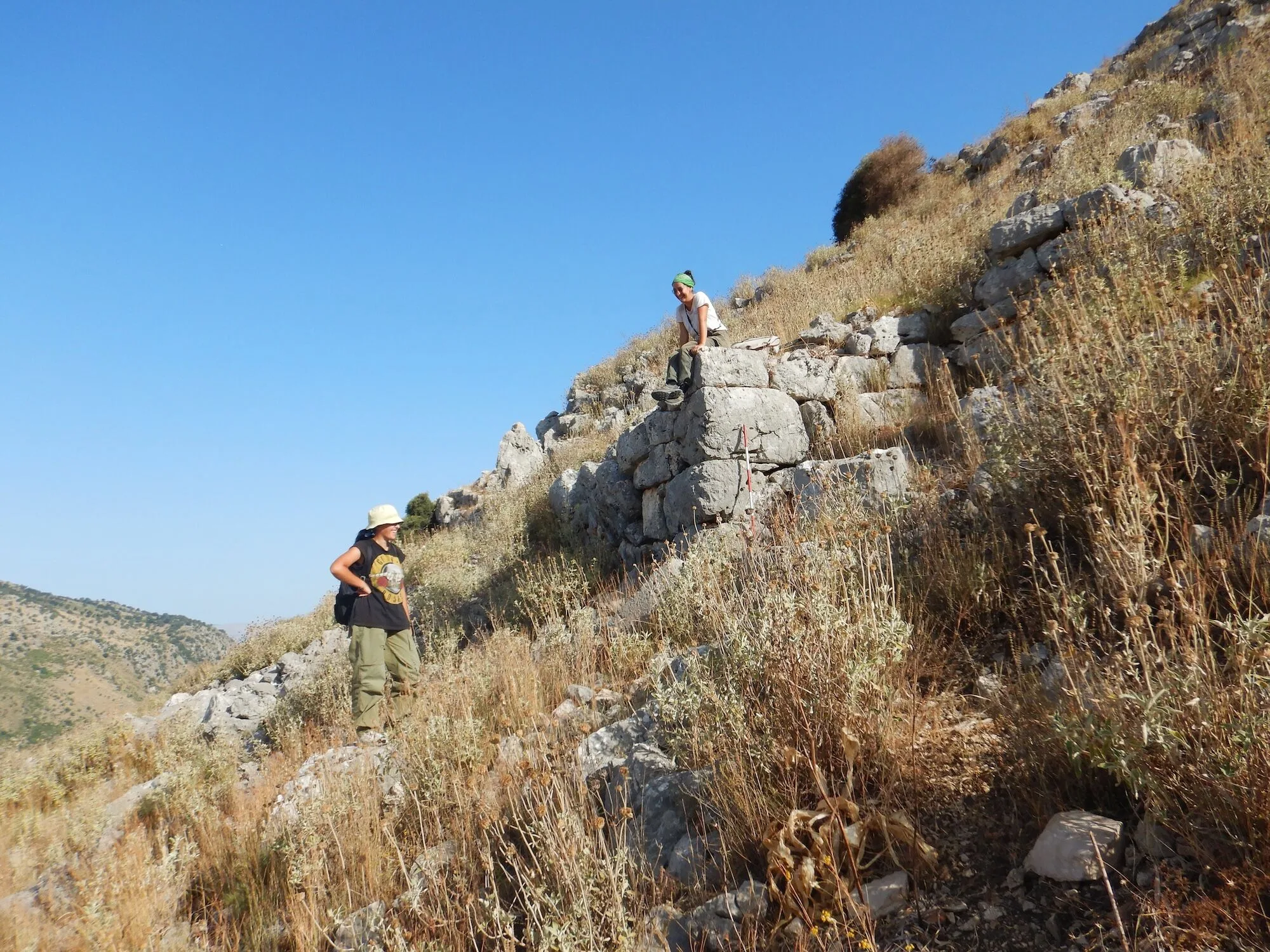
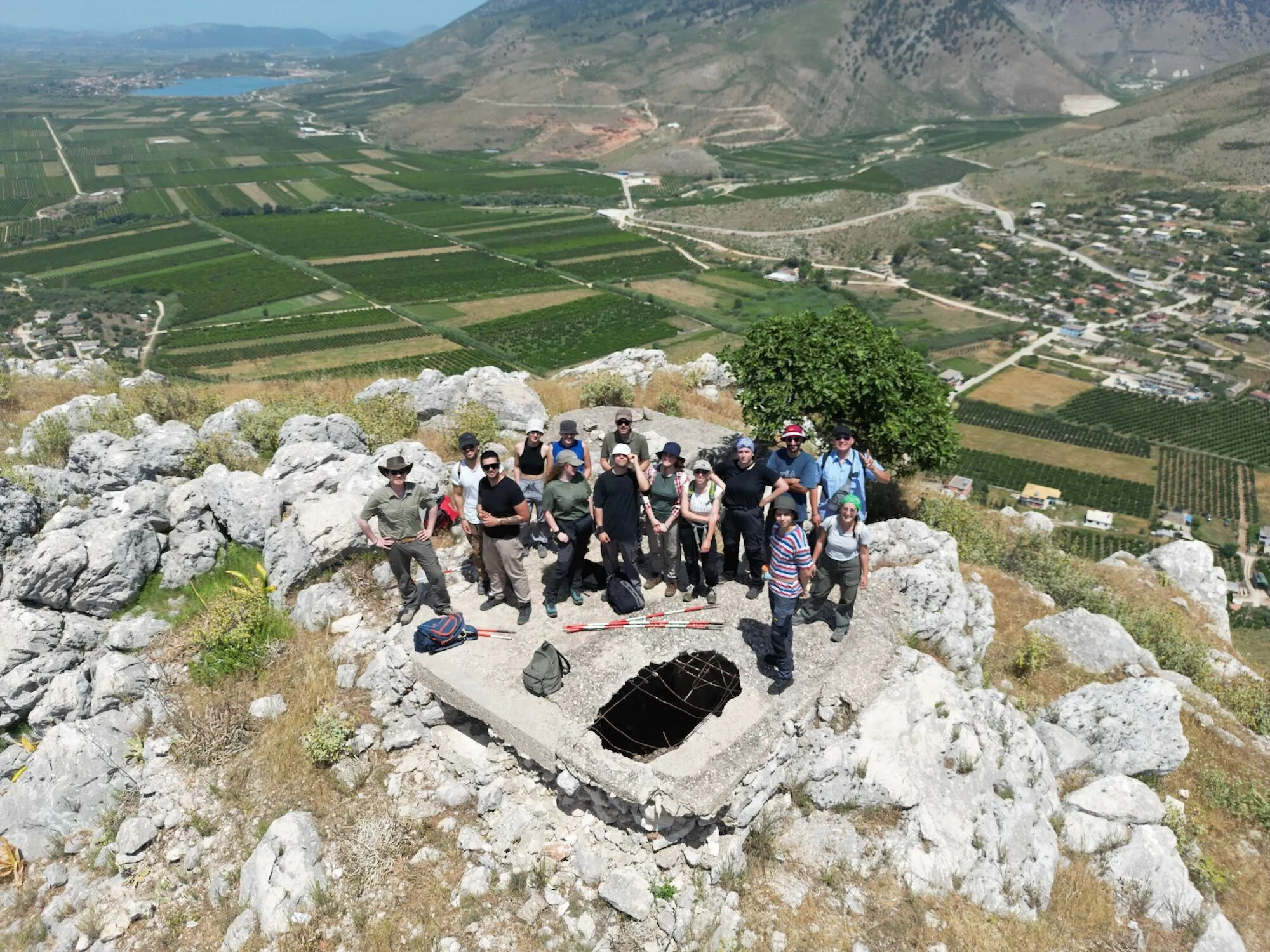
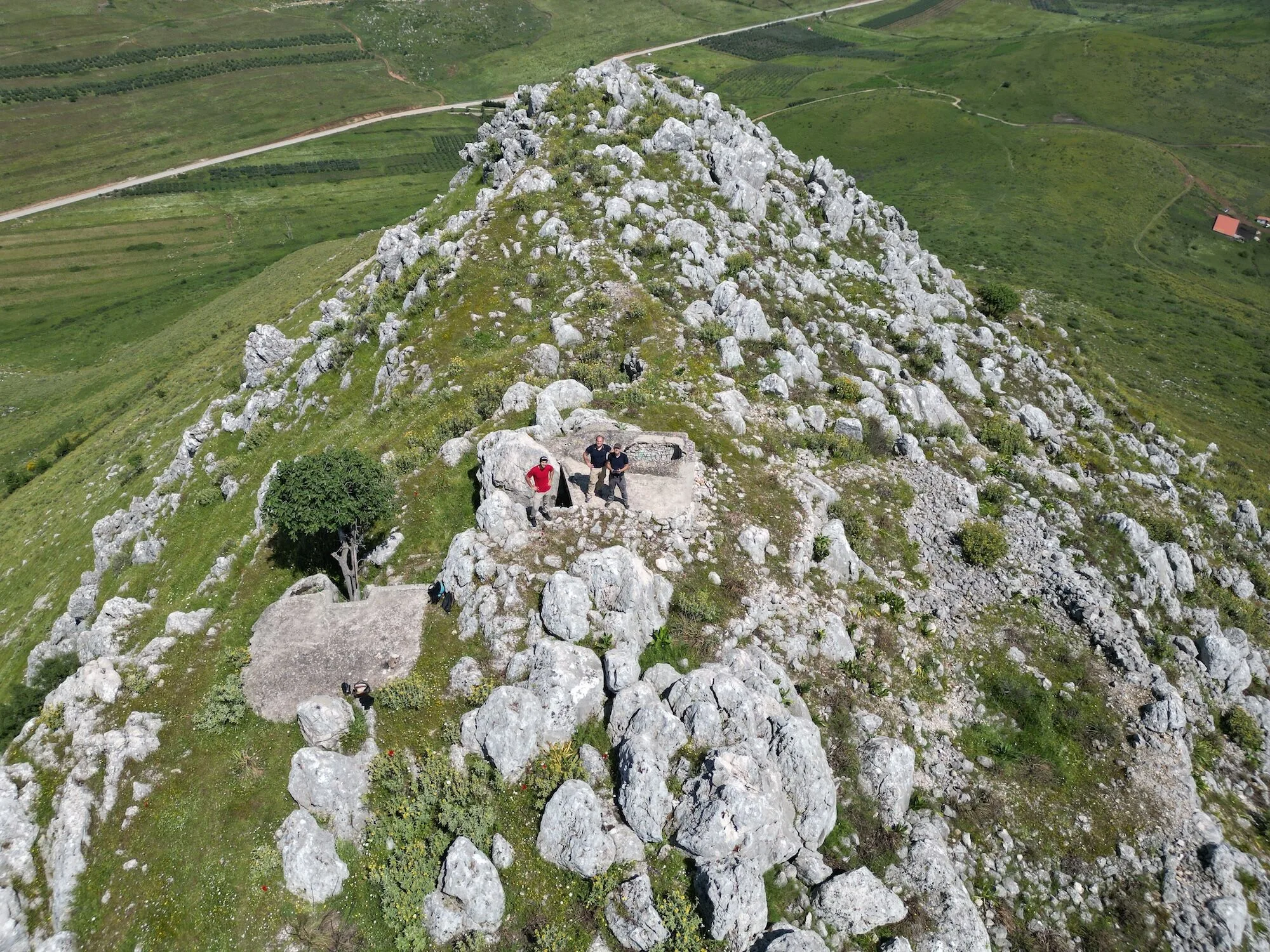
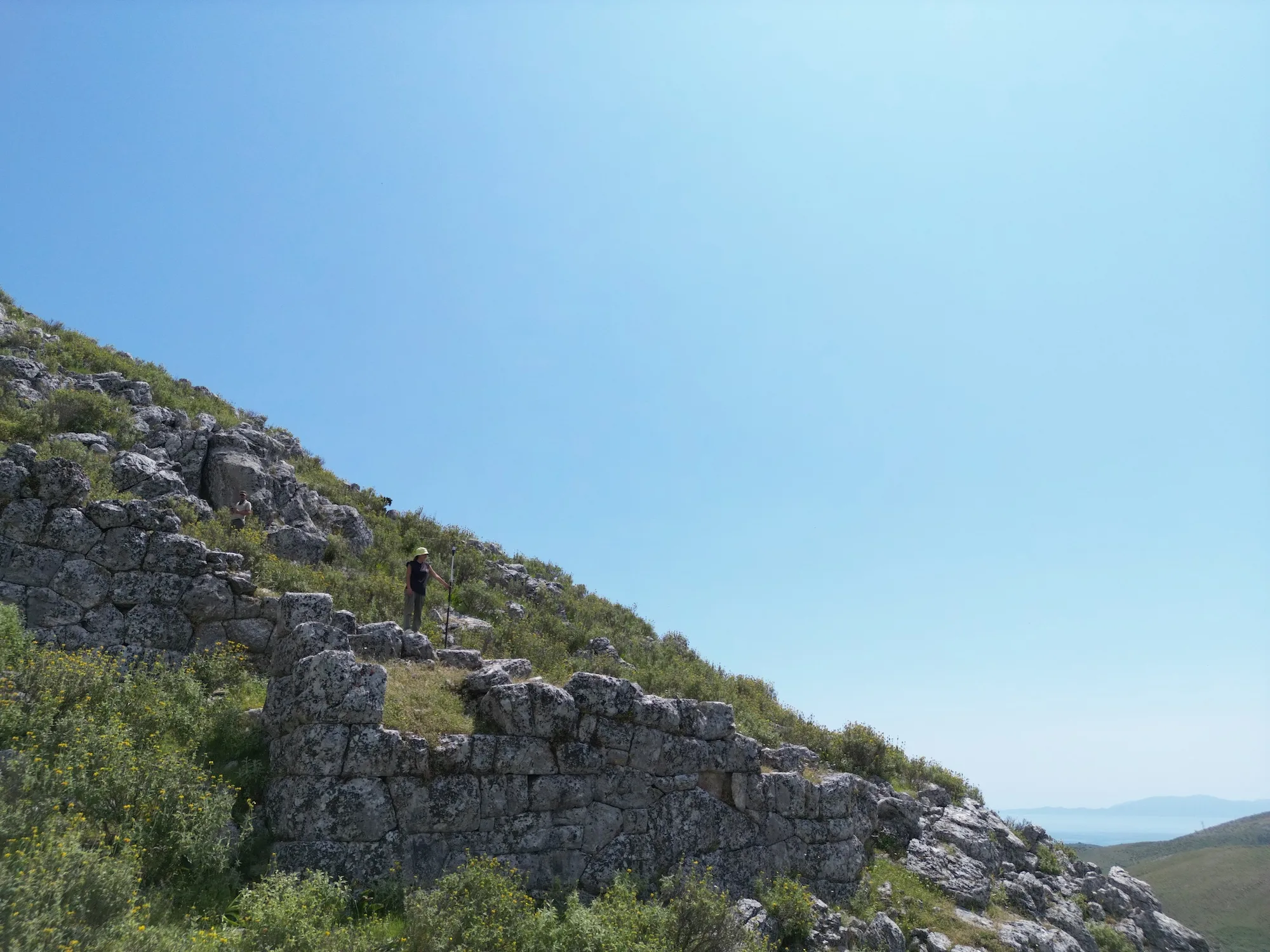
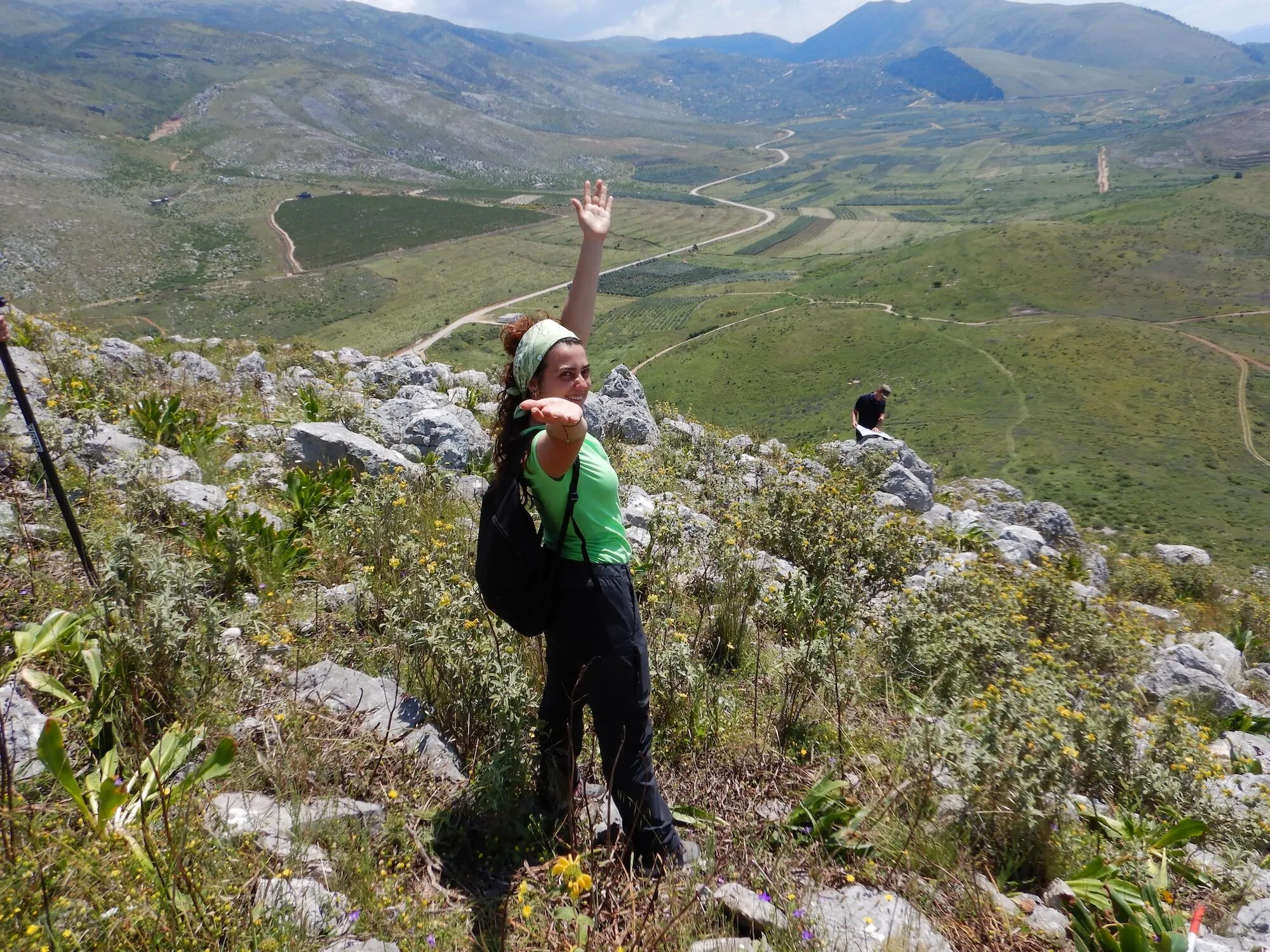
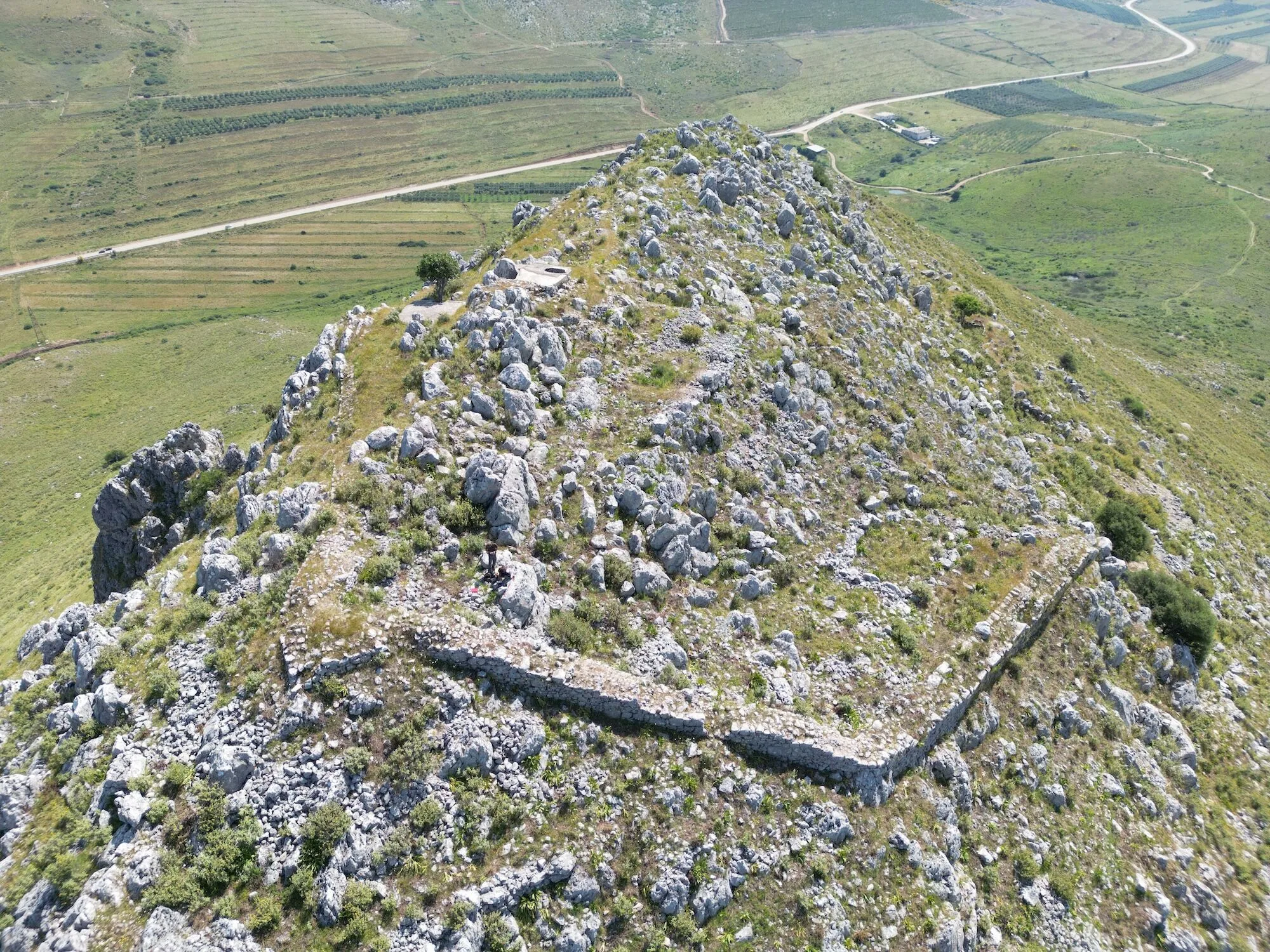
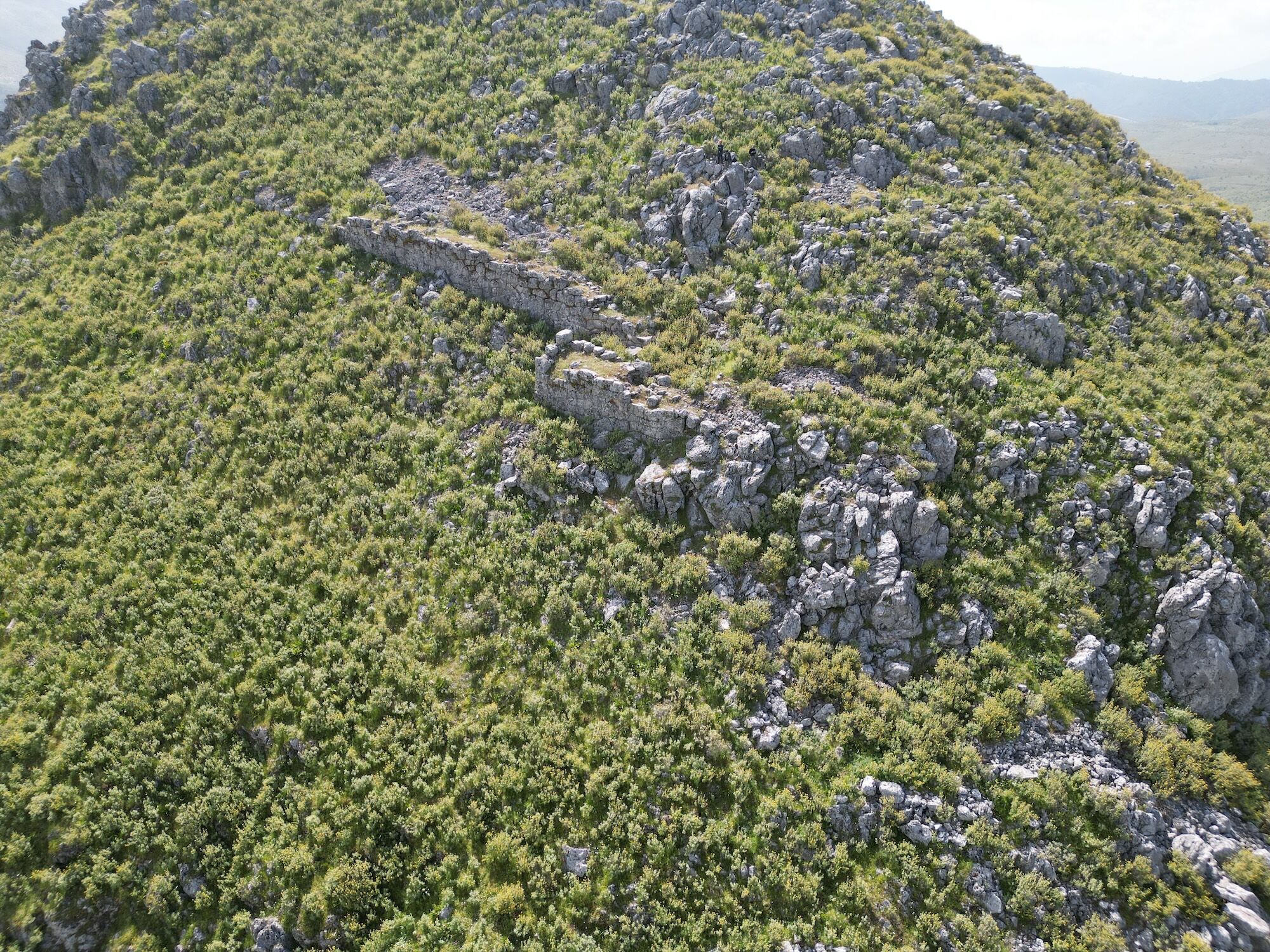
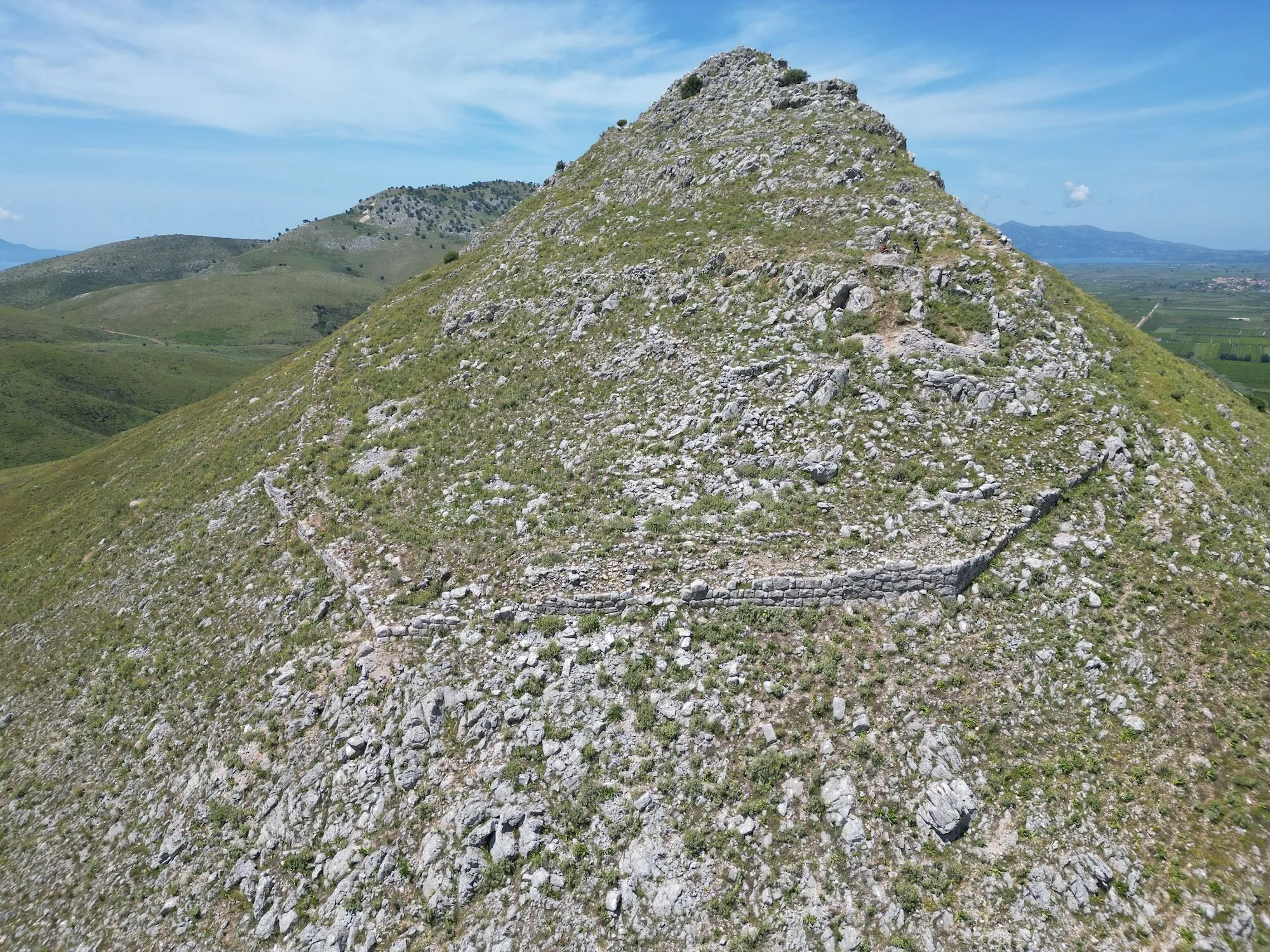
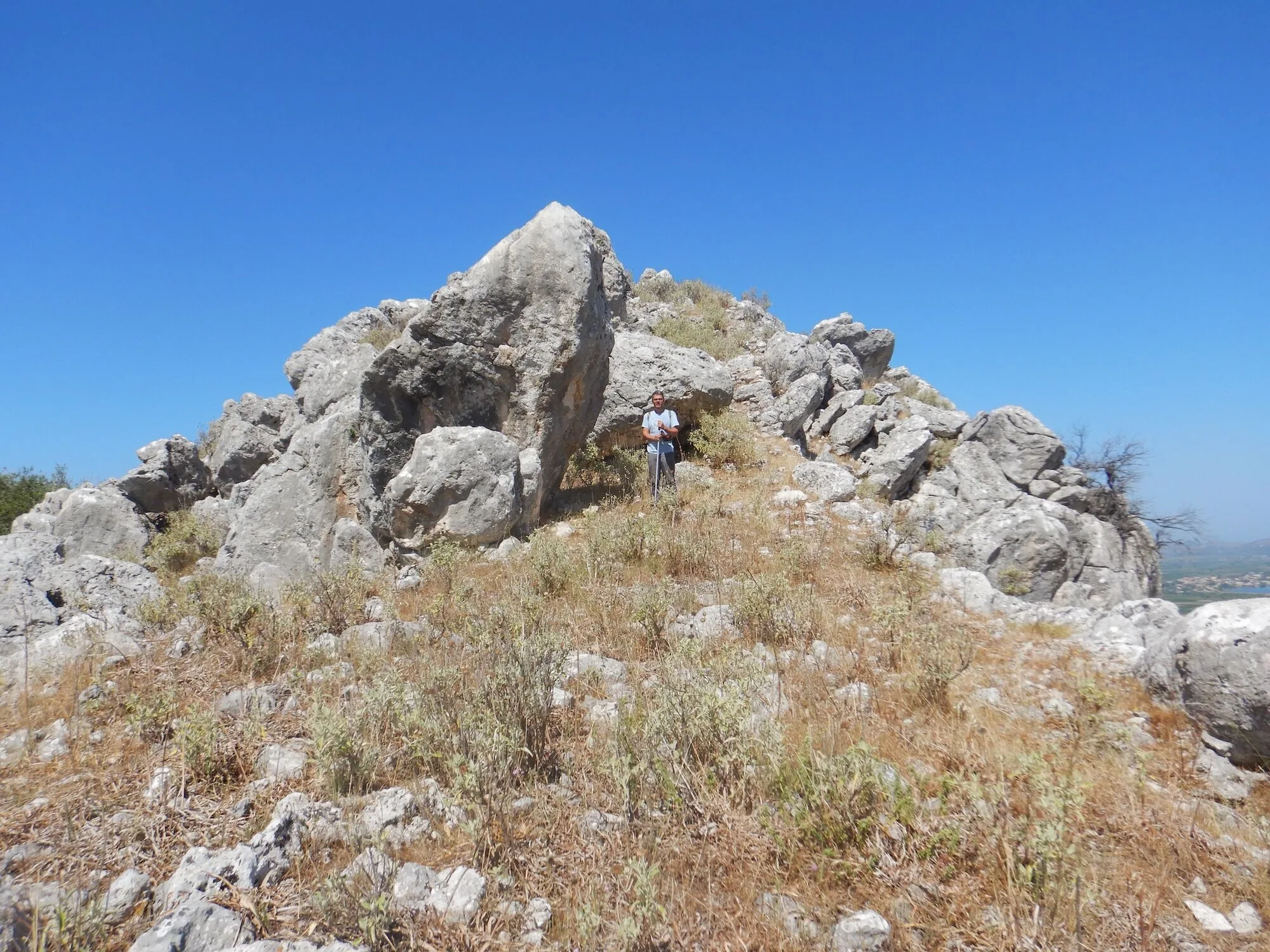
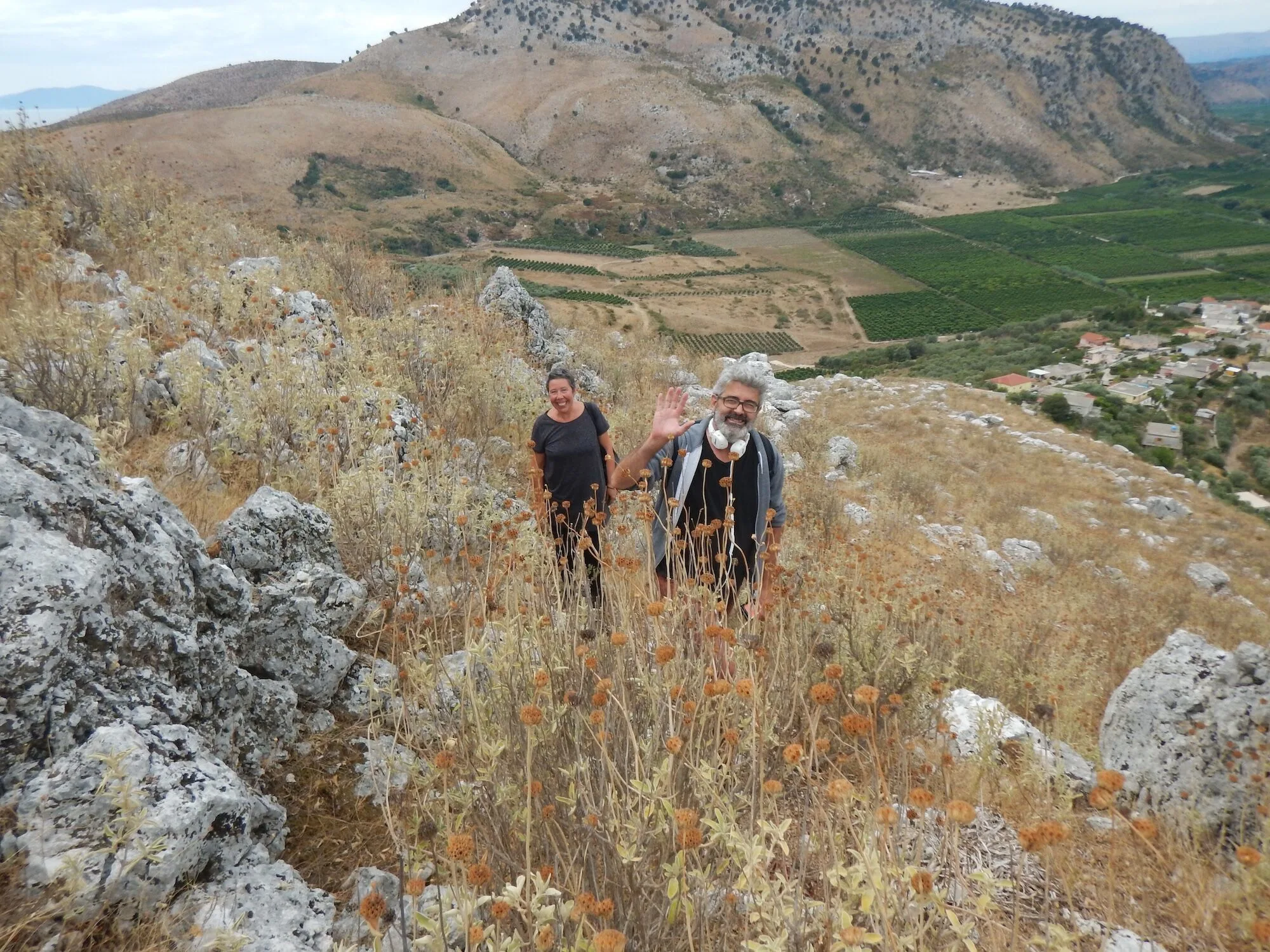
The fortifications of Çuka e Ajtoit are located on the hill of the same name, near the settlement of Çiflik, in the municipality of Konispoli, in southern Albania, and were declared a Monument of Cultural Interest under law no. 6 of 15.01.1963, on a proposal by the Rectorate of the then State University of Tirana. The hill dominates with its sharp profile the plain of Vrina to the north and that of Vardhari to the south, lying halfway between Butrint and Konispoli, directly controlling the point where the Pavlla river emerges from the narrow gorge of Bogazi (the toponym means narrow passage, gorge, in Turkish and Persian) and, turning through 90 degrees, heads towards the plain of Vrina. From an archaeological point of view, this is an extremely rich area, with evidence ranging from Prehistory (the cave of Konispoli, that of Shën Marena, Vagalati) to the Hellenistic and Roman period (Malathrea, the quarry of Shkalla, Bregu i Sterës, the pass of Kato Aetos) and the Late Antique and Medieval period (the monastery of Çiflik), without including in this brief list the highly interesting and nearby area of Mursia, Xara and Vrina.
History of research
The archaeological site was visited by William M. Leake in January 1805 during his visit to Konispoli, and by François C.H.L. Pouqueville, who, besides the fortifications in polygonal masonry, also mentions the Late Antique circuit. Çuka e Ajtoit was first surveyed and excavated in the 1920s by the Italian mission directed by Luigi Maria Ugolini, who, having closed operations at Phoinike, had moved to nearby Butrint, where he had undertaken extensive excavations.
The topographer of the Italian mission, Dario Roversi Monaco, compiled the general survey of the hill, of the walls and of the other archaeological remains visible at the time. Unfortunately these campaigns were never published, and for a very long time the manuscripts were thought lost, whereas in fact they were kept in one of the mission’s archives in Rome. This situation persisted until 2005, when they were partially published by the English mission that was working at Butrint in those years.
After the Second World War, fieldwork resumed only towards the end of the 1950s, in collaboration with the Russian archaeologists, the Blavatski couple. Çuka e Ajtoit was surveyed in 1958 and excavated in 1959, and the work was overseen on the Albanian side by Hasan Ceka. Nor did these investigations ever see print, but from the long article by Dh. Budina (1971), which constitutes the archaeological map of the Ionian coast and the Delvina basin, and which summarises the available archival documentation, we know that the archaeologists’ attention focused on the so-called Palace and on the gate of the surrounding wall nearby. An important achievement of this expedition was the drawing up of a general plan of the remains on the hill, the only one available for a long time.
Fieldwork was resumed in 1978 by the then director of the Institute of Archaeology, Selim Islami, and besides the so-called Palace and the Hellenistic circuit, around 40 dwellings were also investigated. The Late Antique fortifications were also the subject of further study. Once again, the work was not published for many years, and very little information on these activities has ever appeared in print. It was only in 2008 that a posthumous volume was published collecting various studies and research by Selim Islami, published and unpublished, among which the Çuka e Ajtoit campaigns also feature.
These fieldwork studies are complemented by a number of specific investigations that shed important light on the site, such as the Hellenistic fortifications (Ceka 1976), the Late Antique phases (Lako 1982, 1982b), the dwellings (Baçe, Bushati 1989), etc. In the 1990s, the English archaeological mission active at the site of Butrint also turned its attention to this site, both through archival research and fieldwork. Published in digital form in 2005, these results were published in definitive form in 2020 (Hernandez, Hodges 2020).
Within the framework of the Italian Mission of the University of Bologna at Phoinike, and on the occasion of my postgraduate specialisation thesis in Archaeology at the same university, I studied this site in depth, seeking to reconstruct the history of research, with particular attention to Ugolini’s excavations and to Roversi Monaco’s surveys, which, although never completed, still constitute to this day the most detailed planimetric basis for the hill.
This work was published in summary form in Italian (Bogdani 2006) and Albanian (Bogdani 2009).
Project aims
As is clear from the summary of the preceding paragraphs, Çuka e Ajtoit is not a site unknown to Albanian and international archaeological research. But it is also true that the publication of this research has appeared in print in summary form and, for the most part, many years after the close of the excavations, and indeed many years after the death of their authors. In any case, these publications today constitute an indispensable basis for the knowledge of the ancient site and its life phases.
In recent decades, our knowledge of the region of Chaonia has made important advances thanks to the publication of work at Phoinike, Butrint and in the Drino valley. From these studies, the importance of the so-called second-order settlements emerges ever more clearly, following a classification based solely on the area enclosed by walls, such as Melani, Malçani, Borshi and Çuka e Ajtoit. These centres are without doubt a very important part of the regional fortification system built in the Hellenistic period by the main urban centres (chiefly Phoinike and Antigonea), and at the same time are important points of reference for the local communities, koinà, whose names often remain unknown to us owing to the lack of epigraphic evidence. In the case of Çuka e Ajtoit, the studies of Louis Robert brought to our knowledge the presence in this area of the tribe of the Pergamioi. The same scholar, and subsequently N. Hammond, thus identified the site of Çuka e Ajtoit with ancient Kestría, the main centre of the region of Kestríne, whose mythical lineage is traced back to Kestrinos, son of the Trojan exiles Helenus and Andromache, who ruled the region after the death of Neoptolemus (Paus. 1.11.1, 2.23.6).
None of these secondary centres has been investigated systematically and in detail, and the resumption of research at Çuka e Ajtoit would shed important light on the organisation of the region of Kestríne and of the Pavlla river valley, a border area between the Chaonian and Thesprotian tribes. The large urban centres, which have traditionally monopolised scholarly attention, are the exception for the Epirote area, even during the Hellenistic and Roman periods. It is therefore essential, for the understanding of the regional system, to deepen the archaeological knowledge of the secondary centres, among which Kestría is by far the most monumental example.
From this perspective, the study of the history and topography of Çuka e Ajtoit on the one hand, and of the region of Kestríne on the other, are fundamental. This study will be carried out with full respect for all the phases of life of the ancient site, seeking to contextualise not only the monumental remains of the Hellenistic or Late Antique periods, but with particular attention also to the archaeologically less well-known phases, such as the pre-Hellenistic phases (Iron Age and Classical period) and also the Roman phase.
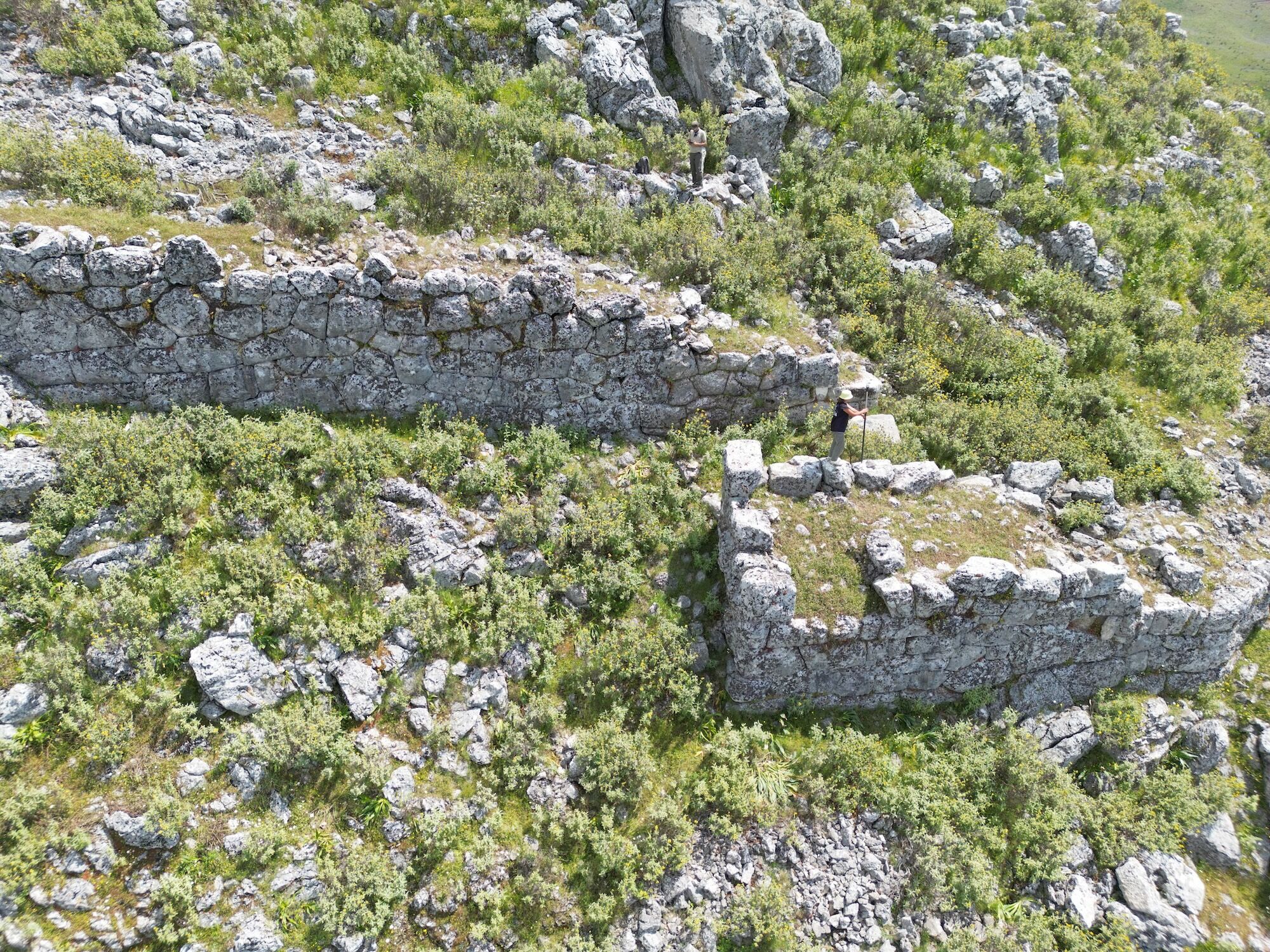
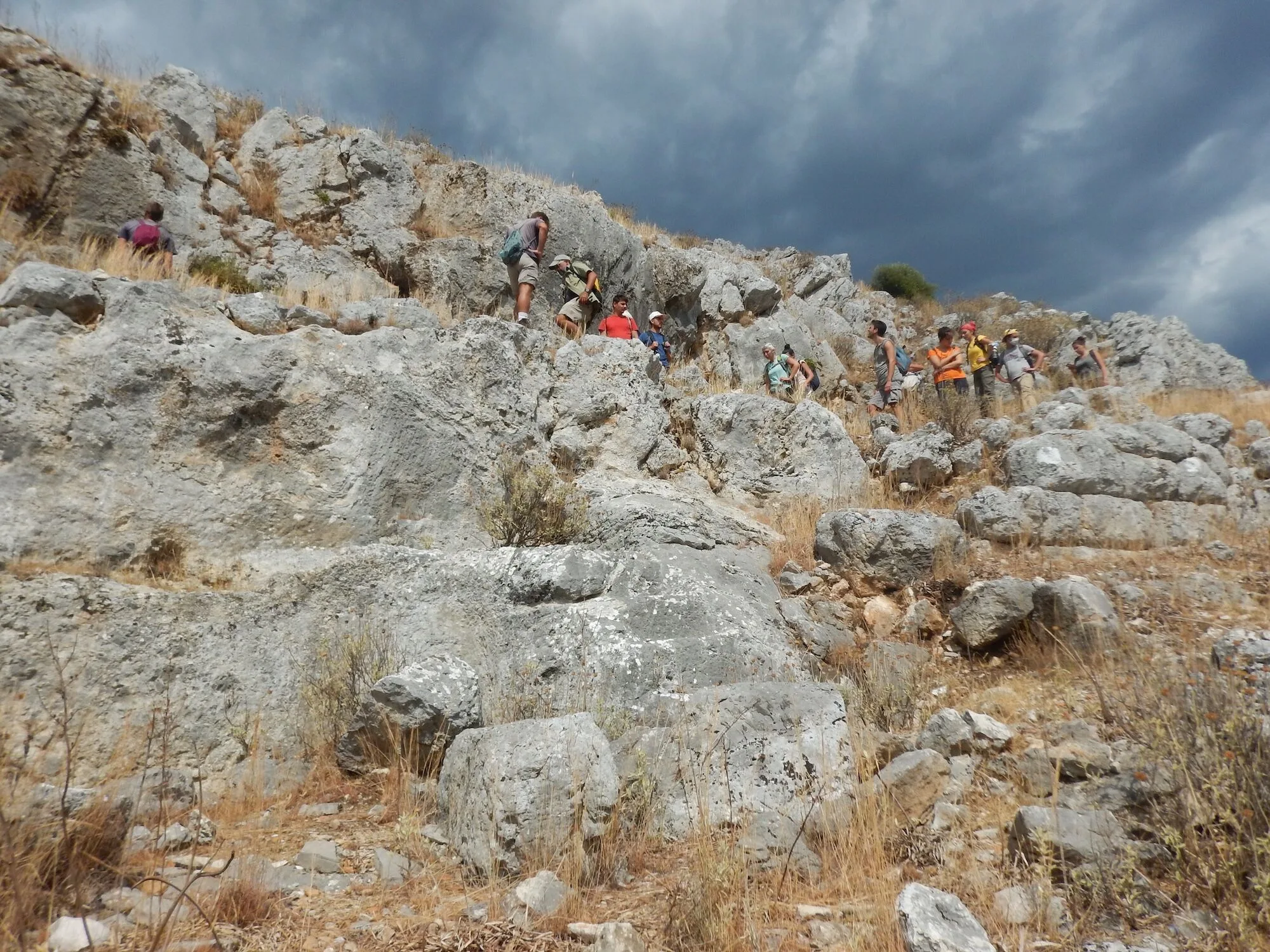
As for specific aspects, the fortifications of Çuka e Ajtoit are an exceedingly interesting and monumental palimpsest of the various building techniques used in the region for the construction of fortification works, and one of the rare instances of the use of polygonal masonry in Chaonia. For this reason, the site constitutes a unique laboratory for the study of fortification techniques in the region. The dating of its walls has to date been carried out on purely stylistic grounds, but the studies of the last decade in the neighbouring regions of Chaonia and Thesprotia, and further afield across the whole Mediterranean basin, prompt us to carefully reconsider the methodological criteria and to reopen from its foundations the question of chronology. Desirable new stratigraphic data from targeted test trenches and the in-depth analysis of building techniques will certainly bring new material for the diachronic study of the masonry works.
Diachrony is another important characteristic of this centre. Previous excavations have highlighted the presence of phases other than the Hellenistic one, such as the Roman, Late Antique and Medieval phases. Fainter, but not absent, are the traces of earlier phases, never yet fully contextualised. Continuities and breaks that can be investigated archaeologically make the site of Çuka e Ajtoit particularly well suited to analysis and reconstruction in the longue durée.
As for the urban and architectural aspects, the study of private and public residential building takes on primary importance at this site, thanks to the presence of dozens of residential units, both within the fortification circuit and outside it, in the “lower town”, as S. Islami calls it, or “the Palace”, as it is called by the local inhabitants. The plan solutions are for the most part very simple, at least as regards the dwellings of the “acropolis” (again using S. Islami’s terminology), where the lack of usable space and the strongly uneven terrain greatly limit the space available for building. The situation is different at “the Palace”, whose rather monumental structures (a gate in polygonal masonry, with a false-arch covering, was transported and reassembled in the courtyard of the National Museum of Tirana) still lack a definitive interpretation.
Scientific output
Over the years, the members of the mission have carried out an important process of scientific output and dissemination of research results, through various publications, organisation and participation in workshops and conferences. Below is a brief overview, which is continuously updated.
Publications
Forthcoming
- Aleotti, N. “Corcira e la sua perea: archeologia del culto in età arcaica e classica (Fine VIII-IV secolo a.C.)”, Diabaseis. Pisa: ETS.
- Aleotti, N. “Corcira e l’Epiro in età arcaico-classica: il contributo dell’archeologia dei culti”, in Fra storia e archeologia: Corcira e l’epeiros. Nuovi dati e prospettive di ricerca a cura di Maria Intrieri e Giuseppe Lepore. Diabaseis. Pisa: ETS.
- Aleotti, N. e J. Bogdani. “Hellenistic pottery from Çuka e Ajtoit (Konispoli, Albania): old and new excavations, old and new methods”, in Proceedings of the 6th IARPotHP Conference, October 2023, 9th – 12th, Catania-Syracuse, Italy.
- Aleotti, N. e B. Risposi. “A colonial Artemis? Aspects of the cult of the goddess”, in Syracuse and Corcyra, Proceedings of the International Conference “Corinth and Syracuse. Connections, Exchanges, Influences”, Siracusa, December 5-7, 2024.
- Antonetti, C. e N. Aleotti. “Un graffito tardo arcaico da Butrinto.”, in Fra storia e archeologia: Corcira e l’epeiros. Nuovi dati e prospettive di ricerca a cura di Maria Intrieri e Giuseppe Lepore. Diabaseis. Pisa: ETS.
- Bogdani, J. “Cestria: un abitato epirota davanti a Corcira. Nuove ricerche archeologiche a Çuka e Ajtoit”. Fra storia e archeologia: Corcira e l’epeiros. Nuovi dati e prospettive di ricerca a cura di Maria Intrieri e Giuseppe Lepore. Diabaseis. Pisa: ETS.
- Bogdani, J. e A. Meta. “Kestria: an Epirote centre. New archaeological research in Çuka e Ajtoit (Konispol, Albania)”. Iliria.
- Gamberini, A. e N. Aleotti, “Food Habits and Ceramic Repertoire: preparing and cooking Food in Hellenistic Epirus”, in Proceedings of the 5th IARPotHP Conference, June 2021, 22nd – 25th Seville, Spain.
- Bogdani, J., a cura di. 2025. Abitare l’Epiro antico. Tipologie, modelli e trasformazioni dell’edilizia residenziale nell’Epiro ellenistico e romano. Sesto Fiorentino: All’Insegna del Giglio
- Bogdani, Julian. 2025. “Prime note sull’edilizia residenziale a Çuka e Ajtoit (Albania)”. In Abitare l’Epiro antico. Tipologie, modelli e trasformazioni dell’edilizia residenziale nell’Epiro ellenistico e romano, a cura di Julian Bogdani, 93–113. Sesto Fiorentino: All’Insegna del Giglio.
- Aleotti, Nadia, e Francesca D’Ambola. 2025. “Appendice: Un deposito secondario di votivi da W4-01”. In Abitare l’Epiro antico. Tipologie, modelli e trasformazioni dell’edilizia residenziale nell’Epiro ellenistico e romano, a cura di Julian Bogdani, 191–98. Sesto Fiorentino: All’Insegna del Giglio.
- Aleotti, N. 2025. “A palmette lekythos from Tower 1 in the Western Defences at Butrint.”, in Butrint 8. The Late Roman and Middle Byzantine Archaeology Of Butrint, its Enclave, Saranda And Santi Quaranta, edited by R. Hodges and N. Molla, 49-50. Oxford and Philadelphia: Oxbow book.
- S. Napolitano, J. Bogdani. 2025. “Ceramica medievale dagli scavi della cosiddetta basilica di Çiflik (Konispol, Albania): nota preliminare.” In X Congresso Nazionale di Archeologia Medievale. Udine – Cividale del Friuli, 9-13 settembre 2025 Volume 3, a cura di Simonetta Minguzzi, Angela Borzacconi, Lorenzo Passera, Laura Biasin, 135-140. Sesto Fiorentino: All’Insegna del Giglio.
- Bogdani, J. E. Giorgi, F. Carbotti, G. Sigismondo, and N. Aleotti. 2025. “FortNet Project: a longue durée approach to the study of settlement, economic and defensive systems in coastal Chaonia (Albania).” Groma. Documenting Archaeology, 9: 151-159. DOI: 10.32028/Groma-Issue-9-2024-324
- Bogdani, J. 2024. “Chaonia in Epirus. A fresh assessment in light of new archaeological data” in Redefining Ancient Epirus a cura di Milena Melfi e Maria Stamatopoulou, 37-61. Borders, Boundaries, Landscapes, 1. Turnhout: Brepols Publishers.
- Bogdani, J. 2024. “Documenting a hilltop settlement: methodologies and preliminary results of the joint Albano-Italian project at Çuka e Ajtoit (Albania).” GROMA: Documenting Archaeology 8 (2023): 18–36. https://doi.org/10.32028/Groma-Issue-8-2023-2832.
- Bogdani, J. 2024. “Troia in Epiro: miti, archeologie, storie e ideologie”. In Il viaggio di Enea a cura di Alfonsina Russo e Roberta Alteri, 193-211. Foro Romano - Palatino. Scavi e ricerche II/2024. Roma: «L’Erma» di Bretschneider.
- Bogdani, J. e N. Aleotti. 2024. “Le necropoli di Çuka e Ajtoit: vecchie e nuove ricerche a confronto”. Atlante Tematico di Topografia Antica, 33: 139-160.
- Bogdani, J. e D. D’Erasmo. 2024. “Old Data, Old Methodology and New Research. A Case Study of Legacy Data Integration from the Cestrine Region, Epirus”. Archeologia e Calcolatori 35 (2): 323–32. https://doi.org/10.19282/ac.35.2.2024.34.
- Bogdani, J. 2023 “Documentare l’invisibile. Il progetto Çuka e Ajtoit: rilievo e documentazione di un sito d’altura”. Archeologia Aerea XVI 2022: 89-101.
- Bogdani, J. 2022. “ΚΕΣΤΡΙΑ ΤHΣ ΧΑΟΝIΑΣ: appunti sulla geografia e storia di una regione di frontiera”. Hesperìa. Studi sulla Grecità d’Occidente 40: 87-104.
- Bogdani, J. e A. Meta. 2022. “Kërkime të reja shqiptaro-italiane në Çukën e Ajtoit”. Candavia, 9: 141-159
Conference organisation
- Living in the Town, Living in the Countryside. Typologies, Models and Transformations of Residential Architecture in Hellenistic and Roman Epirus. An international workshop 15 January 2023. Sapienza University of Rome https://lad.saras.uniroma1.it/ricerca/living-in-the-town-living-in-the-countryside/.
- Linking Pasts And Sharing Knowledge. Mapping Archaeological Heritage, Legacy Data Integration and Web Technologies for Modelling Historical Landscapes. 13-14 November 2023. University of Naples Federico II. Organised in collaboration with the University of Naples Federico II and the University of Sheffield. https://lad.saras.uniroma1.it/ricerca/linking-pasts-and-sharing-knowledge/.
Conference presentations
- Forteresses, forts et camps dans l’aménagement des territoires. De la Méditerranée aux marges des royaumes perse, hellénistiques e de l’Empire romain Université Paris X - Nanterre, Paris, 27-28 May 2025
- Julian Bogdani e Veronica Castignani, “The fortified landscape of the ethnos: the case study of Hellenistic Cestrine, Epirus” https://lad.saras.uniroma1.it/notizie/2025-05-27_28-conference-fortifications-nanterre/
- Scuola Normale Superiore di Pisa. Pisa, 7 April 2025. Sala Stemmi del Palazzo della Carovana, Scuola Normale Superiore, Piazza dei Cavalieri, 7. Seminar organised by Barbara E. Borg.
- Julian Bogdani, “Cestrine in Epiro: mito, storia e archeologia”.
https://lad.saras.uniroma1.it/ricerca/missione-archeologica-sapienza-a-cuka-e-ajtoit-albania/
- Julian Bogdani, “Cestrine in Epiro: mito, storia e archeologia”.
- Viti Arkeologjik 2024 (Archaeological Year 2024). Academy of Sciences of the Albanian Republic, Tirana, Academy of Sciences, 27 March 2025.
- Julian Bogdani, Albana Meta, “Projekti Çuka e Ajtoit: rezultatet e fushatës 2024.”
https://lad.saras.uniroma1.it/notizie/2025-03-25-conferenza-anno-archeologico-2024/
- Julian Bogdani, Albana Meta, “Projekti Çuka e Ajtoit: rezultatet e fushatës 2024.”
- Butrinto Cento (1924-2024). Bilanci e prospettive. University of Bologna, 13-15 November 2024.
- Julian Bogdani, “Ricerche a Çuka e Ajtoit”
- Nadia Aleotti, “What about Pre-Hellenistic pottery? Looking for the 5th and 4th cent. BCE material culture in Northern Epirus.”
https://lad.saras.uniroma1.it/notizie/2024-11-13_25-butrinto-cento-bologna/
- Culti e rituali in grotta: forme e materiali dal Mediterraneo tardoantico. Sapienza University of Rome, 9-10 September 2024. Title of the paper by Julian Bogdani and Francesca D’Ambola: “Praying at the edge: liminal cults and ritual practices in northern Epirus” https://lad.saras.uniroma1.it/notizie/2024-09-09_10-culti-e-rituali-in-grotta/
- 30th European Association of Archaeologist (EAA) Annual Meeting in Rome, Italy 28 - 31 August 2024
- Francesca D’Ambola, “Trojan Wanderers Between East And West: Approaching Sacred Landscapes In Northern Epirus”
- Julian Bogdani, “Fortified Landscapes in Ancient Epirus: New Research in The Hellenistic Site of Çuka e Ajtoit (Albania).”
- Nadia Aleotti, “Northern Epirus Between the Classical and the Hellenistic Period: The Case of Çuka e Ajtoit, Butrint and Their Regional Context”
https://lad.saras.uniroma1.it/notizie/2024-08-28_31-eaa-rome/
- Actualité de la recherche archéologique en Albanie, an international conference organised at the Collège De France by E. Nallbani, F. Quantin and S. Shpuza. Title of the paper by Julian Bogdani: “New researches at Çuka e Ajtoit/Kestria: a fortified site facing Kerkyra”. https://lad.saras.uniroma1.it/notizie/2024-06-28-recherche-archeologique-en-albanie/
- Current Research on Illyria and Epirus. 4th century BC – 1st century AD, organised by the University of Trier (Germany). Title of the paper by Julian Bogdani: “Chaonia in Epirus from the Archaic Period to the Hellenistic Age”. https://lad.saras.uniroma1.it/notizie/2024-04-11_13-current-research-in-epirus-illyria/
- Fra storia e archeologia: Corcira e l’epeiros. Nuovi dati e prospettive di ricerca, International Seminar, 20-21 November 2023.
- Julian Bogdani, “Cestria tra Corcira ed Epiro. Nuove ricerche a Çuka e Ajtoit”.
- Nadia Aleotti, “Corcira e l’Epiro in età arcaica e classica: il contributo dell’archeologia dei culti” https://lad.saras.uniroma1.it/notizie/2023-11-20_21-corcira-e-l-epeiros/
- Linking Pasts And Sharing Knowledge. Mapping Archaeological Heritage, Legacy Data Integration and Web Technologies for Modelling Historical Landscapes. A Hybrid Conference hosted by the University of Naples Federico II, and organised with Sapienza University of Rome and the University of Sheffield. 13-14 November 2023. University of Naples Federico II. Title of the paper by Julian Bogdani and Domizia D’Erasmo: “Old data, old methodology and new research. A case study of legacy data integration from the Kestrine region, Epirus”
- Arkeologjia shqiptare në 75-vjetorin e krijimit të saj: arritje, risi dhe perspektiva. Academy of Sciences of Albania, 8-9 November 2023. Title of the paper by Julian Bogdani and Albana Meta: “Kestria, një qytet epirot: kërkime të reja arkeologjike në Çukën e Ajtoit”.
- Beyond the Wall: City Walls & Urban planning. International workshop. University of Lille (France), with the support of the École Française d’Athènes. Lille, 5-6 December 2022. https://lad.saras.uniroma1.it/notizie/2022-12-05_06-beyond-the-wall/
- Epirus in the Roman World and the New Research on the Acropolis of Butrint by the Albanian Institute of Archaeology and the University of Bologna. University of Bologna, 10-11 November 2022. Title of the paper by Julian Bogdani and Albana Meta: “Kestrine: new data for the long-term archaeology of a border region” https://site.unibo.it/butrint/en/photogallery/international-workshop-epirus-in-the-roman-world-and-new-research-on-the-acropolis-of-butrint
- Landscape Archaeology: a discussion between the new paradigms of methodology. Scuola Superiore di Studi Avanzati. Sapienza University of Rome. 17 October 2022. Title of the paper by Julian Bogdani: “Fortified Landscapes: ethnos and polis in Chaonia, Epirus in the light of recent research”
- L’Epiro e l’Illiria Meridionale: Scavi e Ricerche Recenti, 6 May 2021. Webinar, University of Bologna. Title of the paper by Julian Bogdani: “Siti fortificati di secondo ordine in Caonia. Il caso di Çuka e Aitoit”. https://site.unibo.it/butrint/en/agenda/bogdani-siti-fortificati-di-secondo-ordine-in-caonia-il-caso-di-uka-e-aitoit
- Beyond the wall: Study of fortifications between architecture and history. (Section: 2. Study Scales and Goals: citadel, city, region). Online meetings curated by the École française d’Athènes (EfA). 7 December 2020. Title of the paper by Julian Bogdani: “Fortifying the ethnos. The case study of Chaonia, Epirus”
2025 Season
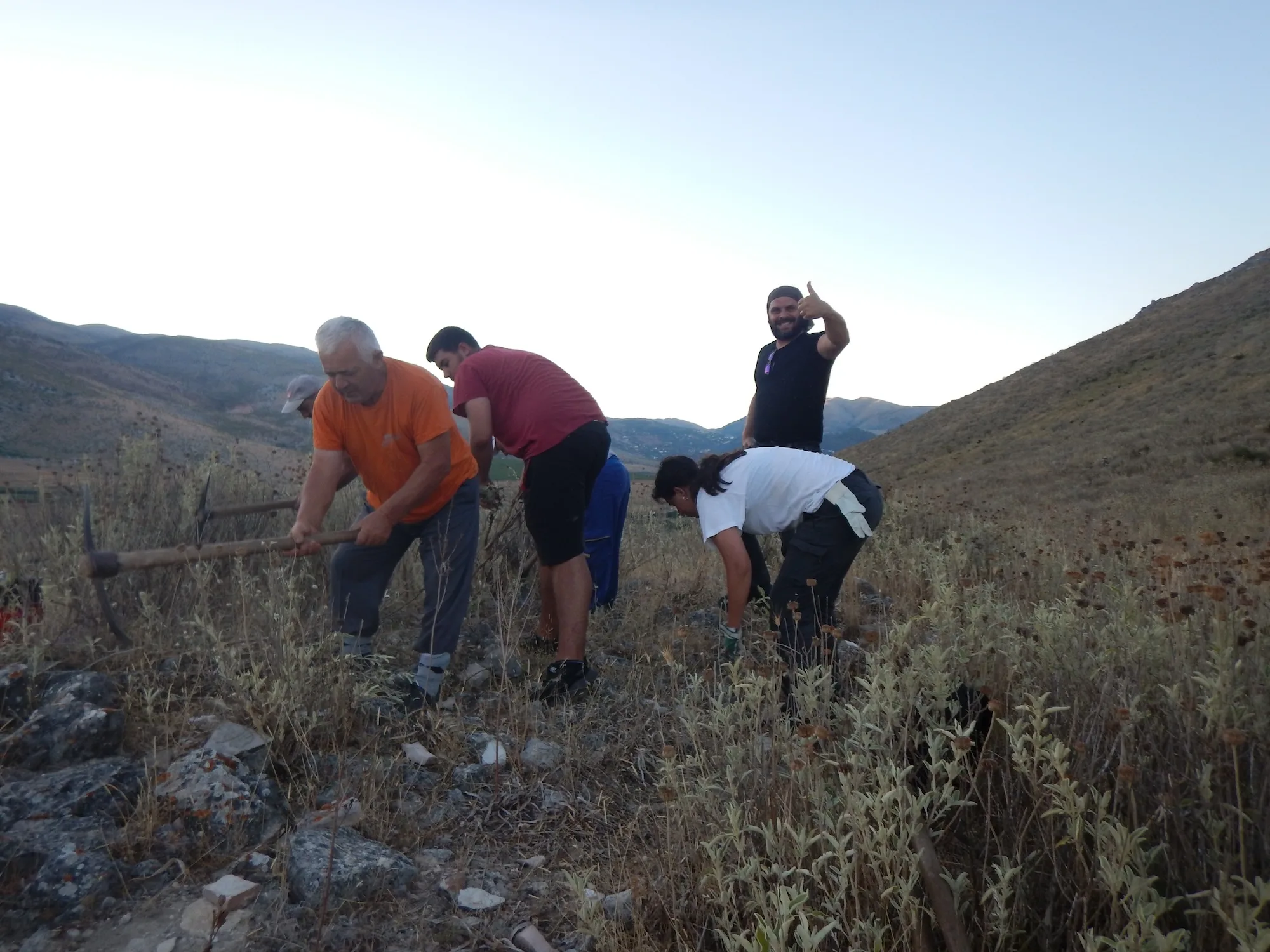
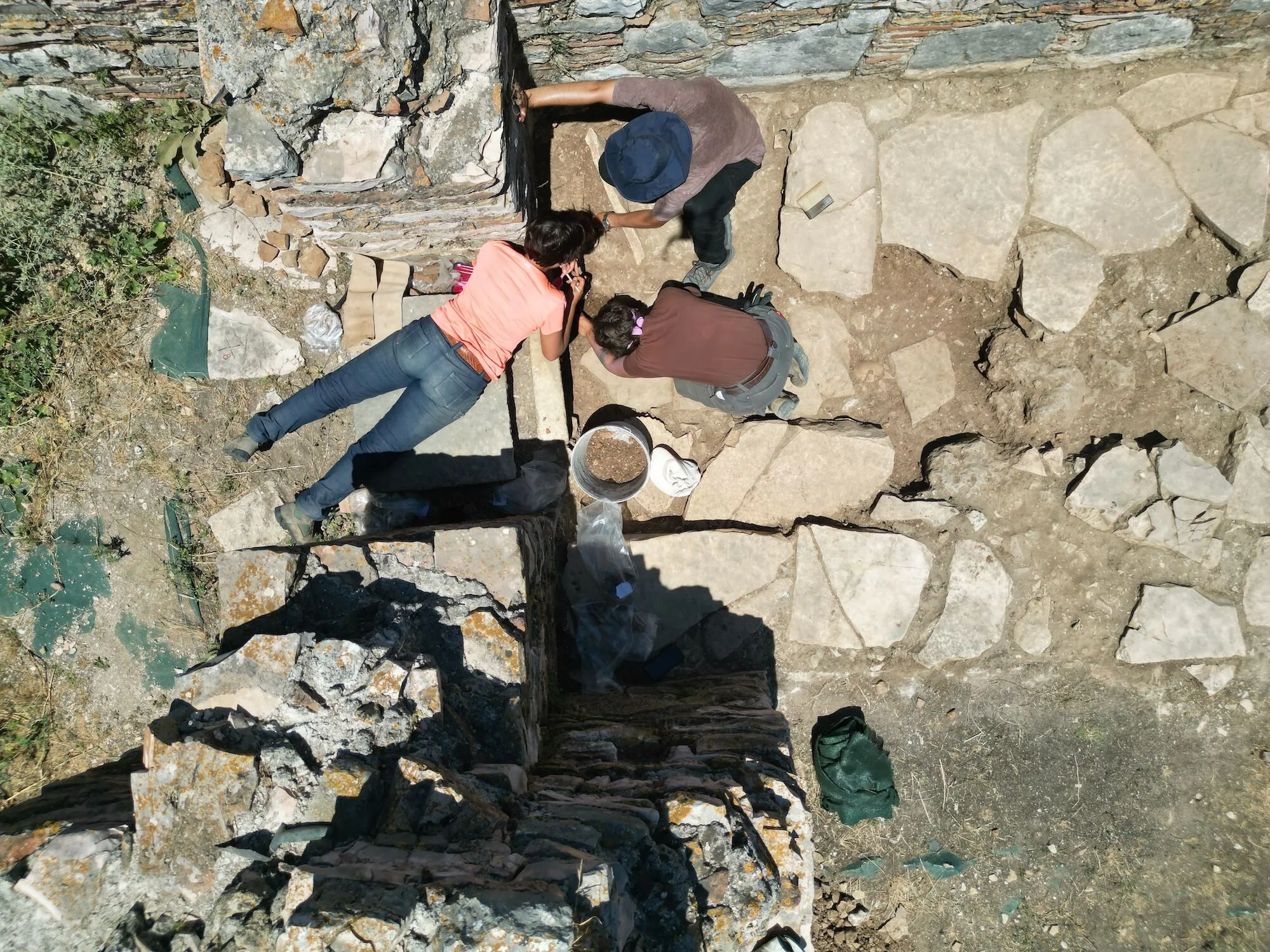
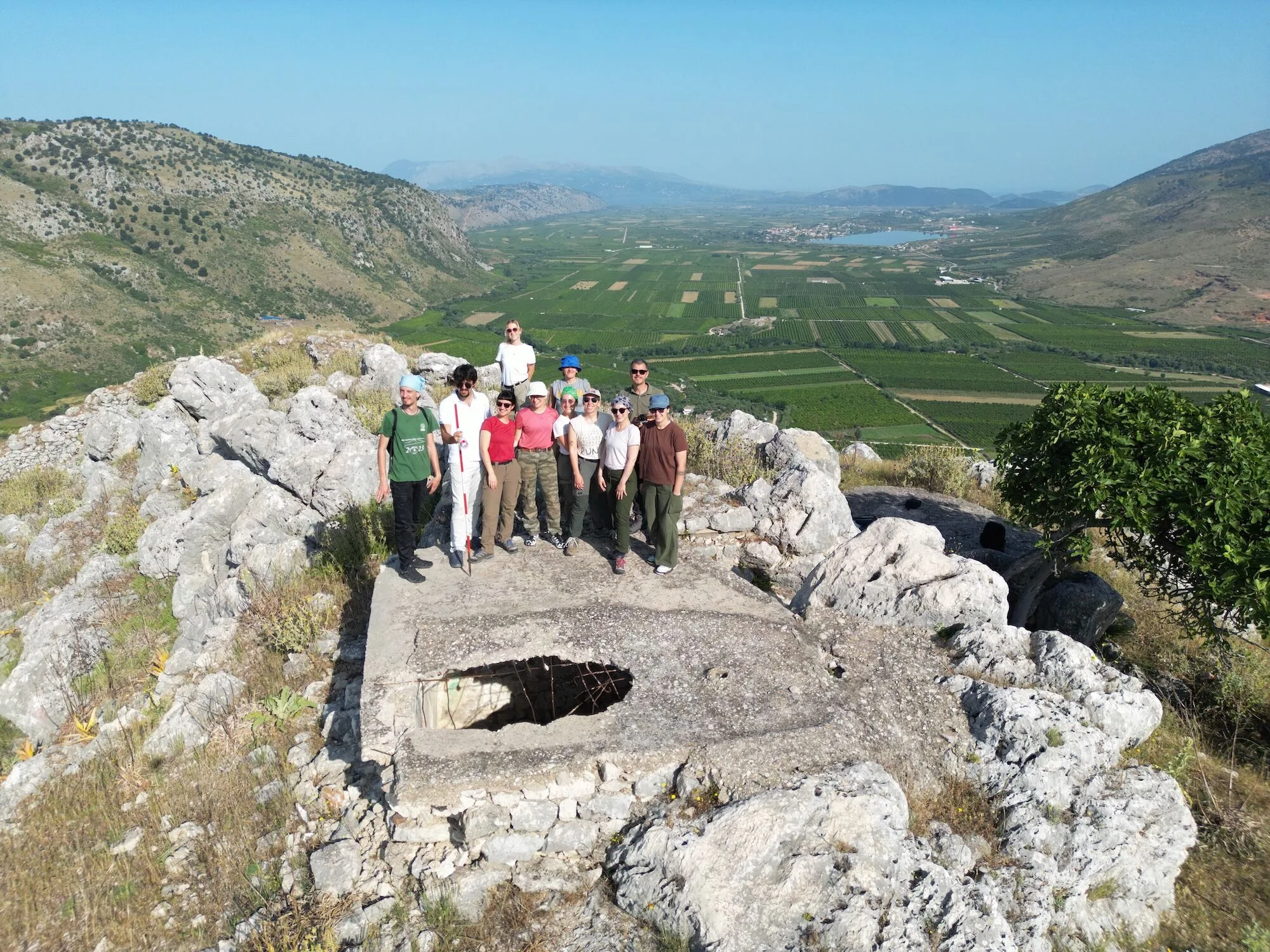
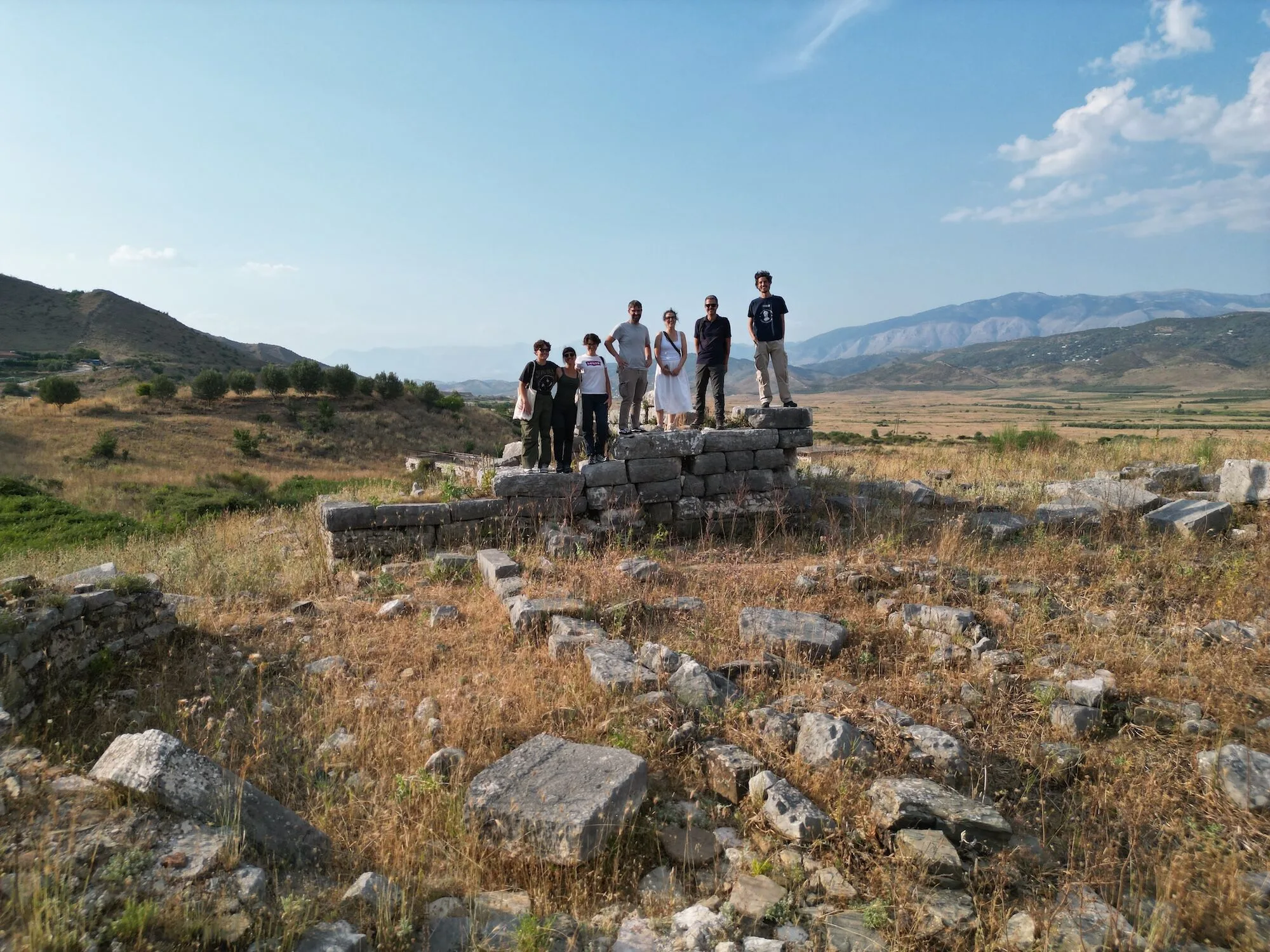
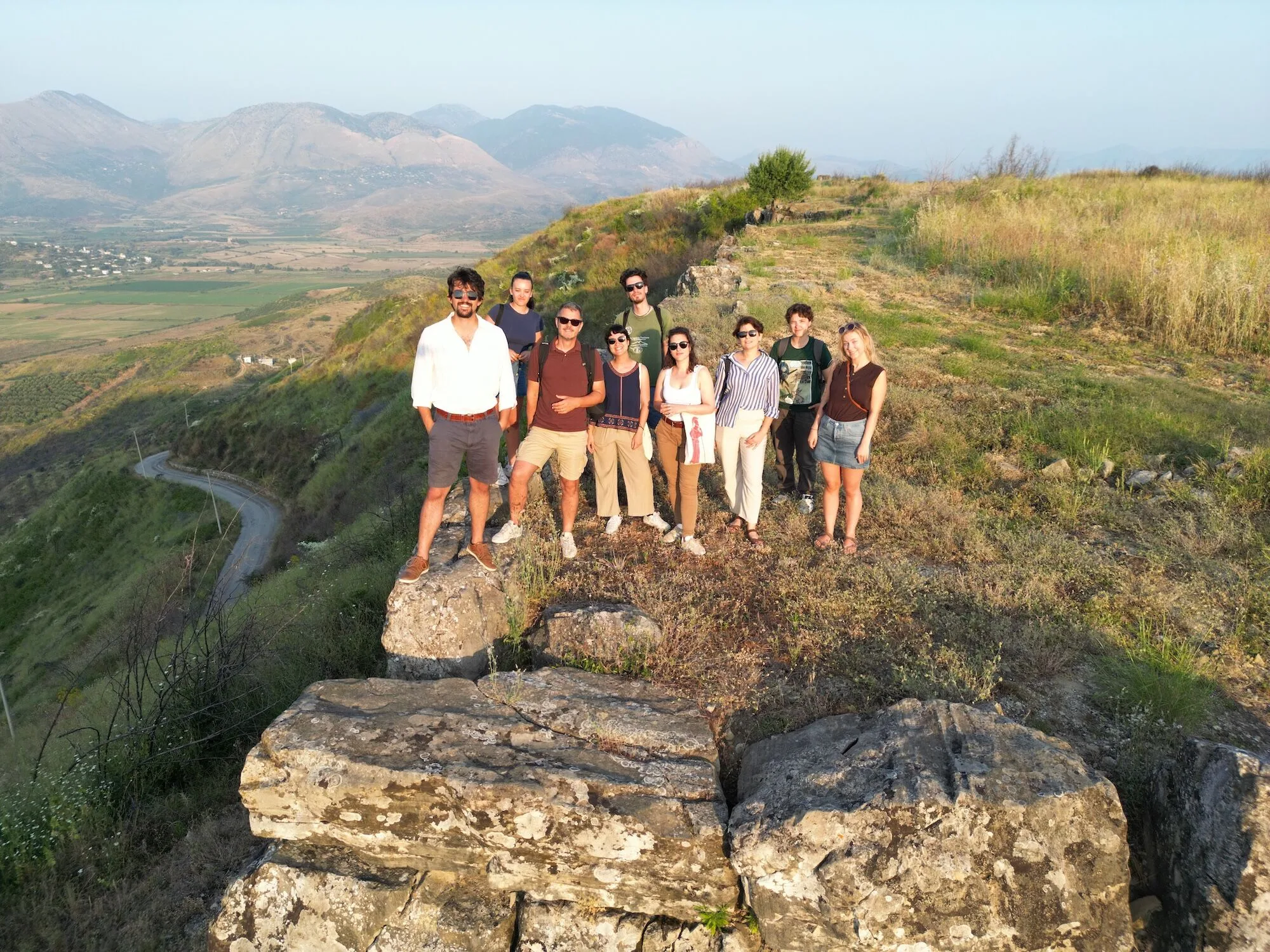
The fifth archaeological season of the joint Italian-Albanian Mission to Çuka e Ajtoit by Sapienza University of Rome and the Institute of Archaeology of Tirana (IA) took place between 8 June and 4 July 2025, with the participation of a research team made up of Italian and Albanian researchers and students.
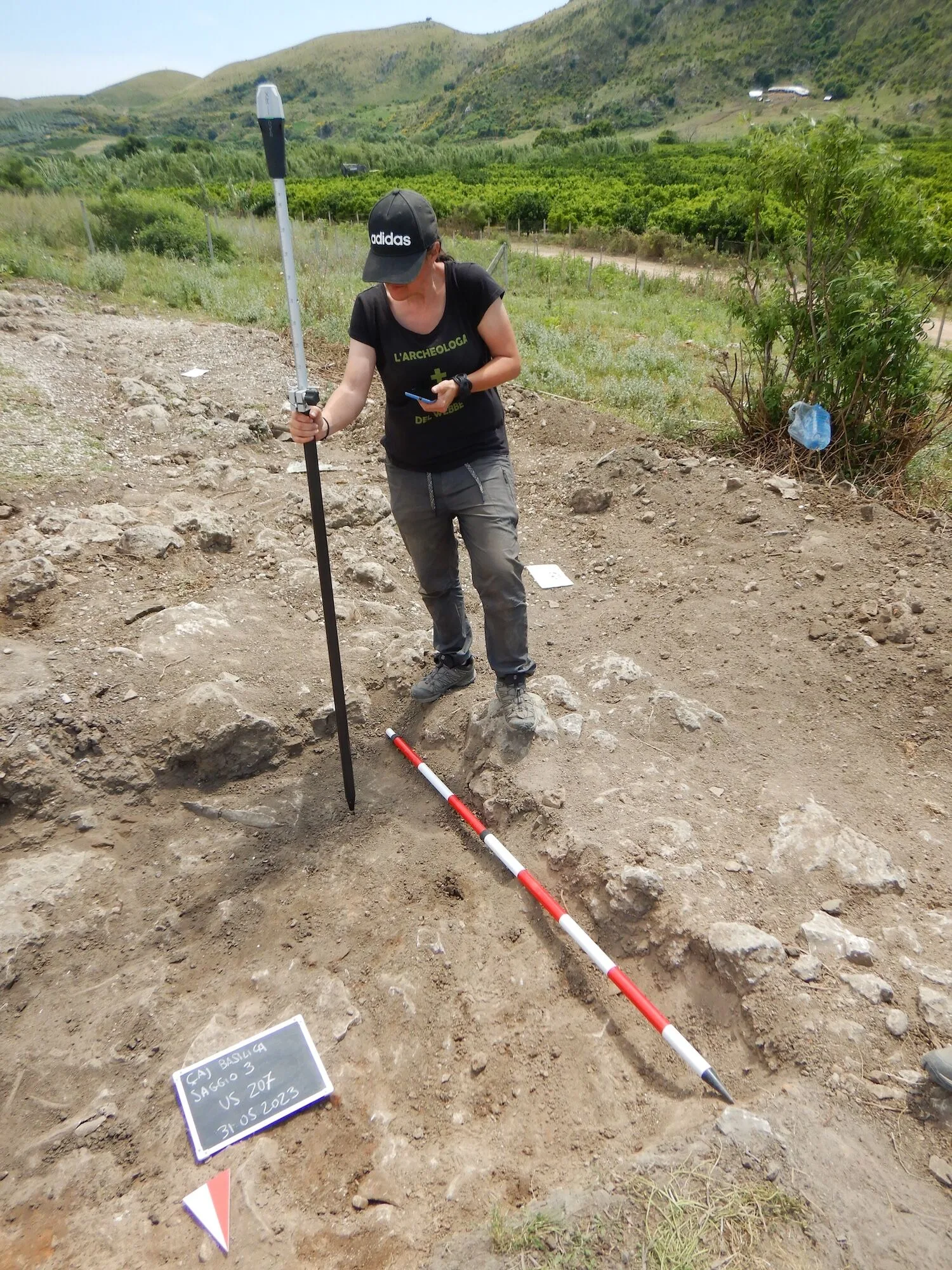
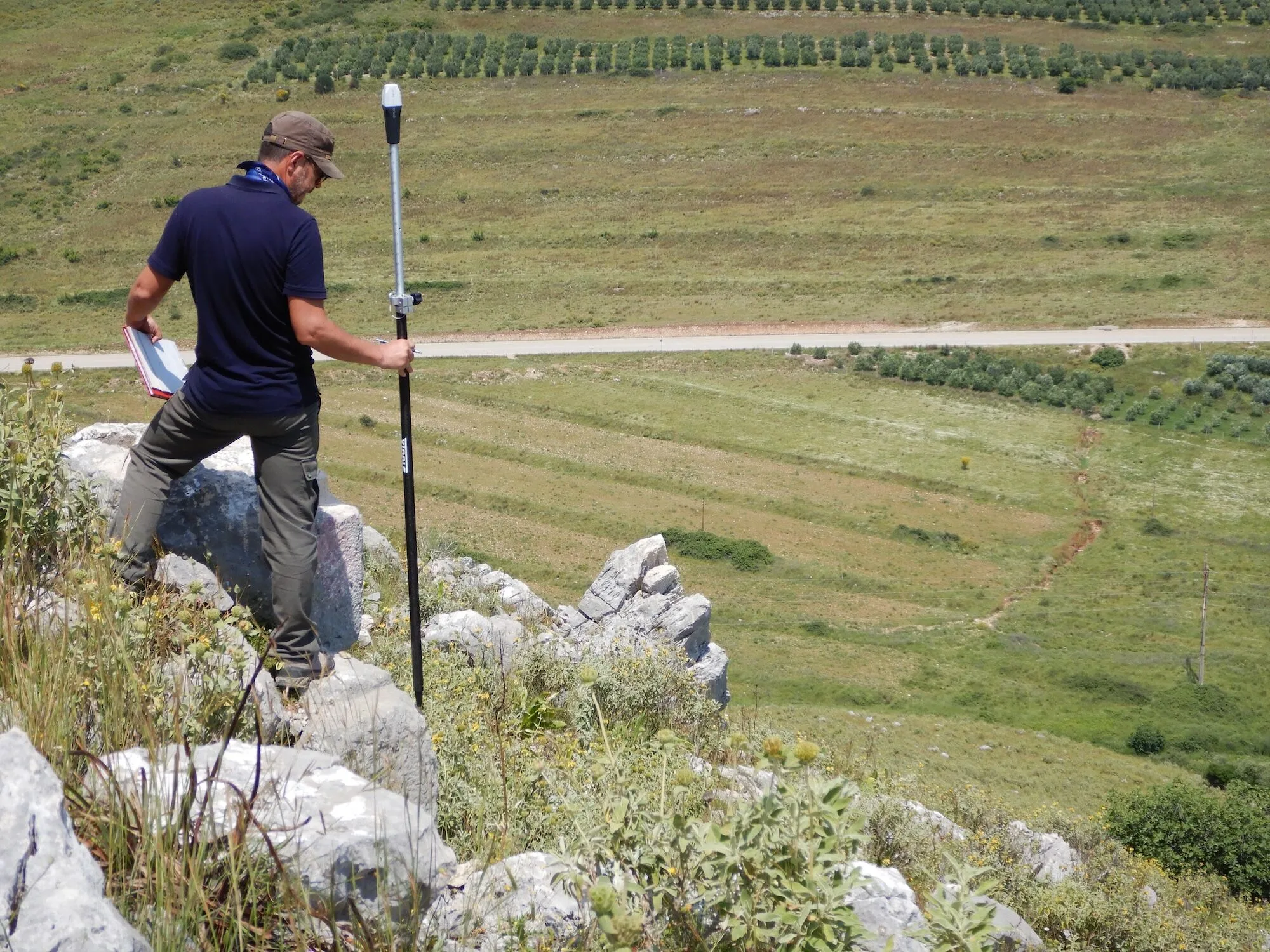
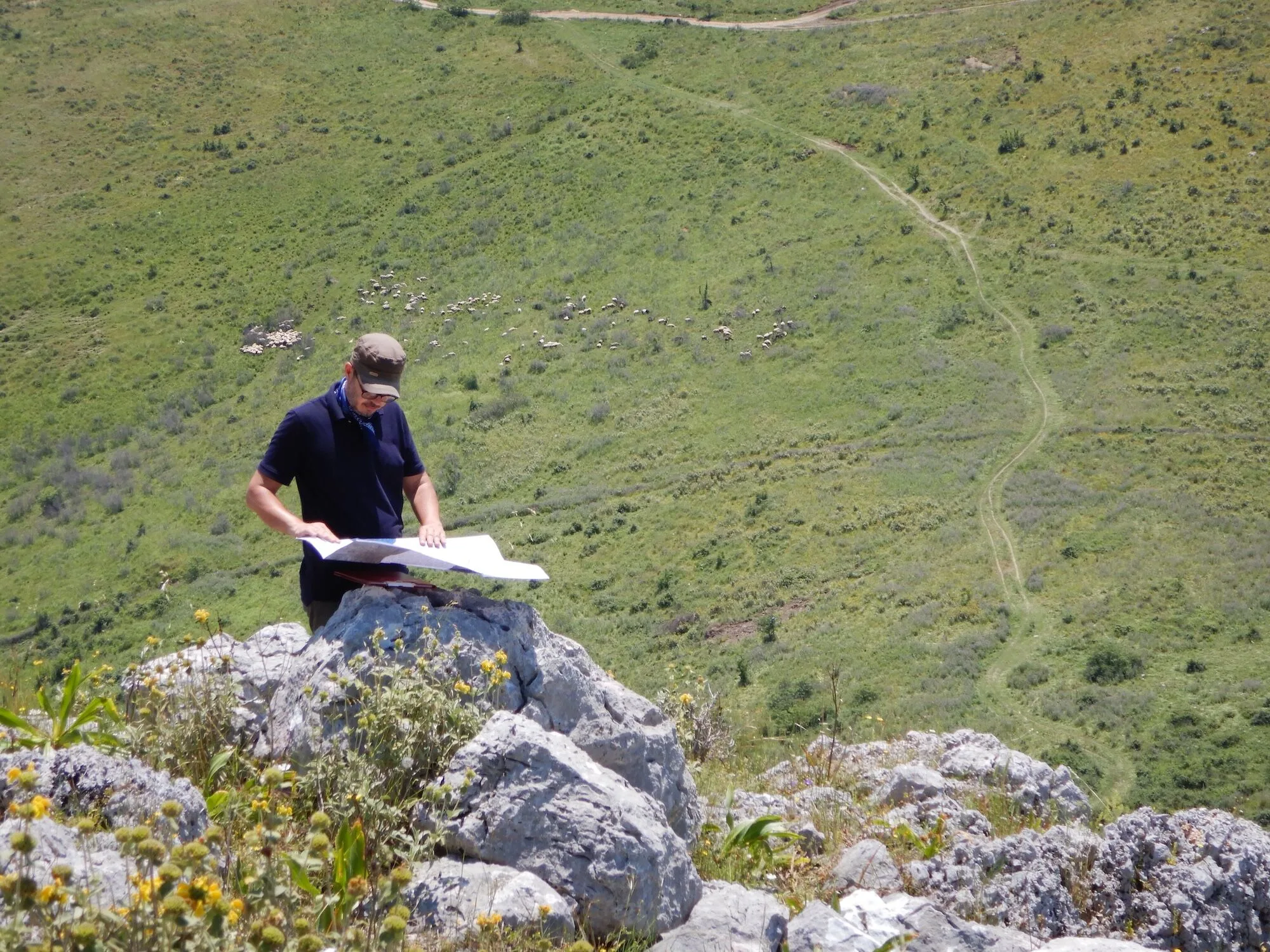
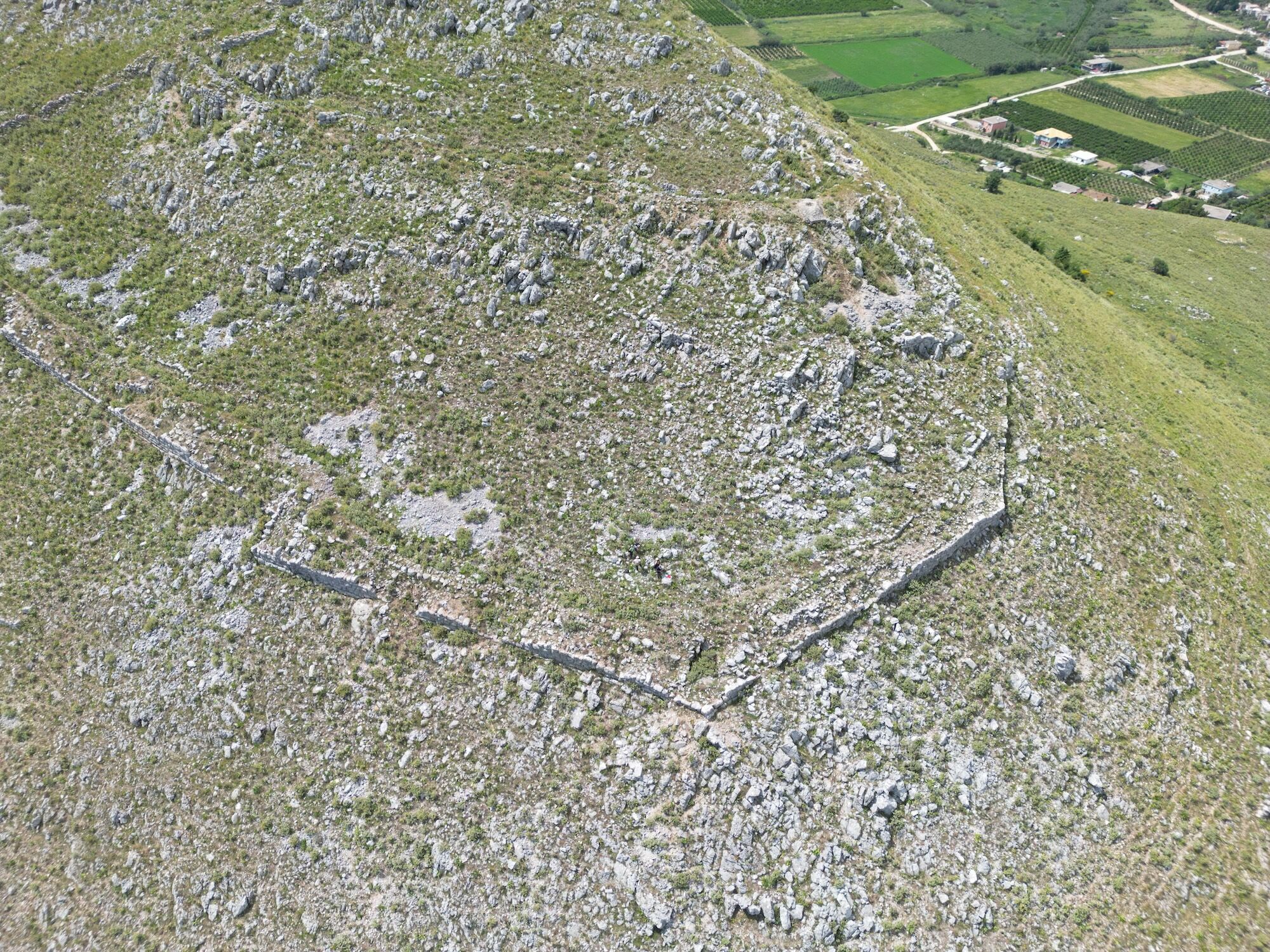
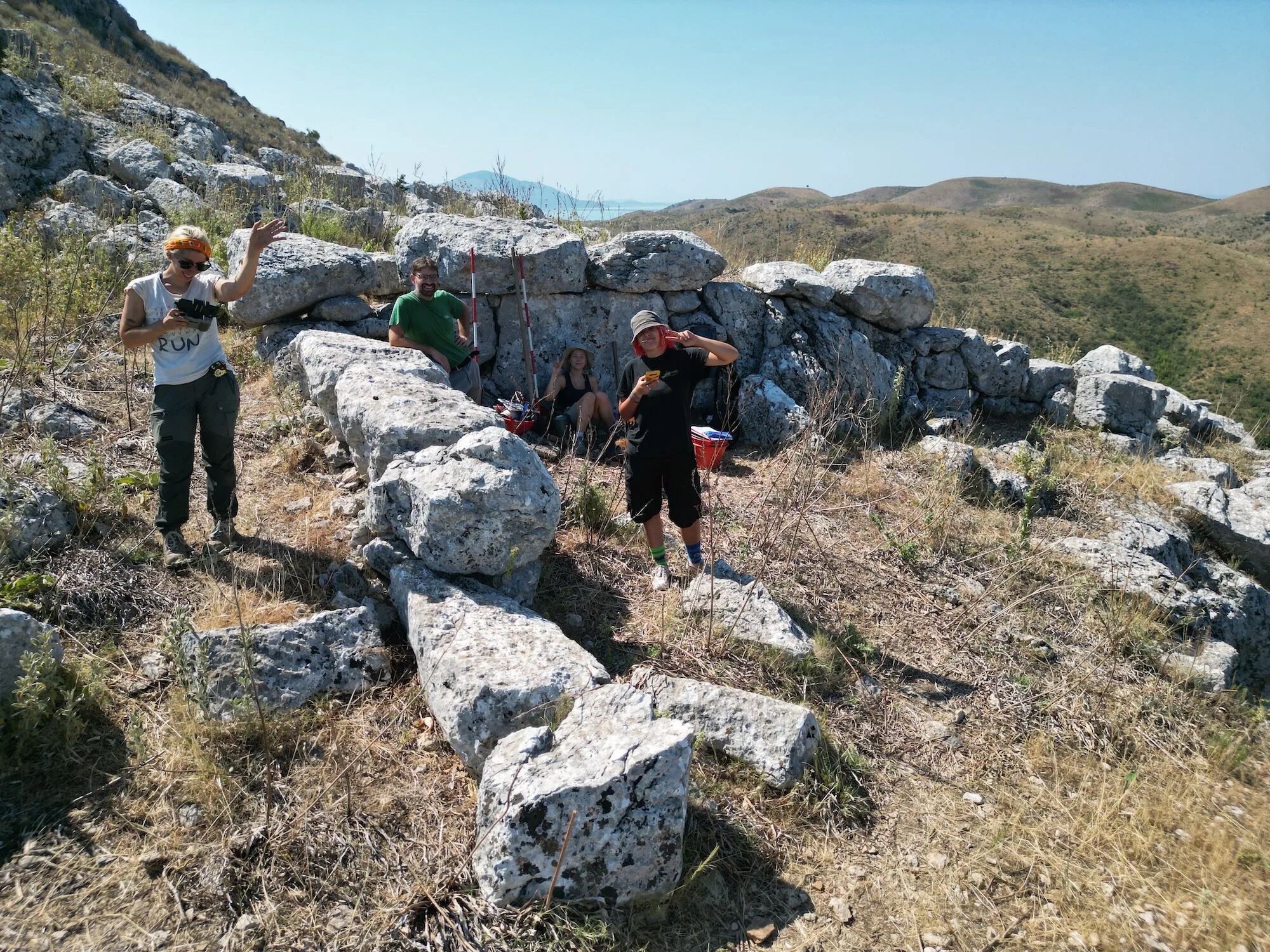
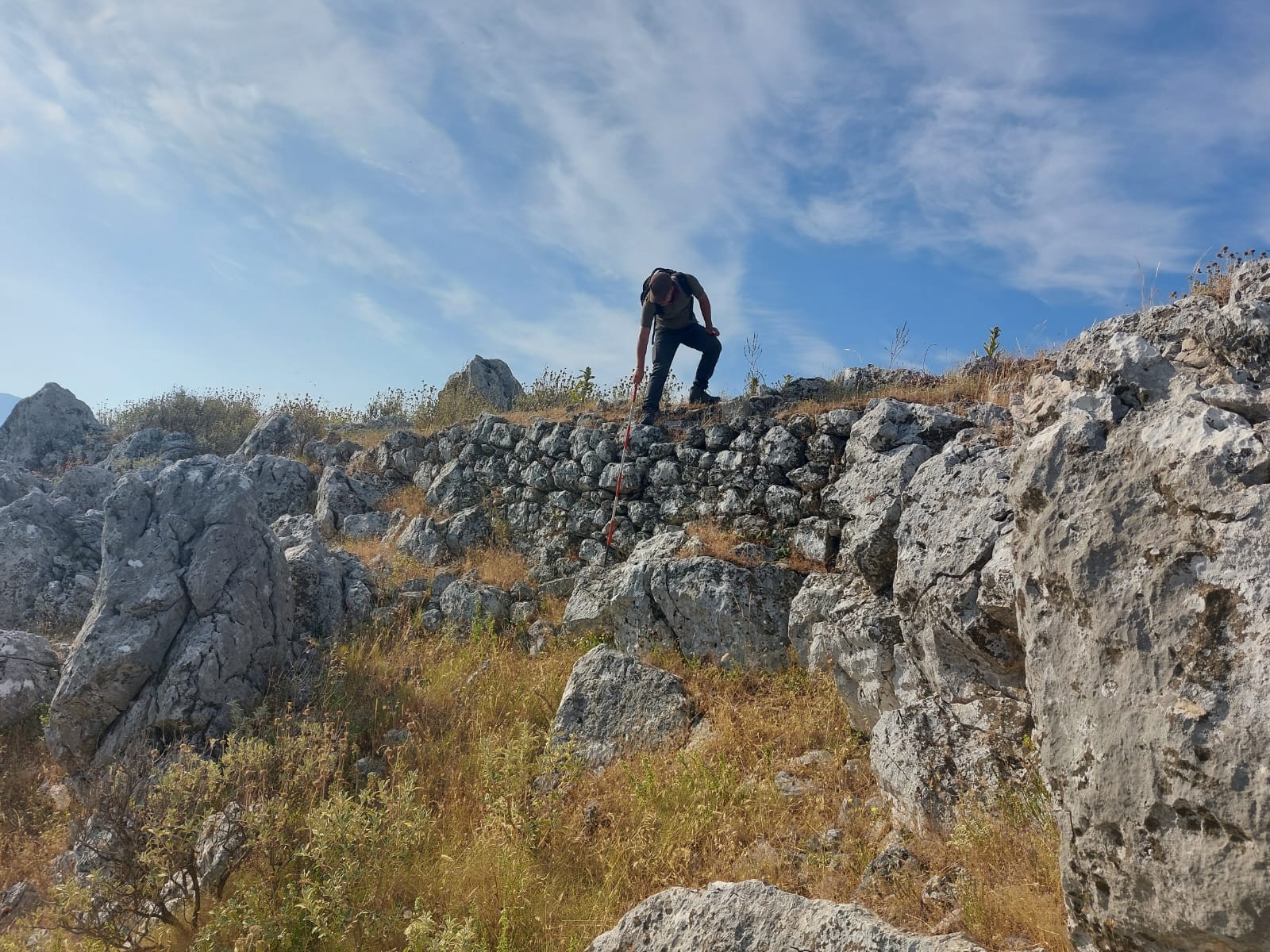
During the 2025 season, survey and archaeological documentation activities continued in the so-called “upper town”, i.e. in the part of the site defended by the Hellenistic-period fortification circuit. The activities focused in particular on ground-truthing the earlier surveys, produced using digital photogrammetry tied to ground control points by means of GNSS receivers with RTK correction. Particular attention was devoted to the Hellenistic and Medieval fortification systems. The latter system, in particular, was the subject of detailed typological observations in order to suggest a possible date, using the chrono-typology of the site of Butrint as a comparative benchmark. In general terms, it can be said that the post-antique defensive system is the result of a unitary design, apparently built in a single construction campaign, making significant use, along its northern and southern long sides, of the line of the earlier Hellenistic fortifications.
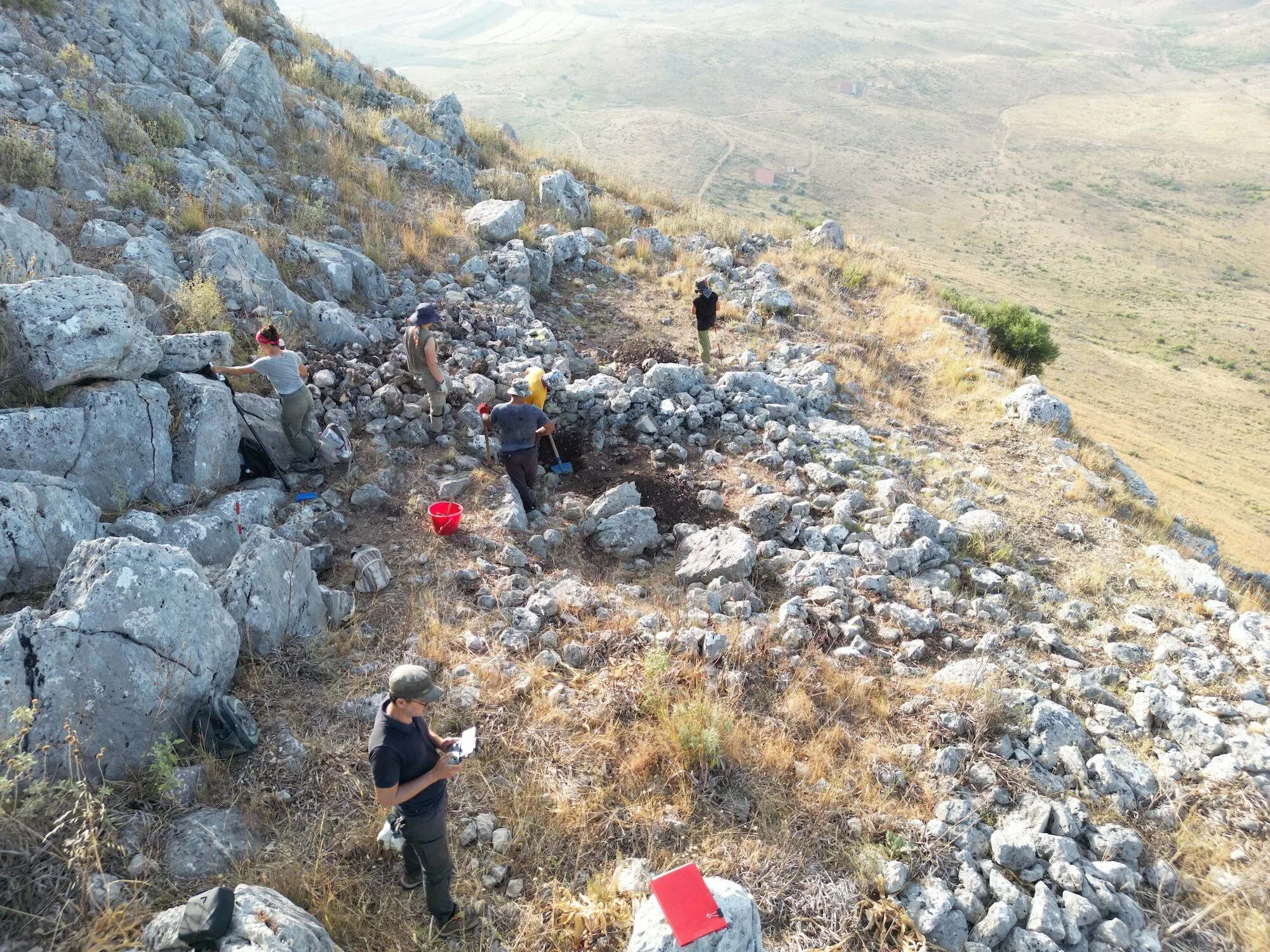
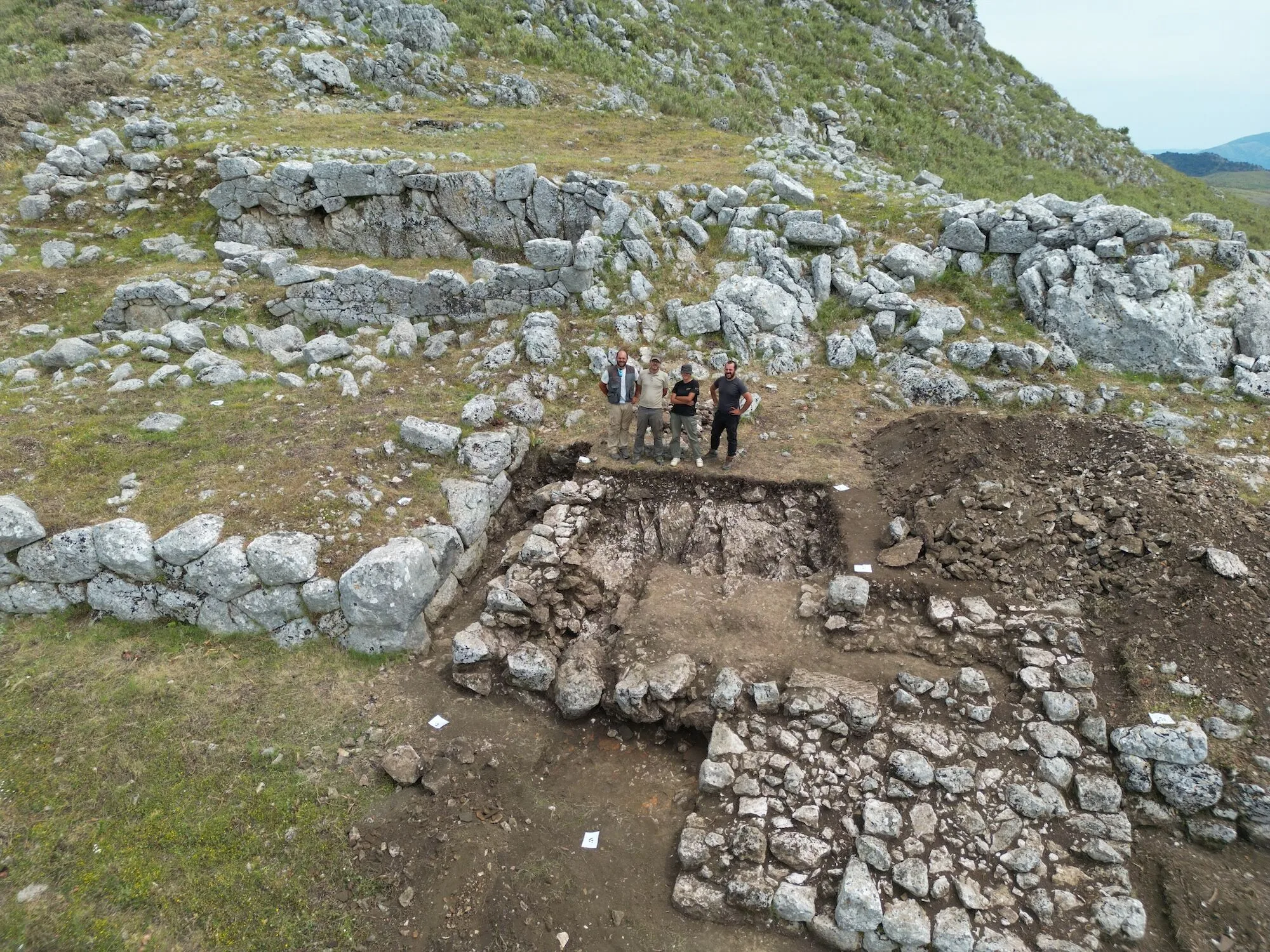
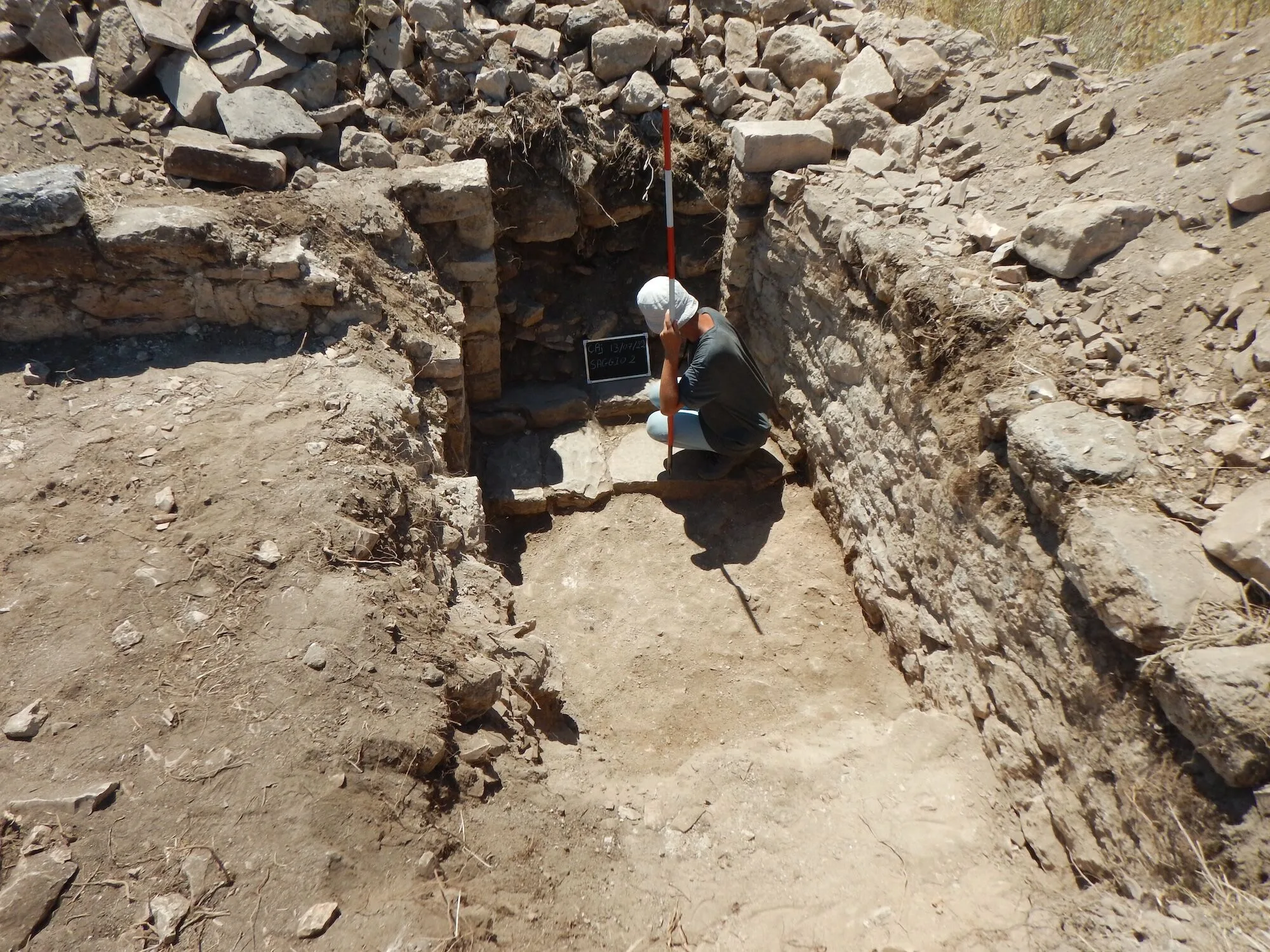
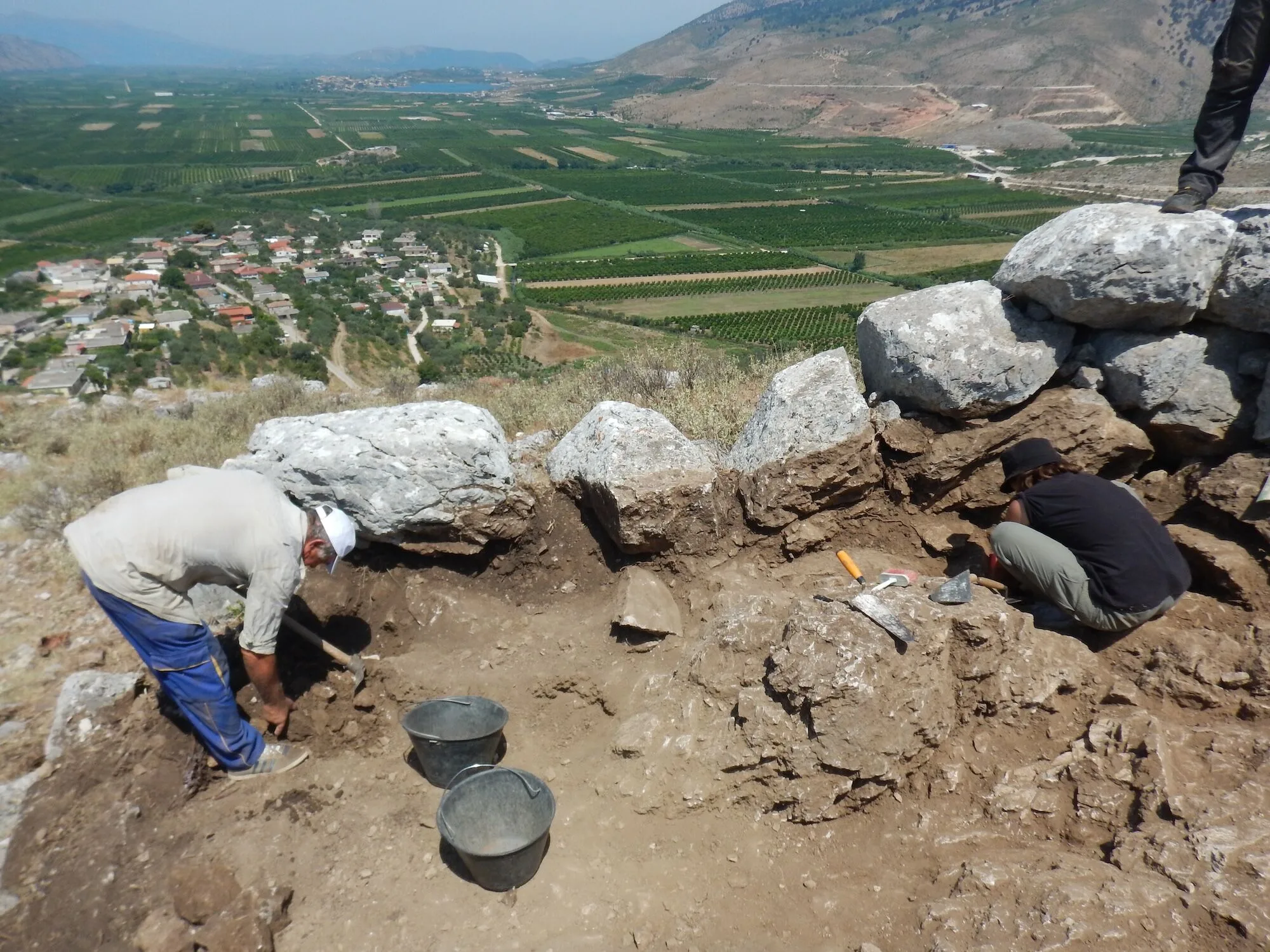
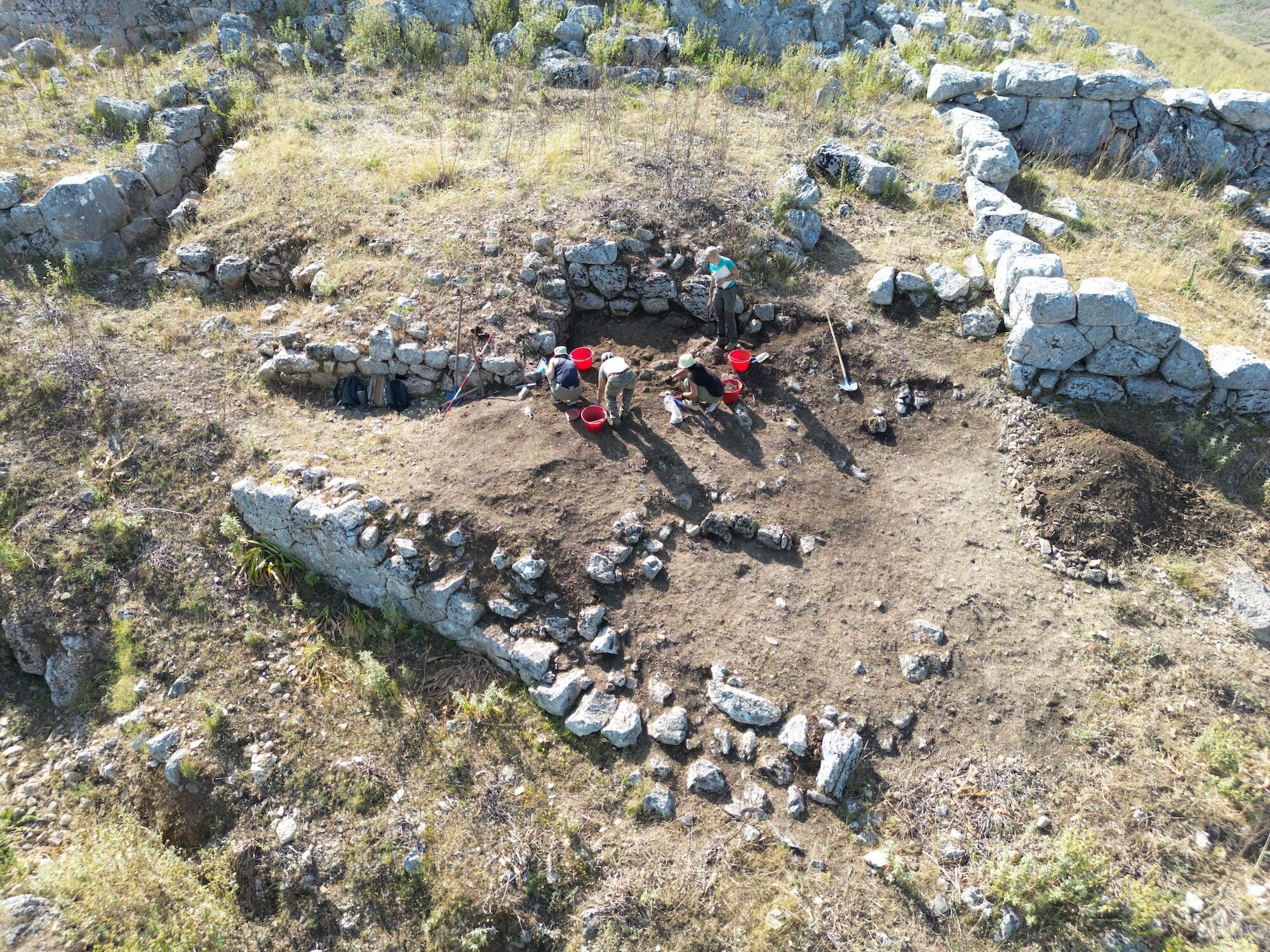
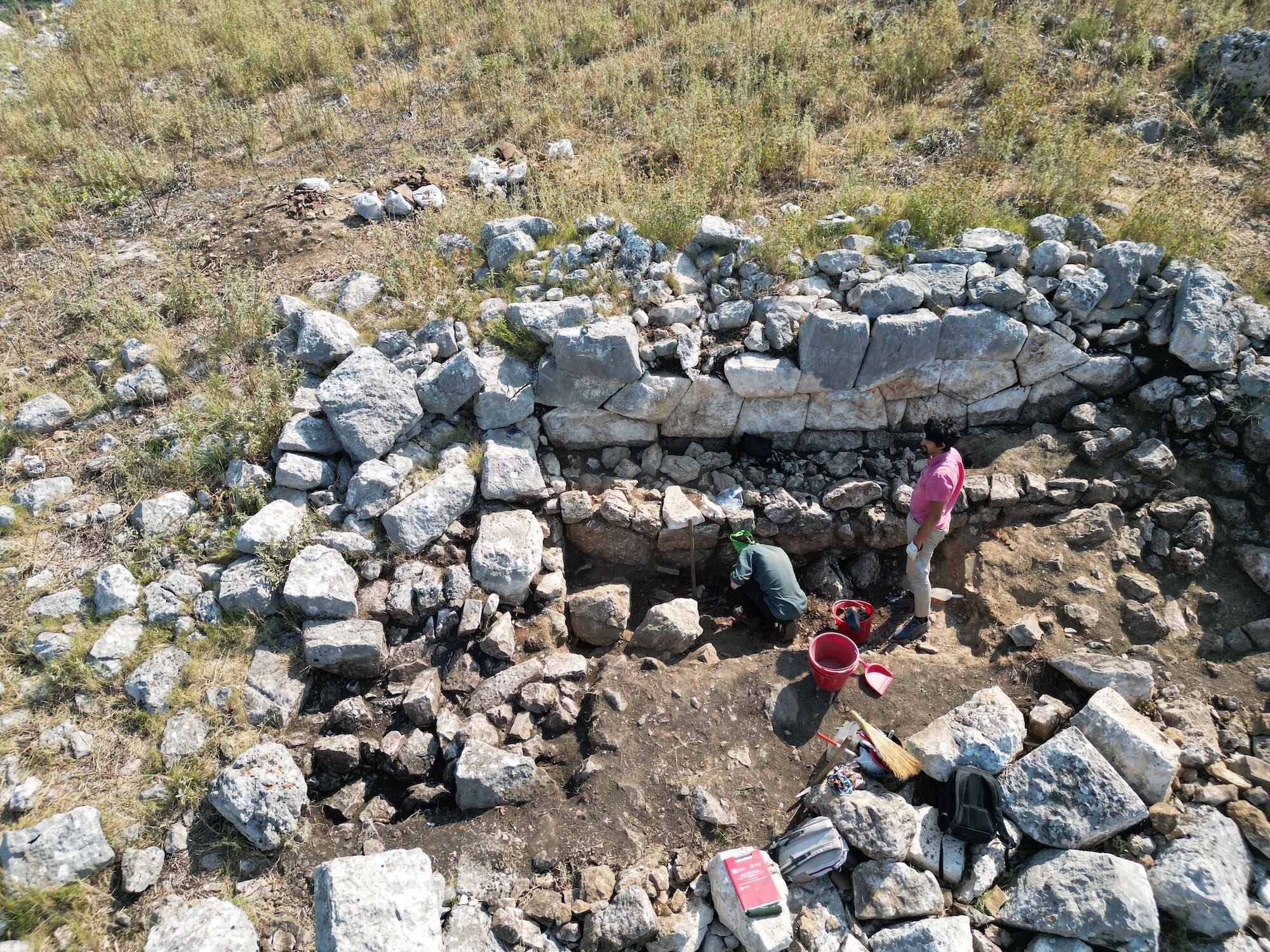
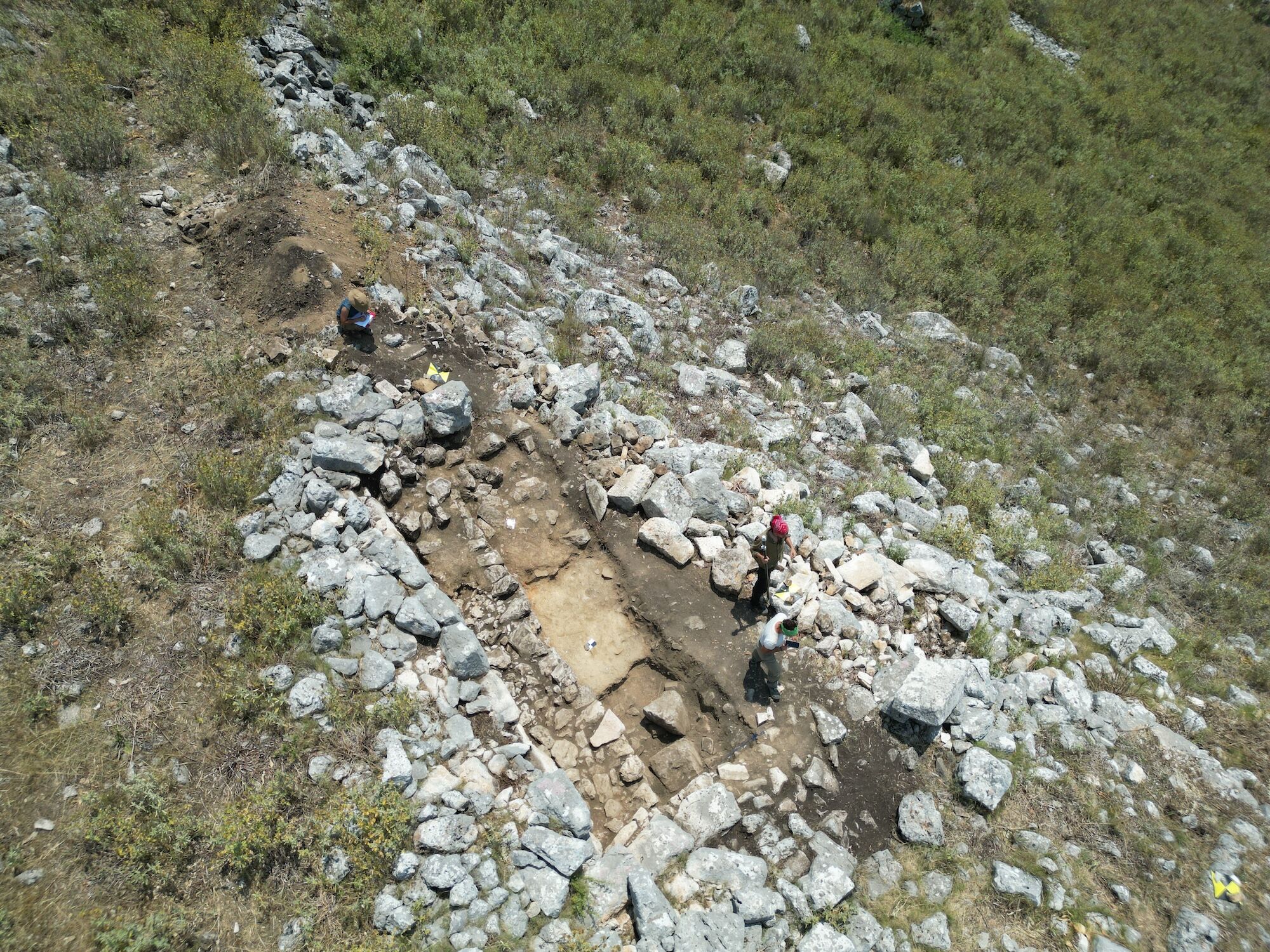
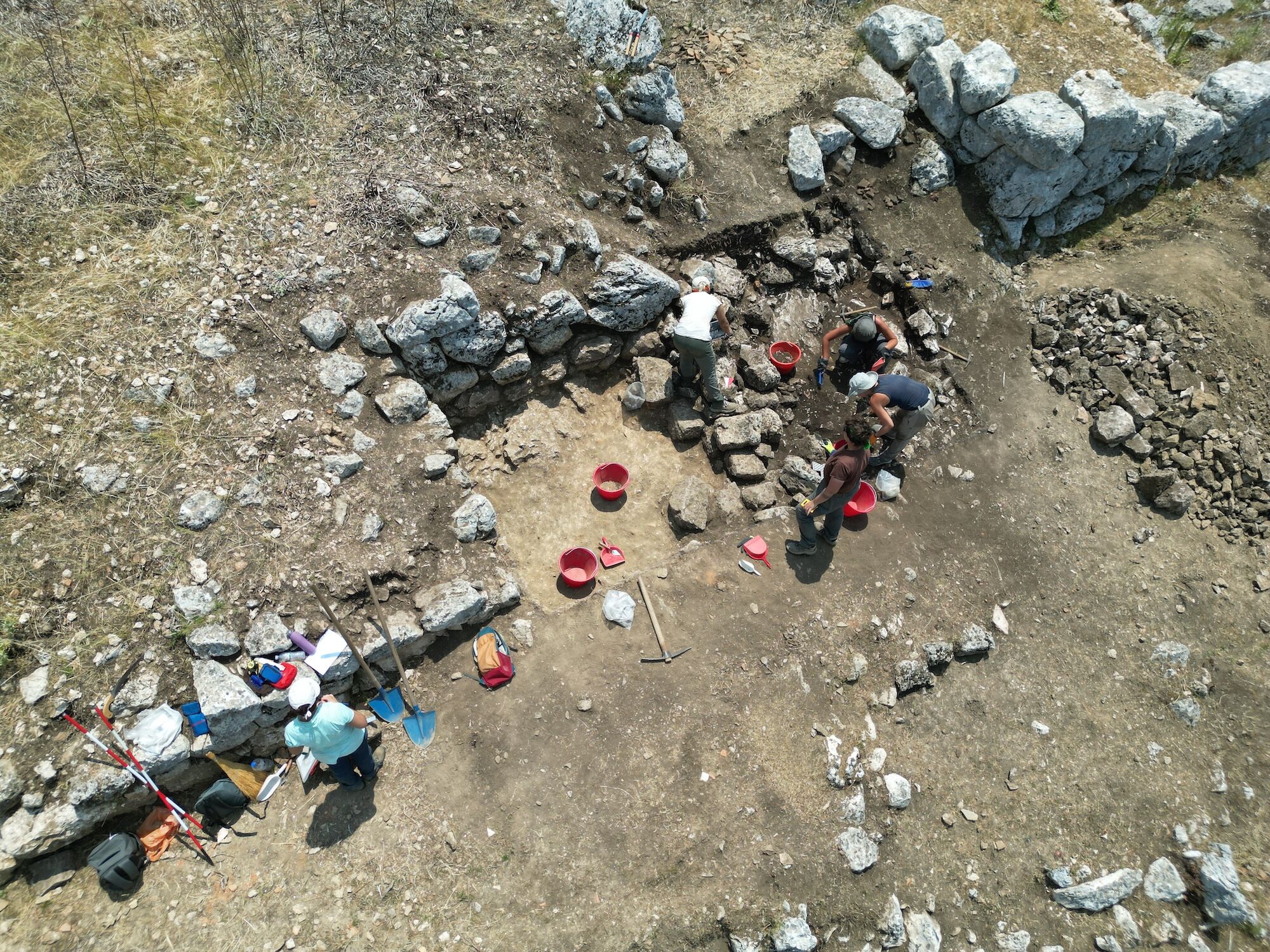
The work of this season mainly concerned the area of the so-called “Palace” (W4-01), where three stratigraphic test trenches were opened (2025-01, 2025-02, 2025-03). The excavations revealed stratigraphy very rich in materials, perfectly consistent with that identified during the 2023 and 2024 test trenches in the same sector. Test trench 2025-01 was located in the north-western area of sector W4-01, with the aim of clarifying the structural relationships between structures B2 and B3 and obtaining further chronological data. The excavation brought to light a north-south oriented wall structure (USM 175), built with limestone blocks in regular polygonal technique, and horizontal levelling fill layers (US 172 and 177) datable to the full 3rd century BC. Among the materials found are a bronze coin of the koinon of the Epirotes (232-168 BC) and fragments of figured coroplastic material.
Test trench 2025-02 was opened as a continuation of the previous year’s excavation in the same area (trench 2024-05), with the aim of understanding the relationships between the structures investigated. The excavation made it possible to identify a bench/platform (USM 202) built with polygonal blocks and an opening between the perimeter walls B13 and B.9.5, 1.35 m wide, where the door jambs are preserved in two rows of blocks. The use phases of the room, represented by the beaten-earth surfaces US 213 and 218, date to the end of the 3rd century BC - beginning of the 2nd century BC. Of particular interest is the presence of impasto pottery datable to the late Bronze Age, found within the levelling layer (US 216) covering the natural bedrock, together with Hellenistic material.
Test trench 2025-03 extended the area previously investigated as test trench 2024-09, with the aim of exploring the continuation of USM 175 towards the west and investigating the as-yet-unexcavated stratigraphy. The excavation confirmed that structure USM 168 represents the northward continuation of wall USM 175, albeit with a cruder construction technique. A new structure (B14) was also identified, a north-south oriented wall that joins B10 at a 90-degree angle. The excavation also revealed a semicircular structure (USM 171) and a tile surface (US 167), probably belonging to an earlier building, perhaps used for processing or storage functions.
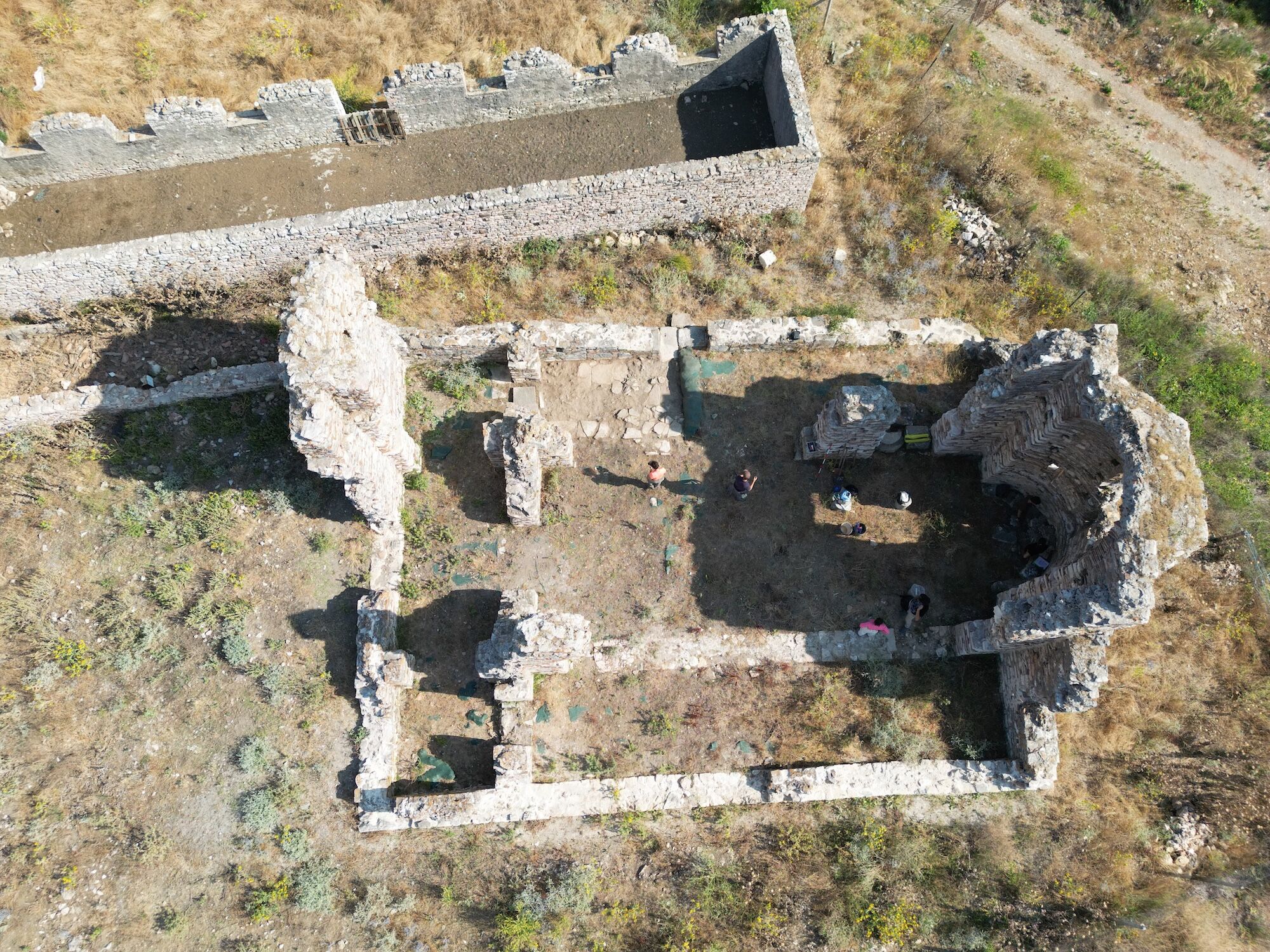
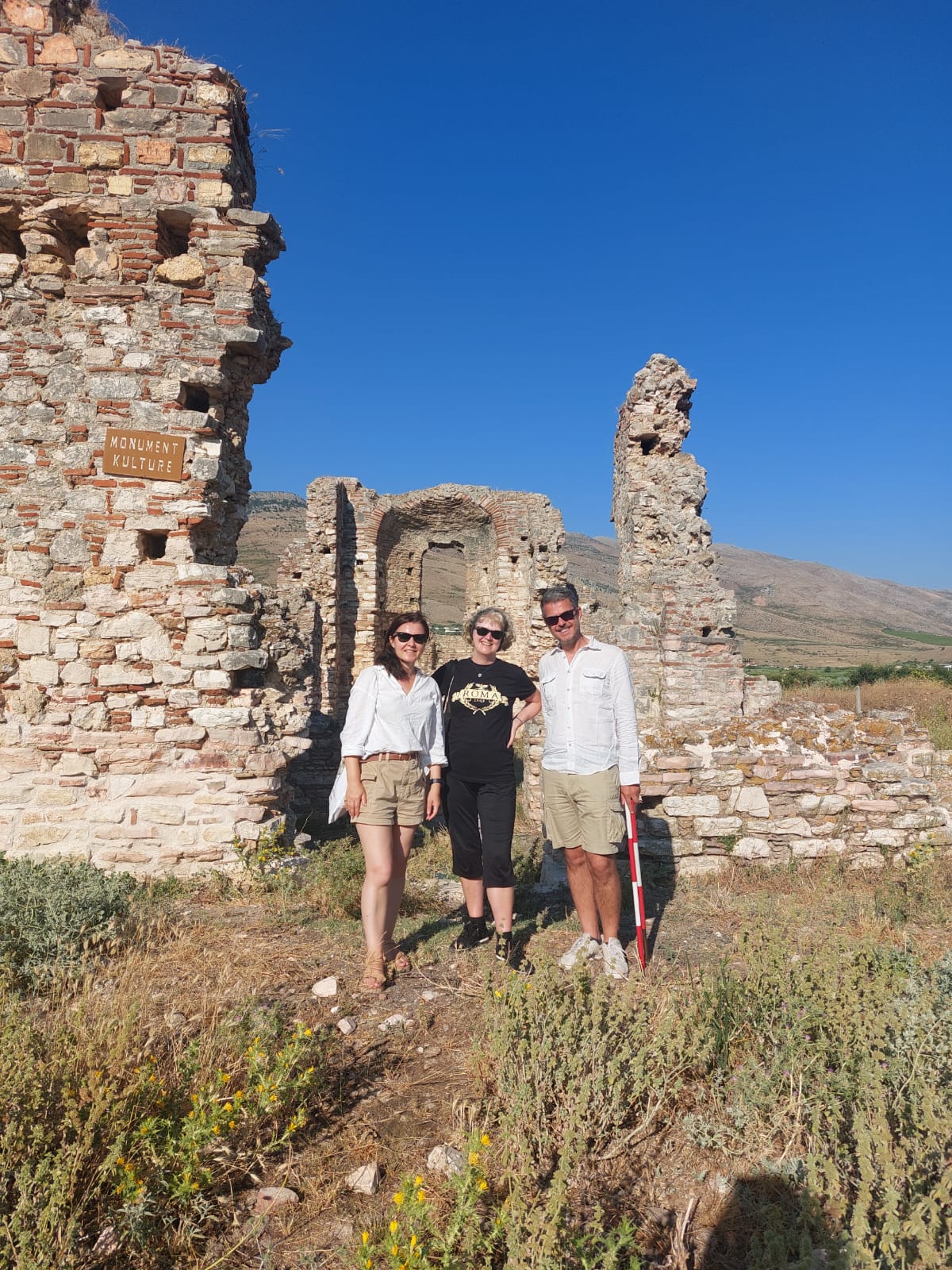
A further stratigraphic test trench (2025-04) was opened in the northern aisle of the Basilica of Çiflik, investigating the westernmost portion, from the passage to the narthex to roughly the middle of the aisle. The excavation revealed the fill of a cut (BA-302) containing several areas with concentrations of human bones, interpreted as secondary depositions of at least six different individuals. Grave T-BA-15 was also identified and documented, severely damaged in antiquity, containing two individuals: a newborn and, possibly, a woman. The grave preserves only a single slab positioned vertically to mark its eastern side.
The assemblage of materials recovered continues to be characterised both by the distinctiveness of the classes represented (above all black-gloss pottery and votive terracottas) and by the characteristics of the objects found, which suggest their connection with the decommissioning of a sacred area. The typological study of the materials has made it possible to place the archaeological sequences investigated within a Hellenistic chronological horizon, in particular the advanced 3rd century BC. The repertoire of black-gloss pottery consists almost exclusively of open forms, in particular bowls (Echinus Bowl), plates (Epirote Fish Plate) and kantharoi. Among the amphorae, most examples belong to the Hellenistic Corinthian B type, the amphora type most commonly attested in 3rd-century BC levels at the site. Among the more recent amphorae are two rims of Greco-Italic type (3rd-2nd century BC) and one rim of Lamboglia 2 type (late 2nd - late 1st century BC), from a destruction layer.
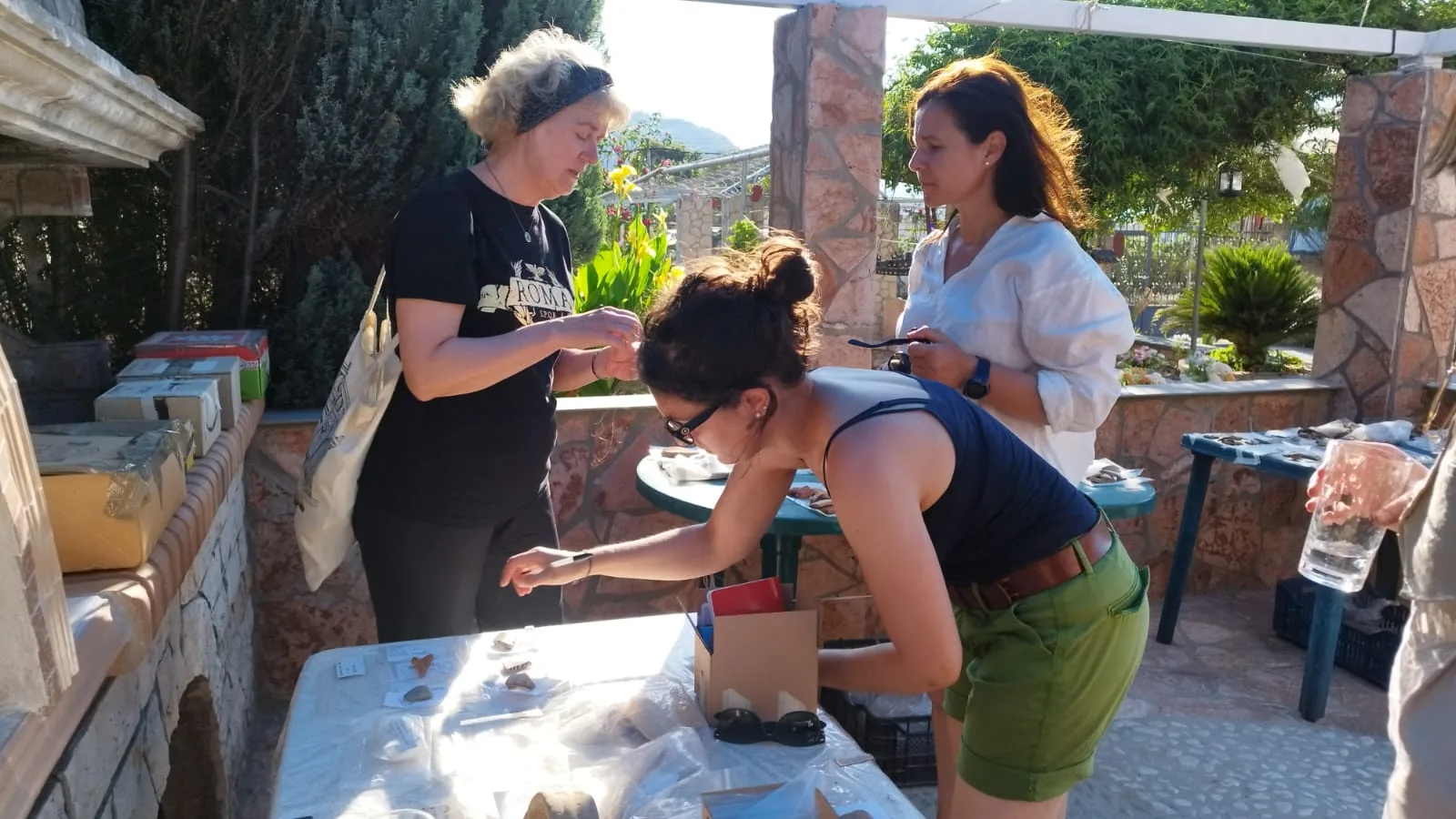
As in previous seasons, the fieldwork was accompanied by the activities of the Mission’s materials laboratory, which covered all stages of material management: washing, sorting into categories, inventorying, cataloguing, typological study, graphic drawing using the Laser Aided Profiler tool, and photographic documentation. Particular importance was given to the study of the ceramic fabrics, accompanied by the taking of samples, for which the administrative procedures for export to Italy and subsequent laboratory analysis are already under way. The cataloguing and study work was accompanied by teaching activities aimed at the students who took part in the mission.
Participants
Mission direction:
- Nevila Molla (co-director of the mission, IA)
- Julian Bogdani (co-director of the mission, Sapienza, Rome)
Senior staff:
- Veronica Castignani (PhD candidate, University of Catania)
- Francesca D’Ambola (PhD candidate, Sapienza, Rome)
- Matilde Fortunato (Sapienza, Rome)
- Giuseppe Monte (PhD candidate, University of Catania)
BA, MA:
- Dea Hate (University of Tirana, Albania)
- Luizjan Koçi (University of Tirana, Albania)
- Jihan Sidki (University of Tirana, Albania)
- Noel Vila (University of Tirana, Albania)
- Barbara Alastra (Sapienza, Rome)
- Lorenzo Del Prato (Sapienza, Rome)
- Dimitrios Gkinis (Sapienza, Rome)
- Julia Karlsson (Sapienza, Rome)
- Maria Noris (Sapienza, Rome)
- Francesca Summa (Sapienza, Rome)
2024 Season
The fourth archaeological season of the joint Italian-Albanian Mission to Çuka e Ajtoit by Sapienza University of Rome and the Institute of Archaeology of Tirana (IA) took place between 2 June and 1 July 2024, with the participation of a research team made up of Italian and Albanian researchers and students.
During 2024, too, archaeological survey activities continued, along with topographic survey through drone image acquisition and its photogrammetric processing for the creation of 3D models. In particular, the 2024 surveys covered the fortifications and the upper part of the hill.
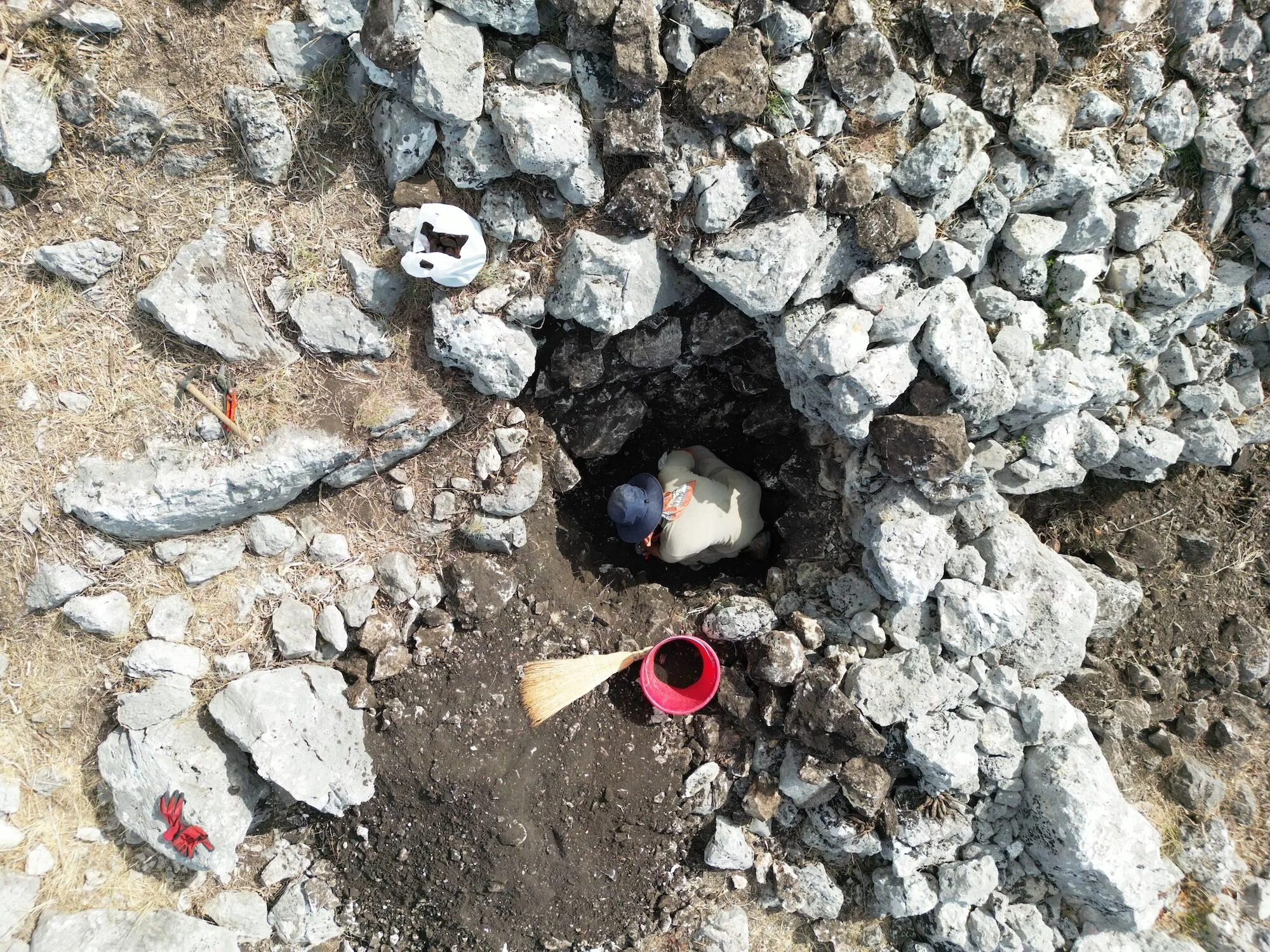
Alongside the continuation of these activities, a number of archaeological test trenches were opened in two sectors of the ancient town. Two test trenches concerned complex F2-01, located on a terrace downhill from the military constructions on the top of the hill, next to the Medieval walls. The excavation revealed a very shallow stratigraphy, but one that yielded a number of impasto pottery fragments datable to the late Bronze Age, which seem to confirm the antiquity of the structures, already suspected on account of their distinctive character (a structure divided lengthwise into two rooms and built with stones of various sizes, not cut into regular shapes) and the same association with this type of pottery already noted in previous surveys of this sector.
The second sector of the hill investigated stratigraphically is that of the so-called “Palace” (complex W4-01), which instead yielded stratigraphy much richer in materials, perfectly consistent with that identified during the 2023 test trenches in the same sector. The assemblage of materials recovered indeed continues to be characterised both by the distinctiveness of the classes represented (above all black-gloss pottery and votive terracottas) and by the characteristics of the objects found (unusual forms and decorations), which suggest their connection with the decommissioning of a sacred area, which took place between the 3rd and the beginning of the 2nd century BC.
A further stratigraphic test trench was opened to investigate structure NE-12 in the Venetian-Ottoman period settlement, identified by the 2022-2023 surveys on the flat plateau at the north-eastern foot of the hill of Çuka e Ajtoit. This sector had already been partially investigated during the 2022 season, and the 2024 test trench confirmed the dating of the settlement to the 18th century AD.
During the 2024 season, research also continued at the site of the so-called Basilica of Çiflik. Three stratigraphic test trenches were carried out, two located outside the structures and one inside. The test trenches, although limited in extent, allowed for a clearer stratigraphic reading of the areas investigated, adding further detail to that already gathered during the 2023 excavation activities.
Alongside this fieldwork, the activities of the Mission’s materials laboratory took place, covering both the materials from the surveys of previous years (2022-2023) and the materials from the 2024 season’s test trenches. This season saw the start of the use of the LAP (Laser Aided Profiler), which considerably reduced the time needed to produce drawings of the ceramic fragments, and therefore considerably increased the documentation produced.
Finally, the 2024 season saw the participation of Dr Melania di Fazio and Dr Sara Capriotti, of the geomaterials archaeometric characterisation laboratory – GEOMLAB of the Department of Earth Sciences at Sapienza University of Rome. Their presence was useful for carrying out an initial survey of the regional geology and a first direct examination of various fortification structures in the region, of possible quarry areas and of possible clay deposits that could provide useful comparative data for the archaeometric analyses, already under way, of the region’s ceramic fabrics, also under their direction.
Participants
Mission direction:
- Julian Bogdani (Sapienza, Rome, Italy)
- Albana Meta (Institute of Archaeology, Tirana, Albania)
Senior staff:
- Nadia Aleotti (Sapienza, Rome, Italy)
- Sara Capriotti (Sapienza, Rome, Italy)
- Veronica Castignani (University of Catania, Italy)
- Francesca D’Ambola (Sapienza, Rome, Italy)
- Domizia D’Erasmo (Sapienza, Rome, Italy)
- Melania Di Fazio (Sapienza, Rome, Italy)
- Salvatore Napolitano (University of Campania “Luigi Vanvitelli”, Italy)
BA, MA:
- Francesco Andretti (Sapienza, Rome, Italy)
- Simona Maria Bellone (Sapienza, Rome, Italy)
- Claudio Cammarota (University of Campania “Luigi Vanvitelli”, Italy)
- Marco Fallibene (Sapienza, Rome, Italy)
- Dea Hate (University of Tirana, Albania)
- Klea Muftali (University of Tirana, Albania)
- Eren Polat (Sapienza, Rome, Italy)
- Annalisa Rondinelli (Sapienza, Rome, Italy)
- Marco Russo (Sapienza, Rome, Italy)
- Valerio Sordillo (University of Campania “Luigi Vanvitelli”, Italy)
2023 Season
The third archaeological season of the joint mission of Sapienza University of Rome and the Institute of Archaeology of Tirana at Çuka e Ajtoit (Albania) came to a close on 13 June, with the participation of researchers and students from both countries.
The season ran from 14 May to 13 June 2023 and had multiple objectives, including the completion of the survey of the hill through the now well-established method of drone photogrammetric survey. These activities were complemented by ground documentation and survey using traditional methods of the remains observed in the digital models, and by the completion of a second excavation test trench in the area of the Palace, which brought to light ceramic materials of the 4th century BC, which currently define the earliest phase of this complex.
At the foot of the hill, particular attention was devoted to the structures of the Medieval Basilica near Çiflik. The church was cleared, and a careful three-dimensional survey was carried out, again by photogrammetric means. The model forms the basis of an ongoing stratigraphic study of the structures. In order to verify the stratigraphy, two stratigraphic test trenches were also carried out in the area, one inside the church and one in an external position, near a structure probably connected to the church itself. Preliminary examination of the stratigraphy and materials currently confirms a 13th-century date for the church structures.
Finally, research was carried out at the site known by the toponym Kisha e Psarit, literally the church (Alb. kisha) of the fish (Gr. ψάρι). The site had been briefly visited the previous year, and traces of structures in rectangular masonry and of masonry walls using lime mortar, probably of Medieval date, had been noted. In this case, too, a surface clearing was carried out (not complete or thorough, owing to the limited time available) and an excavation test trench, which revealed the presence of a Roman imperial-period phase. The walls in rectangular masonry define a rectangular-plan building, while those of smaller dimensions using mortar probably belong to a smaller building fitted with an apse, almost certainly to be interpreted as the church that gave the site its name. Knowledge of this site will need to be deepened in future seasons.
This site was not previously known in the archaeological literature.
As in previous seasons, this year too the targeted investigations were accompanied by surveys of the territory prompted by reports from local inhabitants, which brought to our attention important new traces of archaeological interest, which will be the subject of further research in future seasons.
Participants
Mission direction:
- Julian Bogdani (Sapienza, Rome, Italy)
- Albana Meta (Institute of Archaeology, Tirana, Albania)
Senior staff:
- Nadia Aleotti (Sapienza, Rome, Italy)
- Domizia D’Erasmo (Sapienza, Rome, Italy)
- Noemi Giovino (Sapienza, Rome, Italy)
- Eleonora Iacopini (Sapienza, Rome, Italy)
- Paolo Rosati (Sapienza, Rome, Italy)
BA, MA:
- Halil Braho (University of Tirana, Albania)
- Dea Hate (University of Tirana, Albania)
- Antonio Maria Fini (Sapienza, Rome, Italy)
- Filippo Josić (Sapienza, Rome, Italy)
- Noemi Lerro (Sapienza, Rome, Italy)
2022 Season
The second season of archaeological fieldwork at the site of Çuka e Ajtoit (Albania) came to a close on 18 July 2022, with the participation of Italian researchers from Sapienza University of Rome and from the Institute of Archaeology of Tirana. This year also saw the start of a fruitful collaboration with the University of Tirana, which made it possible for students from that university to take part in the investigations.
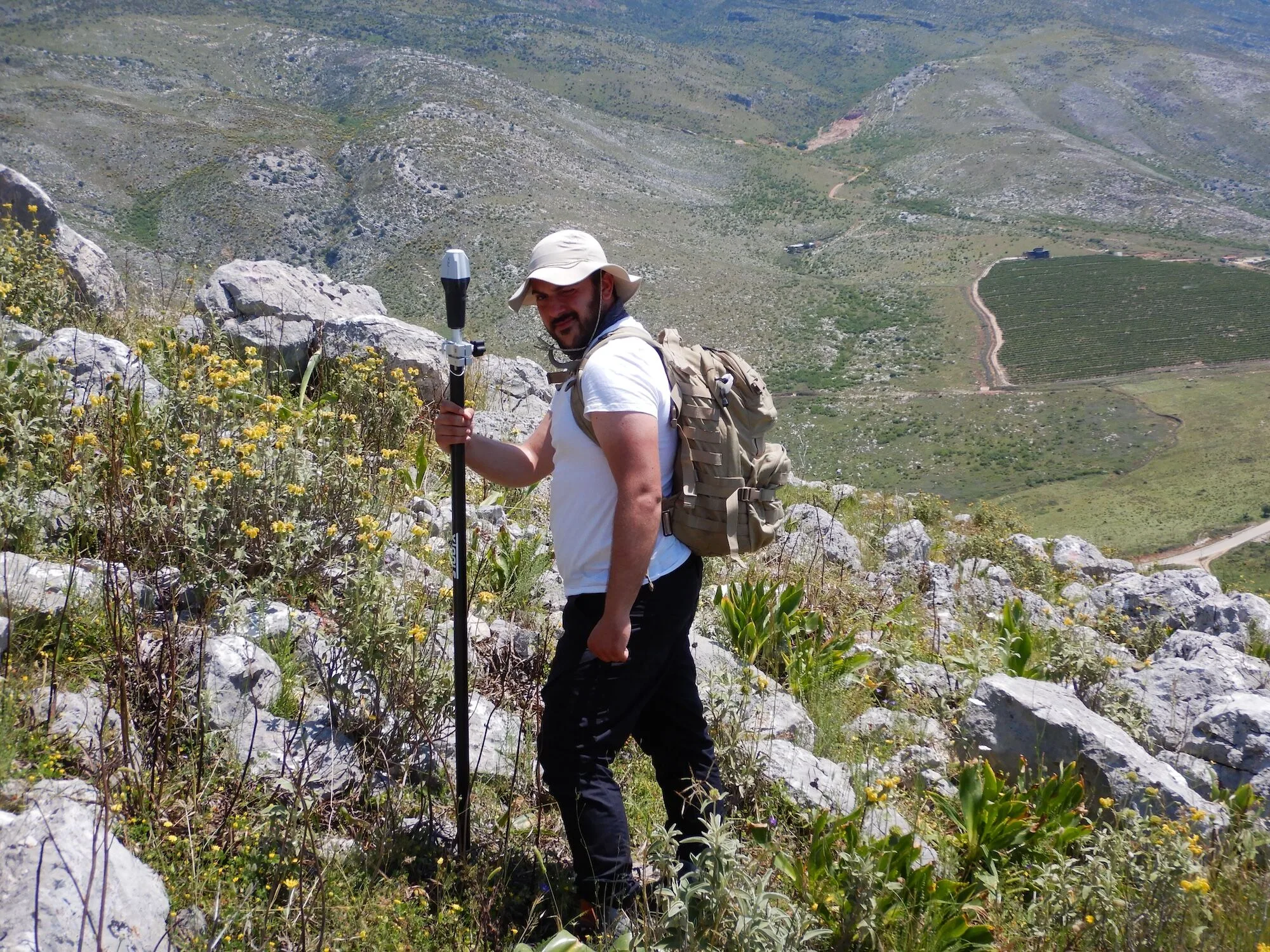
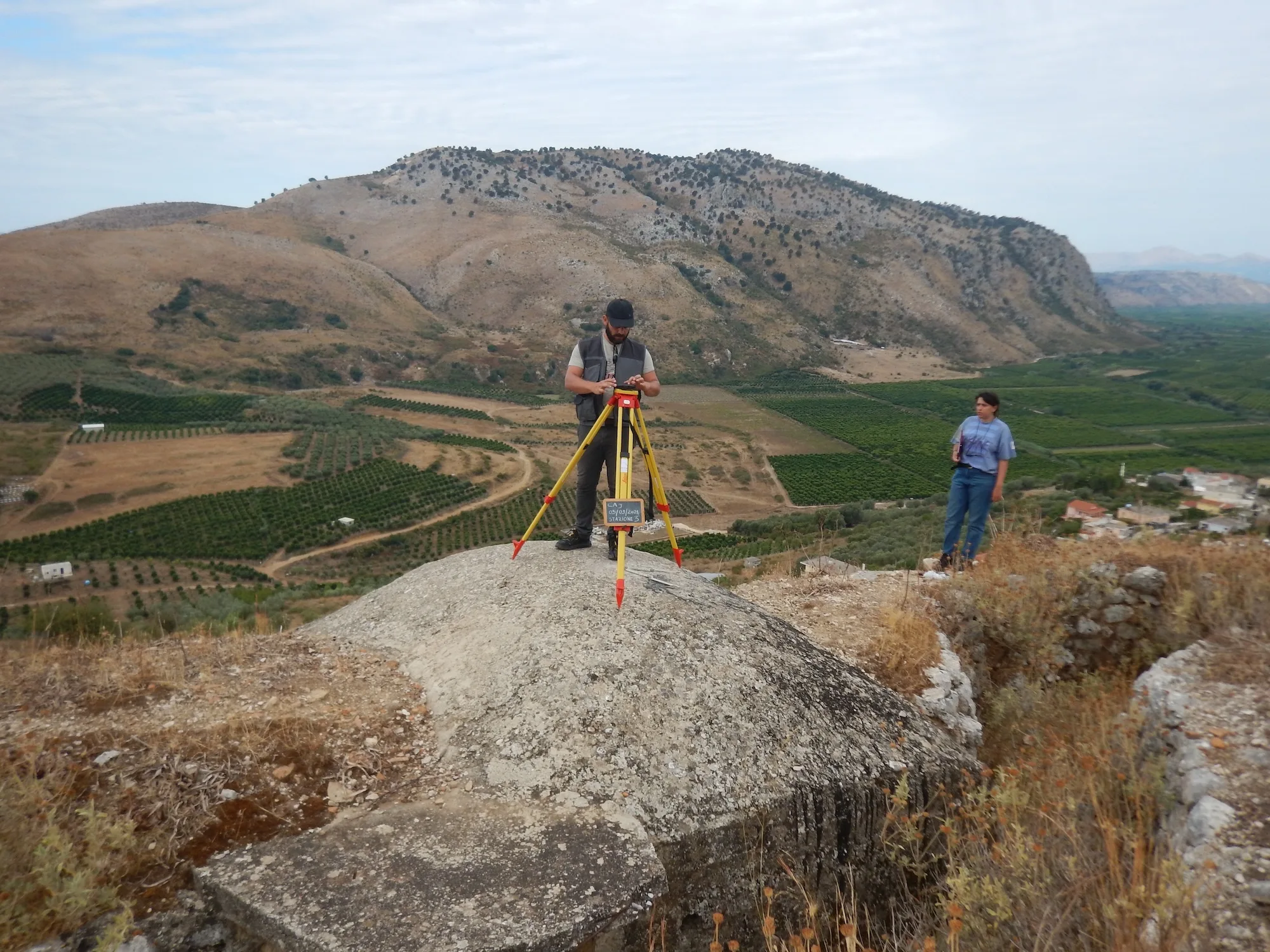
The season ran from 22 June to 18 July 2022 and had several objectives, the main ones being the completion of the survey of the hill and of the archaeological remains, using drone photography and photogrammetric processing. In addition, the 2022 season saw ground surveys carried out alongside these using RTK-mode GNSS, made possible by the Mission’s collaboration with the company Rilievi srl for GNSS equipment and with the ALBCORS programme of the National Geoportal of Albania (ASIG). This made it possible to georeference all the surveys carried out with high precision (approx. 2 cm).
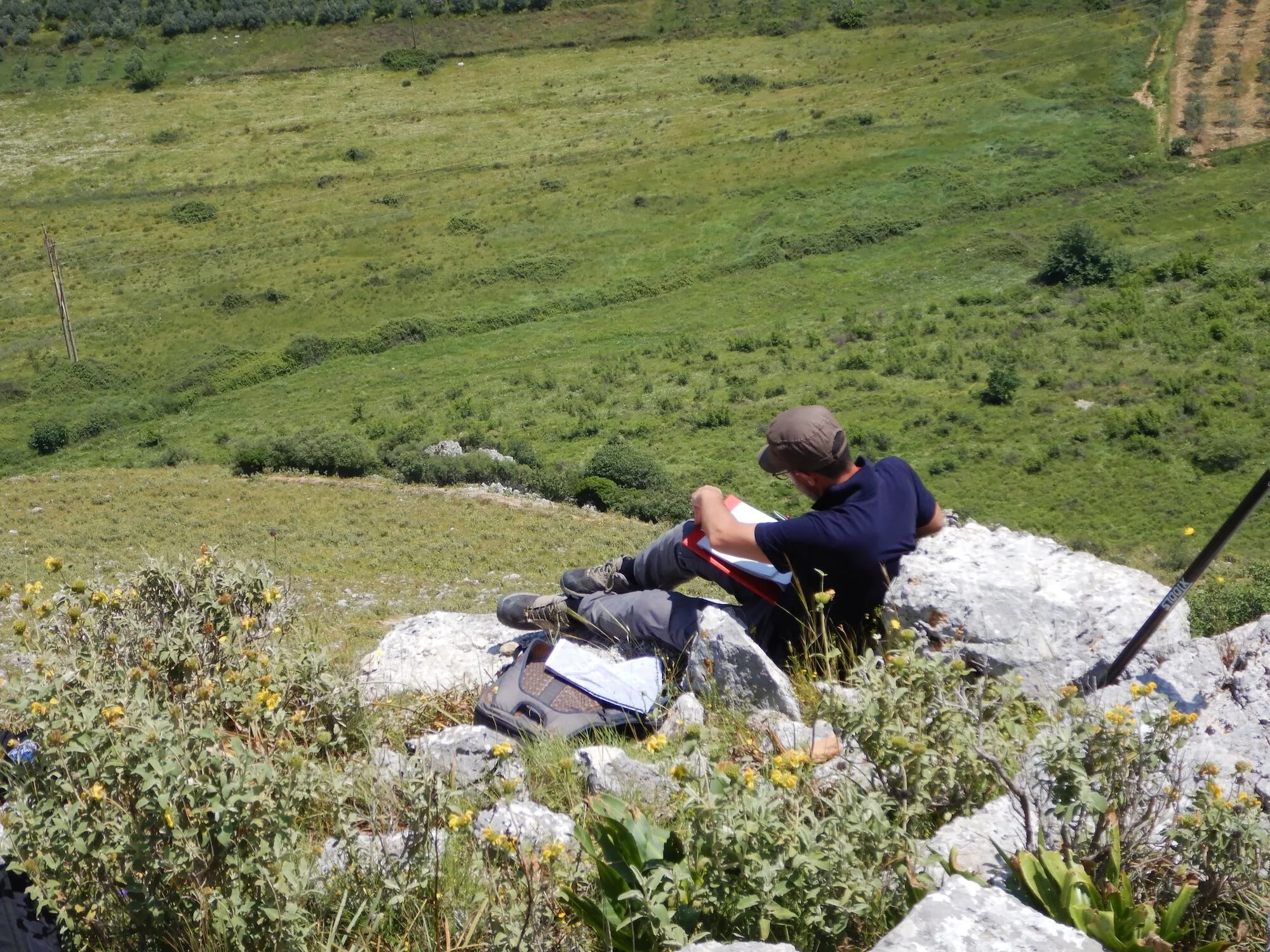
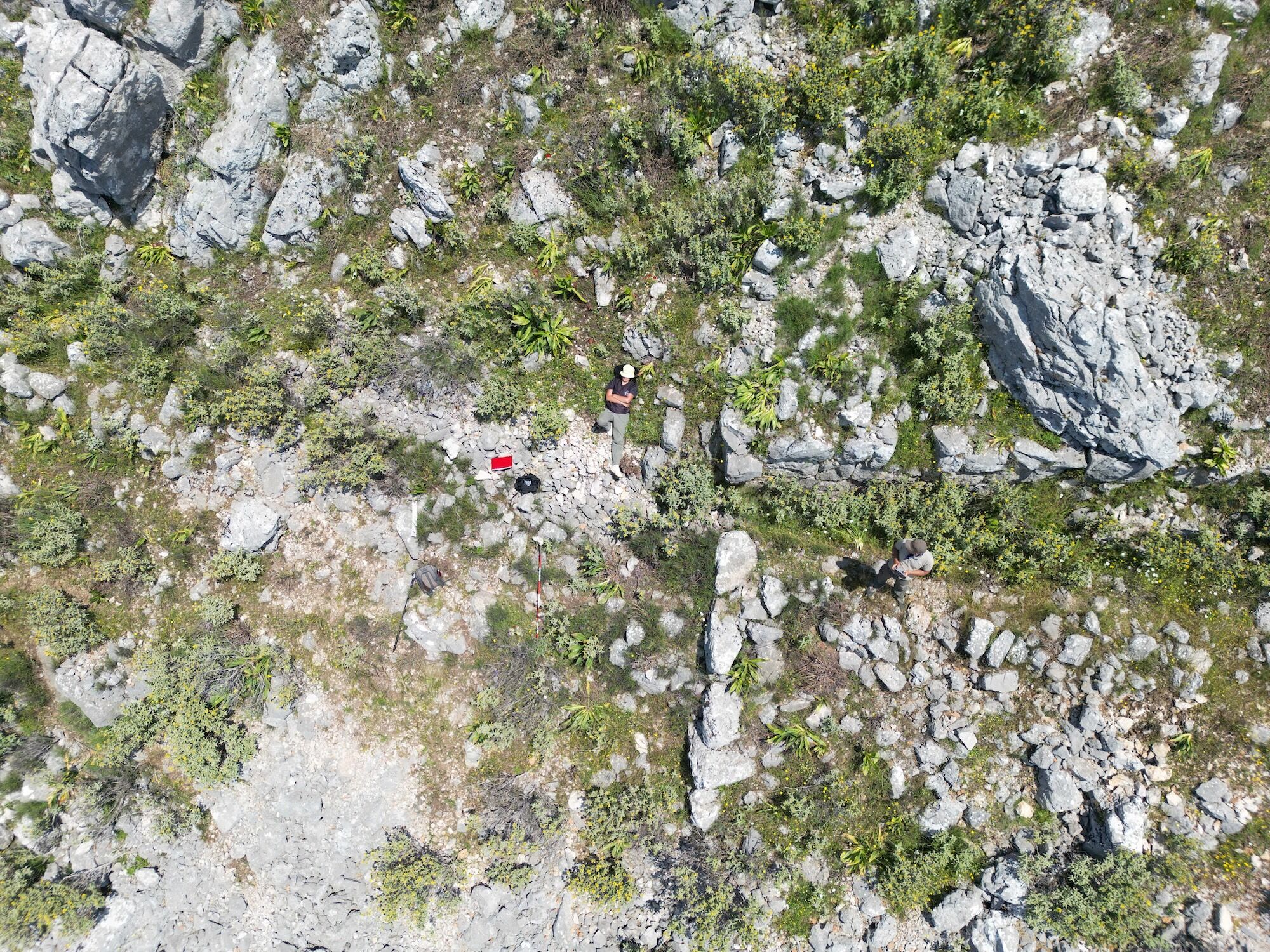
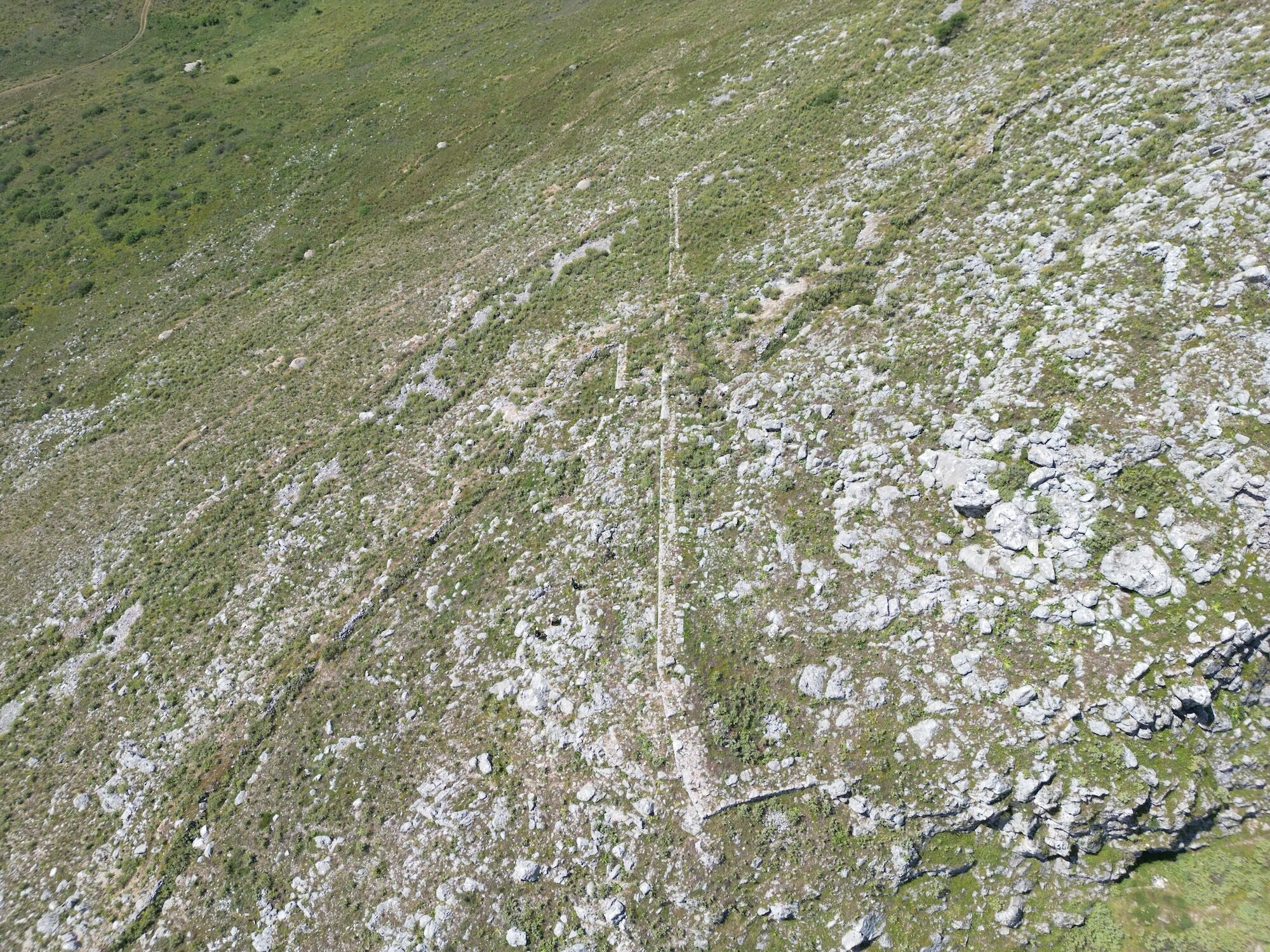
In addition, work was carried out to verify and catalogue archaeologically the remains identified by the surveys of the previous season (2021). Through painstaking work of identification, cataloguing, photographic documentation and analysis, a large part of the sectors of the town were documented, work made particularly difficult by the uneven and steeply sloping nature of the terrain. This very important verification led, on the one hand, to the exclusion from the archaeological picture of certain traces identified by aerial photography, to be attributed to the natural shape of the terrain, and, on the other, to the confirmation of the great majority of the other surveyed features and to the identification of further structures and complexes whose identification from above had been made difficult or impossible by various factors. A very solid archaeological basis is now available for the reconstruction of the plan of the ancient centre, including not only the fortifications but also the numerous dwellings and other built terraces that have been identified.
Two stratigraphic test trenches were also carried out, one in the so-called “Palace”, the structure on the hillside and outside the walls that lies along the western slopes of the hill, where it was possible to identify and stratigraphically document a number of sealed stratigraphic deposits, very useful for dating the polygonal structures of the “Palace”.
The second test trench was carried out at one of the structures of the so-called Ottoman village, on a raised plateau at the foot of the north-eastern slopes of the hill, identified during the previous season. In this case, too, the sounding was aimed at verifying the consistency and quality of the archaeological deposits and providing some functional and chronological indications for the structures.
The work of this season will continue over the coming months with the study of the archaeological material, mainly ceramic, now kept in the storerooms of the Albanian Institute of Archaeology in Saranda. The material was collected from the stratigraphy of the test trenches, but also from the surface, with sample collections in different areas of the town, in order to provide as complete a picture as possible of the different life phases of the ancient centre. The study is still at a very preliminary stage, but some initial results concern the discovery of impasto ceramic fragments, probably dating to the final Bronze Age, in several areas of the hill, attesting to a presence in this period that was probably one of settlement and not merely sporadic. Fundamental in this respect was the participation, in the first part of the mission, of Prof. Alessandro Vanzetti of Sapienza. In addition, the chronological hypotheses concerning the Ottoman village, initially put forward solely on topographic grounds, appear to be confirmed. The material collected on the surface and that from the test trench seem to confirm a date for the structures from at least 1600 with continuity through to the turn of the 1900s. Here too, further in-depth study of the archaeological material will in future make an important contribution to the understanding of this part of the ancient site.
Special thanks are due, finally, to Halil Shabani, a now-retired local archaeologist who made an important contribution to the knowledge and documentation of the rich area of Konispoli. With him, we carried out field visits useful for the knowledge of sites that were reported but little known in the Albanian-language literature and entirely unknown in the international literature. It was also possible to positively verify a number of local reports of other, entirely unknown, archaeological sites, such as the terraced and paved road near the hill of Çuka e Ajtoit.
Besides colleagues and friends, the Mission’s work was also visited and reported on by the Albanian media, both national and local, which produced reports and documentaries, such as that of the national network Top Channel (available at https://youtu.be/5kCHIahg4CA) and the Report TV feature, picked up by SarandaWeb and by Shqiptarja.com.
Participants
Mission direction:
- Julian Bogdani (Sapienza, Rome, Italy)
- Albana Meta (Institute of Archaeology, Tirana, Albania)
Senior staff:
- Domizia D’Erasmo (Sapienza, Rome, Italy)
- Noemi Giovino (Sapienza, Rome, Italy)
- Paolo Rosati (Sapienza, Rome, Italy)
BA, MA:
- Halil Braho (University of Tirana, Albania)
- Dea Hate (University of Tirana, Albania)
- Klea Mufali (University of Tirana, Albania)
Guests
- Alessandro Vanzetti (Sapienza, Rome, Italy)
- Halil Shabani (Archaeologist and historian, Saranda, Albania)
- Giuseppe Valentini (MA, Sapienza, Rome, Italy)
Support
The activities of the Sapienza Archaeological Mission to Çuka e Ajtoit have also been made possible thanks to a fruitful collaboration with institutional bodies and Italian and Albanian companies, to whom we extend our full gratitude for their continued support.
The Sapienza Archaeological Mission to Çuka e Ajtoit thanks Past & Present Journeys, Tirana, for its continuous and essential support.
- Website: https://pastandpresent.al/
- Facebook: http://www.facebook.com/pages/PastandPresent-Travel-Company/106348866175295
- Twitter: @PastPresentTrav
Thanks to Rilievi srl for the GNSS equipment and for their continuous support with survey equipment and advice.

Finally, thanks go to the ALBCORS programme of the National Geoportal of Albania (ASIG) for the RTK service and for field support for the topographic survey with GNSS equipment.
Institutional partners
Bibliography
- Baçe, A. dhe V. Bushati. 1989. “Vështrim mbi banesën prehistorike dhe qytetare në Iliri dhe Epir.” Monumentet, 1, 5-48 (20 segg.)
- Bogdani. 2006. “Le fortificazioni di età ellenistica di Çuka e Aitoit.” Ocnus, 14, 43-59
- Bogdani. 2009. “Çuka e Aitoit: një kontribut i ri (Çuka e Aitoit: a new assessement).” Iliria 33, 233-258.
- Bogdani. 2012. “Le residenze rurali della Caonia ellenistica. Note per una nuova lettura.” Agri Centuriati 8, 121-144.
- Bogdani, J. e E. Giorgi. 2012. Il territorio di Phoinike in Caonia. Bologna: Ante Quem (249-252).
- Budina, Dh. 1971. “Harta arkeologjike e bregdetit Jon dhe e pellgut të Delvinës.” Iliria I, 275-342 (317-321)
- Bogdani. 1974. “Gjetje Rasti. Rrethi i Sarandës.” Buletini Arkeologjik, 235-244 (235-236 e tab.II, 241).
- Cabanes, P., M. Korkuti, A. Baçe dhe N. Ceka. 2008. Carte archéologique de l’Albanie. Tirana (88-91).
- Ceka, N. 1976. “Fortifikimi antik i Butrintit dhe i territorit të presaibëve.” Monumentet 12, 27-44 (33-35 e tabb.I, III-IV, 40, 42-43)
- I. Lyse Hansen, O.J. Gilkes e A. Crowson, Kalivo and Çuka e Aitoit, Albania. Interim report on survey and excavations 1928-2004 http://www.butrintfoundation.co.uk/publications.htm.
- Hammond, N.N.G. 1931. “The terrain of Epirus and the Pindus routes.” Annual of The British School in Athens. 1, 94-95. plate VI a-b.
- Hammond, N.N.G. 1967. Hammond, N.G.A. Epirus: the geography, the ancient remains, the history and the topography of Epirus and adjacent areas, Oxford: Oxford at the Claredon Press.
- Hernandez, D.R. e R. Hodges. A c. 2020. Butrint 7: Beyond Butrint: Kalivo, Mursi, Çuka e Aitoit, Diaporit and the Vrina Plain. Surveys and Excavations in the Pavllas River Valley, Albania, 1928-2015. Oxford: Oxbow books.
- Islami, S. 1975. “Problèmes de cronologie de la cité illyrienne. Aglométarions fortifiées illyriennes.” in Utverdena Ilirska Naselja. Posebna izdanja, Knjiga XXIV. Sarajevo, 37-45 (42).
- Islami, S .1981. “Jeta Shkencore.” Iliria XI, 1, 269-273 (270).
- Islami, S. 1982.“Qyteza e Çukës së Aitoit.” Saranda. Almanak 2, 9-18.
- Islami, S. 2008 Historia e Ilirëve. Tirana (263-336).
- Lako, K. 1982. “Kështjella e antikitetit të vonë në Çukën e Aitoit.” Iliria, XII, 2, 207-219
- Lako, K.. 1982b. “Një keshtjellë e antikitet të vonë.” Saranda. Almanak, 2, 67-73.
- Leake, W.M. 1935, Travels in Northen Greece I London.
- Louis, H. 1927. Albanien. Eine Landeskunde vornehmlich auf Grund eigener Reisen. Stuttgart.
- Pouqueville, F.C.H.L.1936. Voyage dans la Grèce II. Paris.
- Robert, L. 1940. “Pergame d’Epire.” Hellenica I, 95-105.
- Shabani, Halil. 1983. “Njoftime arkeologjike nga zona e Konispolit (Ndihmesë për hartën arkeologjike të vendit) / Informations archéologiques de la région de Konispoli.”, Iliria 13, 1: 261-276.
 con Georgia Pliakou.CGWYl7Xz.webp)