

Research project details
- P.I.: Paolo Rosati
- Funding: “Progetti per Avvio alla Ricerca” programme of Sapienza University of Rome
- Year: 2022
- Protocol no.: AR22218166C6157C
- Participants:
- Paolo Rosati, P.I. paolo.rosati@uniroma1.it
- Julian Bogdani, Tutor julian.bogdani@uniroma1.it
Abstract
This application for early-career research support is set within the context of the activities of the Sapienza archaeological mission in Albania (Çuka e Ajtoit, Konispoli). The site, identified with the ancient toponym Kestría, presents important phases ranging from the late Classical period to the Ottoman period. In the early Medieval period, probably in the Justinianic era, a fortress was built on the summit of the hill, partly reusing the layout of the earlier defences, forming a summit defensive stronghold. The frurion played a role in the defence and control of the region gravitating around the ancient city of Butrint, a UNESCO site whose Roman, Late Antique and Medieval phases are well known and have been studied for years through international investigations.
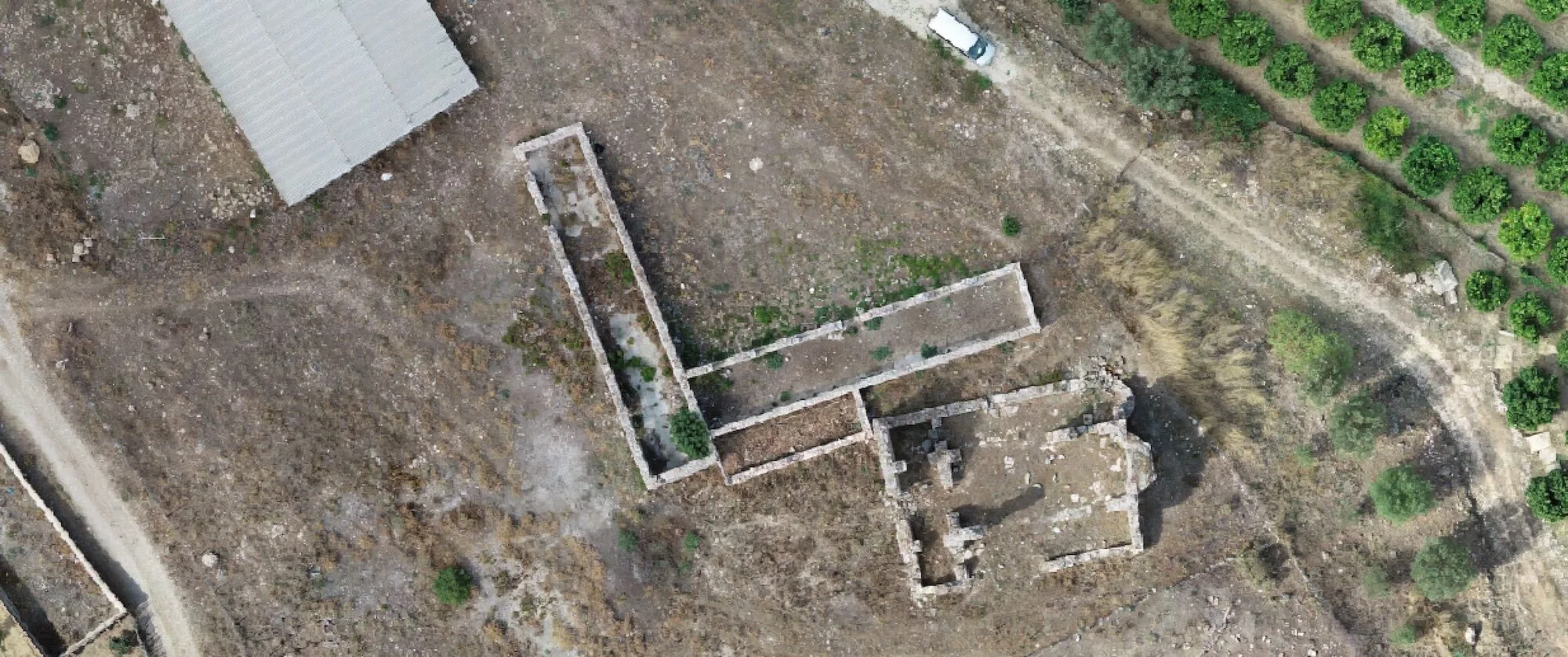
The research proposal presented here intends to focus mainly on the Medieval period, when, in addition to the fortifications on the hill, a basilica was also founded on the plain at its foot, of which important traces survive above ground today. The complex, markedly neglected by previous scholarship, is listed among the assets protected by the Albanian State, and is generically dated to the 13th century on the basis of comparisons of building techniques with the ecclesiastical complex of Mesopotamos. The present research aims to provide new graphic and topographic documentation of the structures, produced using recent technologies, mainly the photogrammetric method and drone imagery, and a new overall reading of the stratigraphy of the standing structures, in an attempt to reconstruct the life phases of the complex, the cataloguing of the architectural remains still found scattered or reused, and finally a general historical-archaeological recontextualisation of the monument within its regional setting.