

Five years ago, in Digital encoding of chronology, we tried to lay out a problem that anyone who has designed an archaeological database knows well: how do you record a dating. The hard part is not the precise date — that is easy — but everything around it: ranges, approximation, uncertainty, alternative dates, missing termini. And, above all, how do you then search by chronology.
That article surveyed three families of solutions. The first: two fields, data_from and data_to, a start year and an end year — simple, compact, and above all searchable by the database, but unable to express approximation or uncertainty explicitly. The second: the Extended Date/Time Format (EDTF), an ISO standard, extraordinarily expressive — Y-3345~/Y-3300~, [Y79-08-24,Y79-10-24] — but which no database can query natively, shifting all the work onto the application. The third: period gazetteers such as PeriodO, which assign a URI to each period and let different databases be linked together, but which are very awkward to use at data-entry time. The conclusion was that a universal solution does not exist, and that the most sensible route — at least for an excavation database — is a hybrid: a year range for searchability, a layer of expressiveness on top, and possibly a bridge towards period vocabularies.
BraDypUS 5 — the version presented in BraDypUS 5: a new interface, an open API and the first archaeology plugins — brings that hybrid into production, in the form of a system plugin called fuzzy_date. This article explains it from scratch: first the idea, then the syntax with many examples, then how it integrates with the rest of the system. Readers who only want to know what to type in the chronology box can jump straight to the quick guide at the end.
The examples that follow are drawn — or adapted — from the contexts of the Sapienza Archaeological Mission to Çuka e Ajtoit, ancient Kestría, a Hellenistic fortified centre of northern Epirus, in southern Albania.
What the fuzzy_date plugin does
The plugin is enabled per table: Config → Tables, select the table, scroll to the System plugins section and switch on Chronology (fuzzy date). On activation the system adds five columns to the table, with no further configuration:
| Column | Type | Content |
|---|---|---|
chrono_from | integer | start year (negative = BCE); NULL for ante quem or undated |
chrono_to | integer | end year (negative = BCE); NULL for post quem or undated |
chrono_label | text (200) | human-readable label, generated automatically by the system |
chrono_certainty | text | certainty level: certain / probable / possible |
chrono_period | text | qualitative period name (e.g. “Hellenistic”); no numeric mapping |
The design mirrors Solution 1 from 2021: the dating lives in two integers, chrono_from and chrono_to, which the database can index, sort and compare. The new part is that those two numbers are not typed by hand. You write a string in a compact notation — c4l BCE, -350 / -300, ? / c4q3 BCE — and the system parses it into from and to, generating the label at the same time. As you type, the panel shows a live preview: the generated label and the numeric range, so you can check the result before saving.
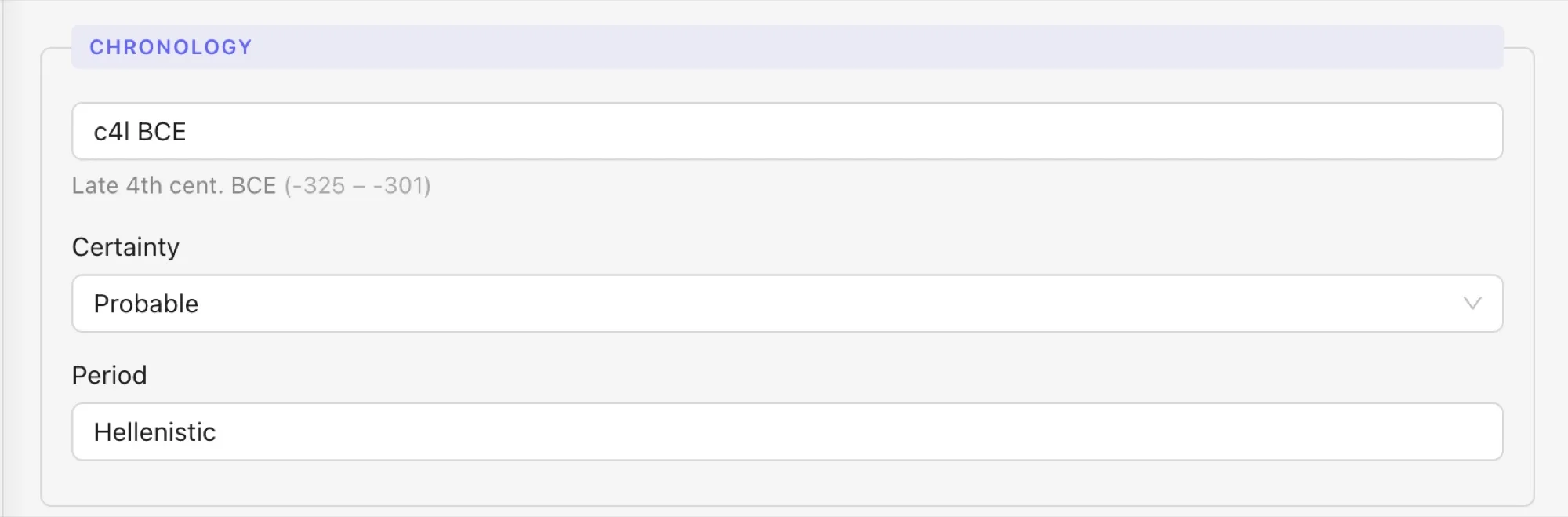 The “Chronology” panel in edit mode. The string
 c4l BCE produces the preview “Late 4th cent. BCE (−325 – −301)”; below, Certainty (“Probable”) and Period (“Hellenistic”).
The dating type is not a field: it is inferred from which of the two endpoints are set.
chrono_from | chrono_to | Dating type |
|---|---|---|
NULL | NULL | undated |
| X | X | point date (exact year) |
| X | Y (with X < Y) | range / circa |
NULL | Y | ante quem (no later than) |
| X | NULL | post quem (no earlier than) |
Compared with bare Solution 1 there is, however, one important addition: alongside the range, an explicit certainty axis (certain / probable / possible) and a free period label. On how these fields relate to the notions of approximation and uncertainty, see below.
The syntax, with examples
The chronology string has a minimal structure:
input = token → single date or century range | token / token → explicit range | ? / token → ante quem | token / ? → post quem | ? → undatedA token is one of two types: century or year.
Century tokens
Always begins with c, followed by the century number, an optional qualifier and the era (BCE / CE):
c{N}{qualifier} {BCE|CE}| Qualifier | Meaning | Example | Range |
|---|---|---|---|
| (none) | full century | c4 BCE | 400–301 BCE |
e | early (~first 25%) | c4e BCE | 400–376 BCE |
m | mid (~middle 50%) | c4m BCE | 375–326 BCE |
l | late (~last 25%) | c4l BCE | 325–301 BCE |
h1 | first half | c4h1 BCE | 400–351 BCE |
h2 | second half | c4h2 BCE | 350–301 BCE |
q1 … q4 | first … fourth quarter | c4q3 BCE | 350–326 BCE |
Careful:
4 BCEis not the 4th century.4 BCEis the year 4 BCE; the 4th century BCE is writtenc4 BCE. Thecprefix is what distinguishes a century token from a year token.
Year tokens
| Form | Example | Meaning |
|---|---|---|
-N | -350 | year 350 BCE |
N BCE | 350 BCE | year 350 BCE |
N or N CE | 300 / 300 CE | year 300 CE |
Ranges and one-sided forms
| String | Meaning | Stored as |
|---|---|---|
c4l BCE / c3m CE | late 4th BCE to mid 3rd CE | from = −325, to = 275 |
-350 / -300 | years 350–300 BCE | from = −350, to = −300 |
? / c4q3 BCE | ante quem: no later than the 3rd quarter of the 4th BCE | from = NULL, to = −326 |
c4l BCE / ? | post quem: no earlier than the late 4th BCE | from = −325, to = NULL |
? | undated | from = NULL, to = NULL |
The correspondence table
Here, side by side, are the three requested forms — century string, year string, discursive dating — with the value that is actually stored. The rows use plausible contexts from Çuka e Ajtoit: a stratigraphic unit, a stretch of fortification, a pottery sherd, a destruction layer.
| String (centuries) | String (years) | In discursive form | chrono_from / chrono_to |
|---|---|---|---|
c4 BCE | -400 / -301 | 4th century BCE | −400 / −301 |
c4h1 BCE | -400 / -351 | first half of the 4th century BCE | −400 / −351 |
c4l BCE | -325 / -301 | late 4th century BCE | −325 / −301 |
c4q3 BCE | -350 / -326 | third quarter of the 4th century BCE | −350 / −326 |
c3m BCE | -275 / -226 | mid-3rd century BCE | −275 / −226 |
c4 BCE / c2 BCE | -400 / -101 | 4th to 2nd century BCE | −400 / −101 |
c1e CE | 1 / 25 | early 1st century CE | 1 / 25 |
| — | -167 | 167 BCE (Roman campaign in Epirus) | −167 / −167 |
| — | -350 / -300 | c. 350–300 BCE | −350 / −300 |
? / c4 BCE | ? / -301 | no later than the 4th century BCE (ante quem) | — / −301 |
c2l BCE / ? | -125 / ? | no earlier than the late 2nd century BCE (post quem) | −125 / — |
? | ? | undated | — / — |
The boundaries of the quarters and fractions of a century are conventional: the system fixes them once and for all, so that two different cataloguers get the same numbers from the same indication. Any caveats stay with the record’s text and the Certainty field.
Re-reading the 2021 “test bench”
The 2021 article tested each solution on a handful of difficult dates. Let us redo the exercise with fuzzy_date.
- 2 September 31 BCE (the Battle of Actium).
fuzzy_dateworks at the year level: you write-31, which producesfrom=to= −31. The day is lost — exactly as in Solution 1 — and goes, if relevant, into the record’s descriptive text. - 44 BCE – 31 BCE (the civil war that ends at Actium).
-44 / -31, i.e.from= −44,to= −31. - First half of the 1st century BCE. In 2021 this was hand-coded as
data_from: -100,data_to: -51. Now it is a single token:c1h1 BCE, which generates the same range, −100 / −51. - 24 August 79 or 24 October 79 (the two proposed dates for the eruption of Vesuvius).
fuzzy_datedoes not represent exclusive alternative dates — like Solution 1, and unlike EDTF, which offers the[..., ...]notation. It falls back on79(a point date), noting the alternative in the text. - c. 3345 BCE – c. 3300 BCE (the lifespan of the Iceman). You write
-3345 / -3300and setchrono_certaintytoprobable(orpossible) to carry the “c.”. The swing of the radiocarbon window has no marker of its own: it lives in the width of the range and in the certainty. For actual radiocarbon determinations there is a dedicated plugin (see below). - 42000 BP (2000) – 12001 BP (2000) (the Sicilian Upper Palaeolithic as defined by ARIADNE). It is best, as the 2021 piece already advised, to convert to BCE first:
-40000 / -12001.fuzzy_datedoes not convert from the before present scale.
Approximation and uncertainty
The 2021 piece carefully distinguished two concepts that get blurred in practice. Approximation is inherent to the object: a sherd of amphora rarely interests us for the precise moment of its production, but for the span of its use-life; its dating is by definition broad. Uncertainty, on the other hand, concerns the method: how much we trust the attribution or the instrument.
fuzzy_date treats the two asymmetrically, and it is worth saying so plainly. Uncertainty has a dedicated field, chrono_certainty, with three steps (certain / probable / possible). Approximation has no marker: it is expressed in the width of the range. A c4 BCE is “approximate” simply by being one hundred years wide; a c4q3 BCE much less so. This is a deliberate simplification: giving up a separate “circa” symbol is the price for keeping everything in two integer columns the database can search.
Integration with the rest of BraDypUS
The advantage of storing chronology as a year range is that everything downstream can use it. This is where the plugin pays back the surrender of EDTF’s expressiveness.
Search: the _chrono_overlap operator
This is the direct answer to the central worry of 2021. Applied to chrono_from, the _chrono_overlap operator finds all records whose dating overlaps a given time window, correctly handling the NULL semantics of ante quem and post quem:
filter[chrono_from][_chrono_overlap][]=-400&filter[chrono_from][_chrono_overlap][]=-300or, as a JSON body:
{ "chrono_from": { "_chrono_overlap": [-400, -300] } }The logic has three branches:
| Record type | Included if |
|---|---|
normal range (from and to set) | the range overlaps [low, high] |
ante quem (from is NULL) | to >= low |
post quem (to is NULL) | from <= high |
undated (both NULL) | never |
So “all contexts that could fall in the 4th century BCE” is a single query, and it includes the wall dated -380 / -320, the fill ? / -350 (ante quem), and the layer -330 / ? (post quem) alike. It is precisely what in 2021 seemed to require “genuinely demanding programming work”: today it is one operator.
Careful.
_chrono_overlapmust be used only onchrono_from. On the other fields the standard operators apply:filter[chrono_certainty][_eq]=probable,filter[chrono_period][_icontains]=hellenistic,filter[chrono_to][_nnull]=truefor dated records only, and so on.
The comparative chronological Timeline
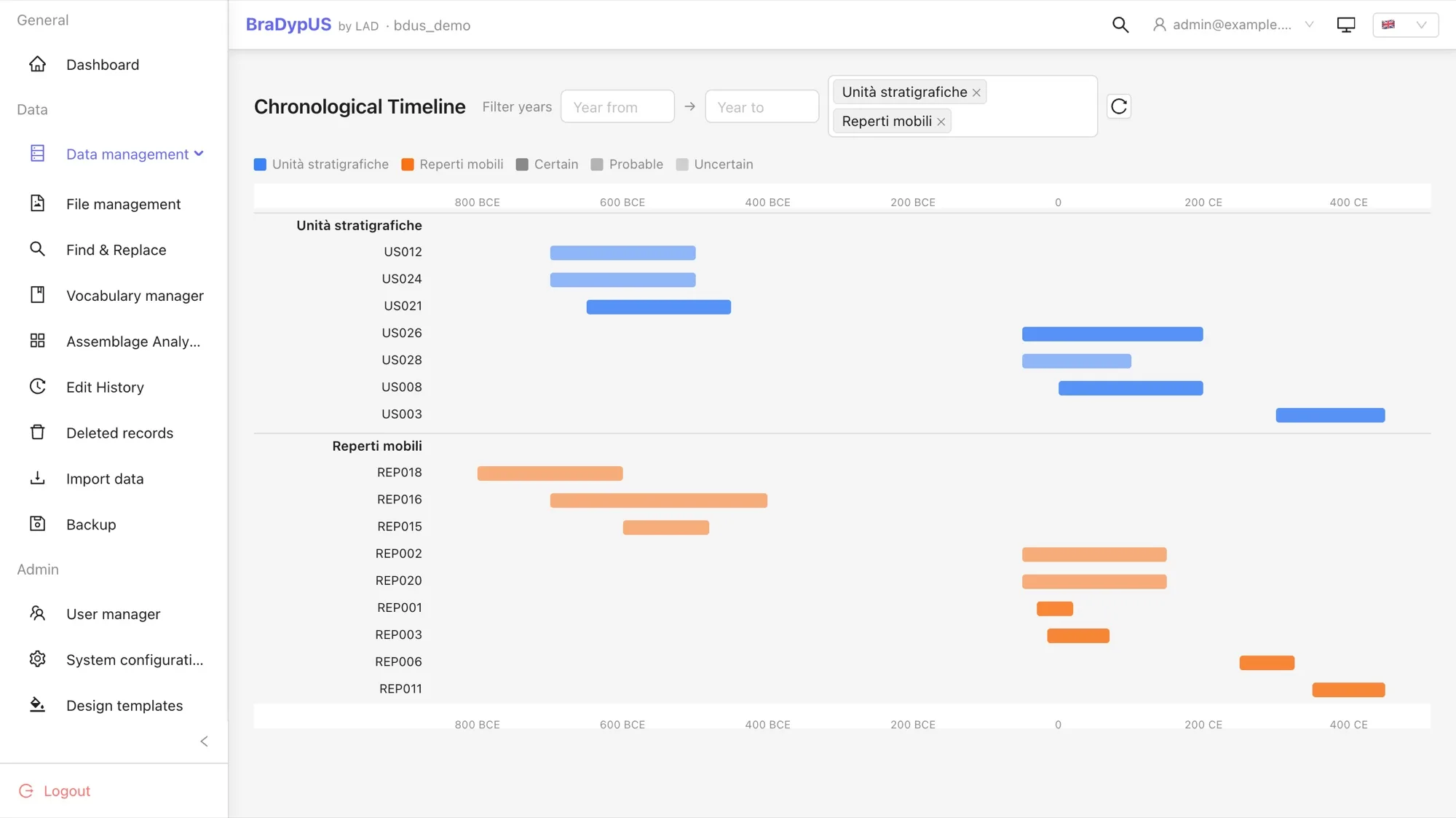
A full-page view opened from the record list (the calendar button in the toolbar) that overlays on a single time axis all records with fuzzy_date data from the selected tables. Each row is a record, grouped by table; each bar runs from chrono_from to chrono_to. Every table has its own colour, and the intensity of the bar carries the certainty: solid for certain, progressively fainter for probable and possible. Hovering over a bar shows the title, the range (raw and human-readable), the period and the certainty. At the top you pick which tables to include and can narrow the axis to a range of years.
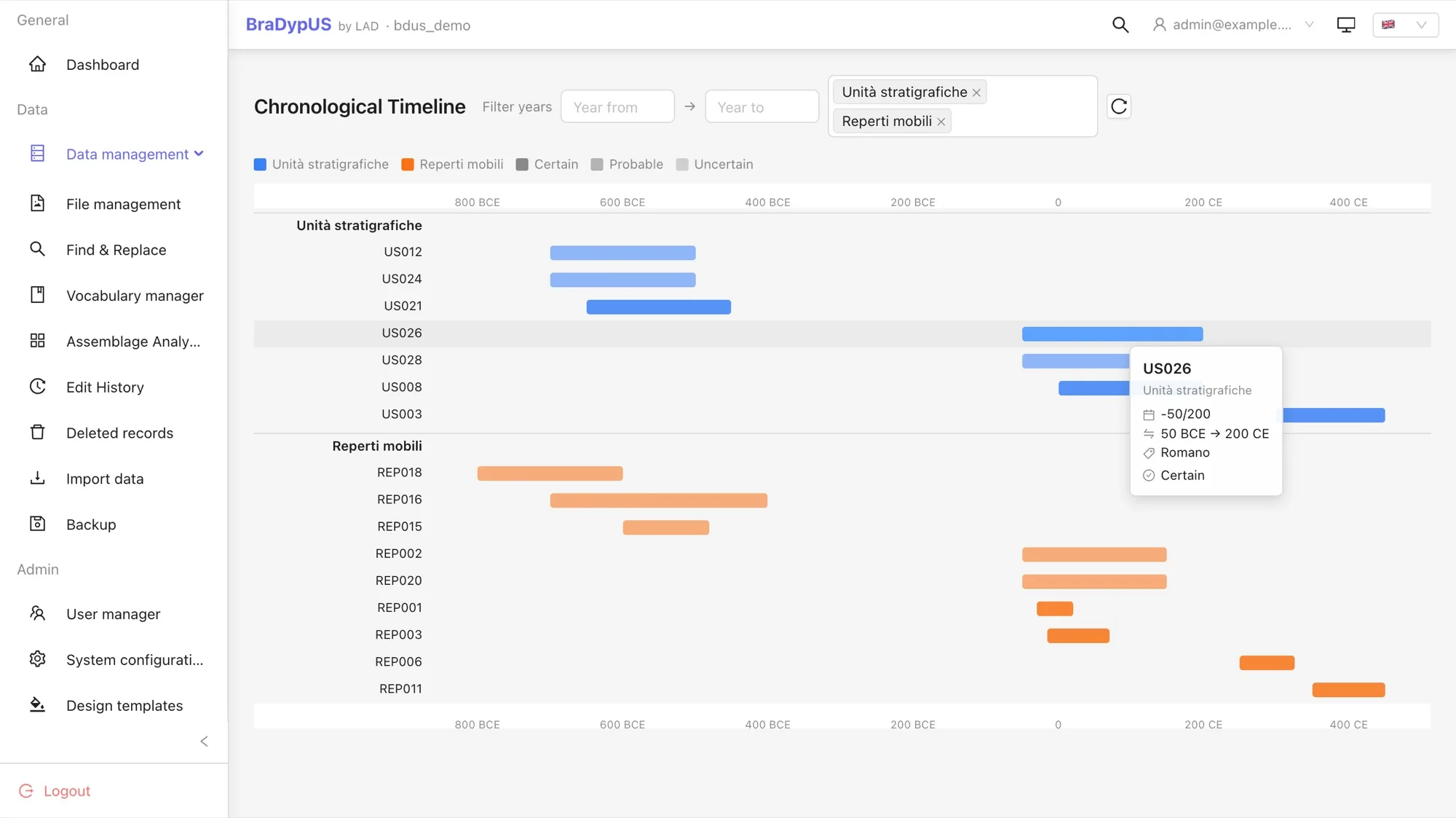 The comparative chronological Timeline with two tables overlaid on the year axis: colour distinguishes the table, opacity the certainty. The tooltip for US026 shows its range, period and certainty.
The derived chronological distribution
A panel that appears in the body of a record’s page when the table has relations to other tables with fuzzy_date enabled. For each related table it computes the chronological density of the records linked to the current one — each record’s chrono_from–chrono_to span is distributed over a sixty-interval axis — and draws it along the timeline. The busiest interval is highlighted with its from and to labels and the record count; each stretch is a link that opens the list of related records filtered to that period.
Concretely: opening a site record, the panel shows how the datings of all the stratigraphic units (or all the finds) linked to it are distributed over time — a glance at “when is this context alive”.
 The derived chronological distribution: the datings of the records linked to a site, spread along the time axis, with the peak interval (here 700–489 BCE, 3 records) highlighted.
The default behaviour follows a single automatic hop: the direct child tables (foreign-key relation) that have fuzzy_date. To reach a more distant descendant — for example “from a Site, the Finds linked through the Stratigraphic units” — each table can have a chronological distribution path configured in Config → Tables: the intermediate tables act as a simple bridge (the SUs need not have a chronology of their own), and only the last table in the chain must have fuzzy_date enabled.
The map (GeoFace)
When fuzzy_date is active on a table, the GeoFace map shows a temporal filter bar: a dual-handle year slider (from −3000 to 2000, in steps of 25 years). As you drag the handles, the map markers are filtered in real time with _chrono_overlap — again including the ante quem and post quem records that intersect the selected window. In practice you “scrub” along time and watch which sites or contexts light up.
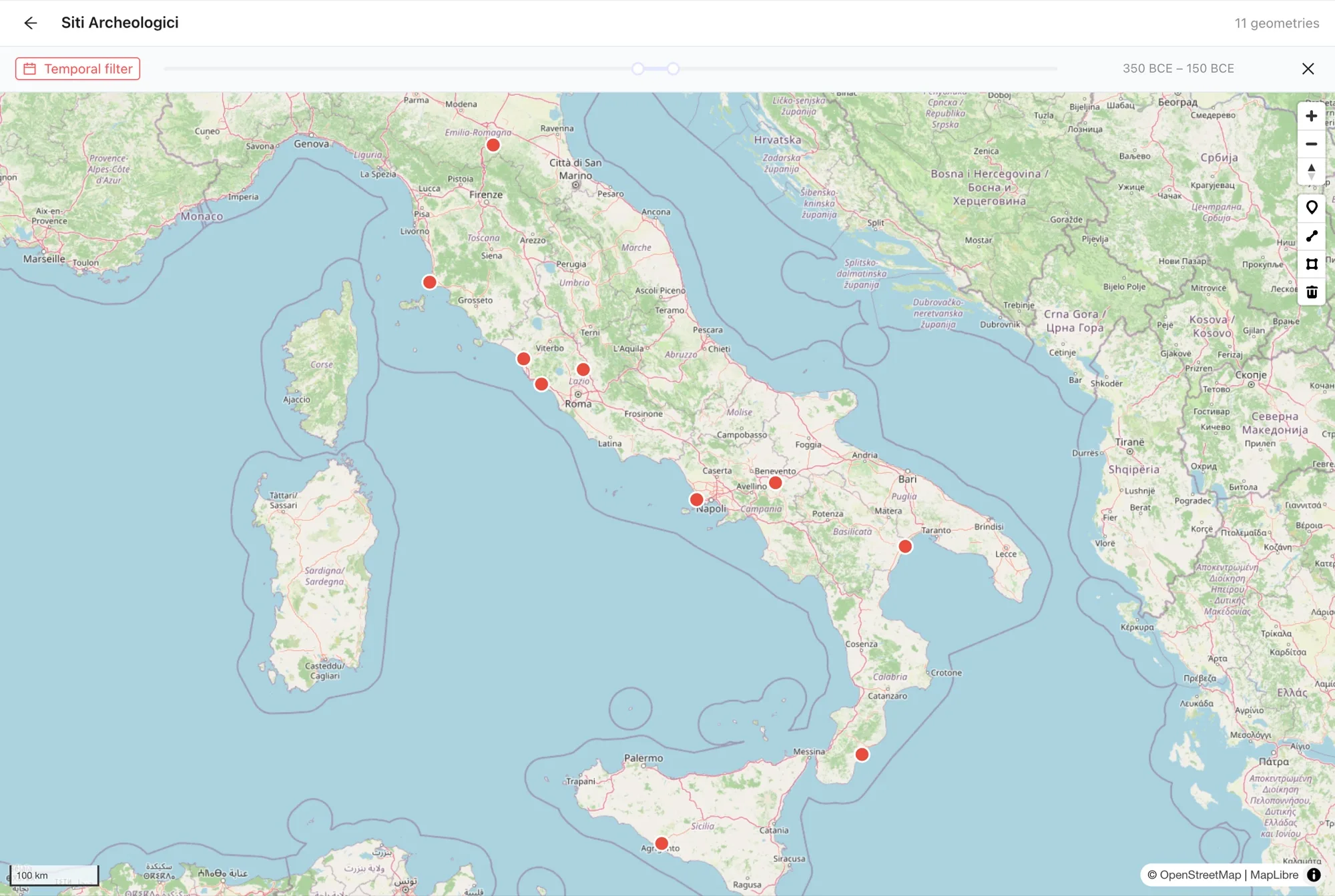 GeoFace with the temporal filter active (350–150 BCE): the dual-handle slider narrows the map markers in real time, using
 _chrono_overlap.
The Harris Matrix on an absolute axis
Already implemented, in a version still being refined: an absolute-chronology layout that places stratigraphic units on a vertical timeline using their fuzzy_date. The stratigraphic diagram, normally purely relative, thereby gains a scale: the units no longer just sit “above” or “below” one another, but take their place in time according to the dating assigned to them.
And radiocarbon?
fuzzy_date is for interpreted datings, the ones you type. Scientific radiocarbon dates have a plugin of their own, radiocarbon: you enter the lab BP value and the error, and the server calibrates against the IntCal20 curve, storing the calendar-year ranges (at 1σ and 2σ) — again as plain integer columns. The philosophy is the same as fuzzy_date: a couple (in fact four) of indexable columns, at the price of a declared simplification — a single range enclosing the result, not the possibly disjoint highest-posterior-density regions that a tool like OxCal would return. The two plugins are independent: a radiocarbon determination does not automatically fill chrono_from and chrono_to. But nothing stops you reading the calibrated range and transcribing the corresponding fuzzy_date by hand — which is, concretely, the 2021 observation that radiocarbon “turns uncertainty into approximation”.
Quick guide
For those who do not want to read the documentation. A reference sheet.
1. Turn on the plugin. Config → Tables → select the table → System plugins section → enable Chronology (fuzzy date). Five columns appear, no other configuration. It can be turned off whenever you like: the data stays.
2. In the record page, type in the “Chronology string” box:
| If you have… | Write | Example |
|---|---|---|
| a century | c{N} BCE or c{N} CE | c4 BCE |
| part of a century | c{N} + e m l h1 h2 q1…q4 + era | c2l BCE, c1h1 BCE, c3q2 CE |
| precise years (a range) | -{from} / -{to} | -350 / -300 |
| a single year | -{year} or {year} BCE / CE | -167, 44 BCE, 330 CE |
| only the upper bound (ante quem) | ? / {token} | ? / c4 BCE, ? / -300 |
| only the lower bound (post quem) | {token} / ? | c2 BCE / ?, -125 / ? |
| no dating | ? | ? |
3. Set the Certainty (certain / probable / possible) and, if needed, the Period (free text, e.g. “Hellenistic”).
4. Check the preview (label + numeric range), then save.
Four rules to stay out of trouble:
cin front = century; withoutc= year.c4 BCEis not4 BCE.- Always state the era:
BCE/CE, or the minus sign for BCE years. - The
/separates the two termini of a range;?stands for “missing endpoint” or “entirely unknown”. - There is no “date type” field: point, range, ante quem and post quem are inferred from which endpoints you leave empty.
In conclusion
In 2021 we foresaw a hybrid, and fuzzy_date is that hybrid:
- the storage is Solution 1 — two integers the database can handle;
- EDTF’s expressiveness has been moved to data-entry time, in the form of a compiled grammar: there is no EDTF in the database, but there is also none of the work of searching over EDTF;
- uncertainty has a dedicated axis,
chrono_certainty; approximation lives in the width of the range; - the period has a field,
chrono_period— for now a simple qualitative label. Linking to shared gazetteers such as PeriodO remains the missing piece, and is under evaluation for a future release of the plugin.
Left out, by choice: sub-year granularity, the full EDTF of levels 1 and 2, exclusive alternative dates. In return, what is there is genuinely searchable — with _chrono_overlap, on the map, in the timeline, in the derived distribution — and for an excavation database that is often what matters most.
Further reading: Fuzzy date (Chronology) · Chronology · Geodata & GeoFace · Radiocarbon dating · and the starting point: Digital encoding of chronology.