

Research project details
- Co-PI for the SARAS Dept.: Paola Buzi
- PI for Sapienza: Orazio Carpenzano
- Project identifier: Extended Partnership 5 (“CHANGES”), Spoke 1 (“Historical landscapes, traditions and cultural identities”), WP 5 (“Archaeology of the Sacred”), thematic line 3 (“Panoramas of Diversity. Jews, Christians and Sacred Space between Sabina and the Aniene Valley, from Late Antiquity to the Present Day”)
- LAD Sapienza University of Rome team:
- Julian Bogdani julian.bogdani@uniroma1.it
- Erasmo di Fonso, erasmo.difonso@libero.it
Abstract
LAD: Digital Archaeology Laboratory at Sapienza has been taking part since 2024 in the activities of the PNRR project, Extended Partnership 5 (“CHANGES”), Spoke 1 (“Historical landscapes, traditions and cultural identities”), WP 5 (“Archaeology of the Sacred”), thematic line 3: “Panoramas of Diversity. Jews, Christians and Sacred Space between Sabina and the Aniene Valley, from Late Antiquity to the Present Day”.
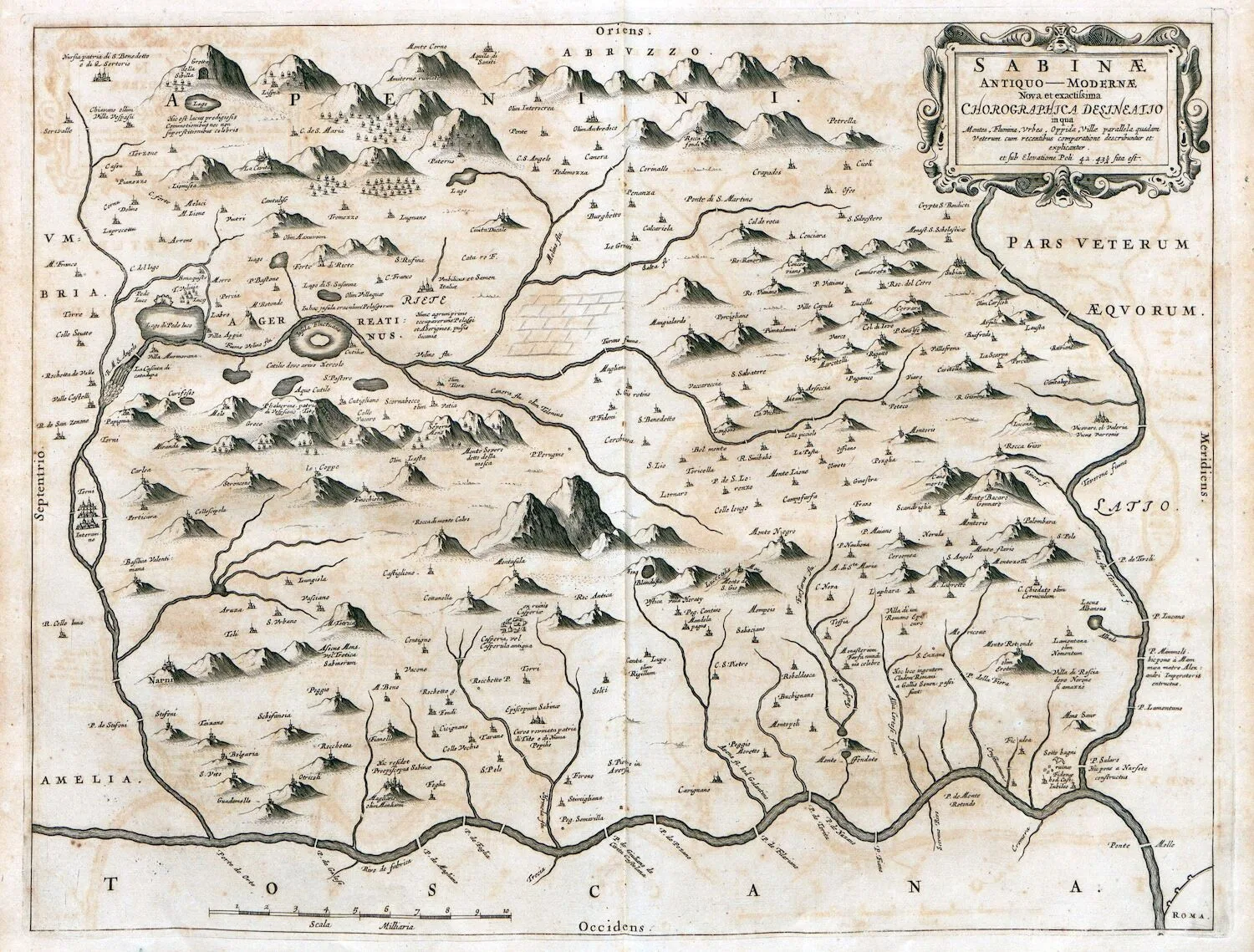
The project aims to trace the historical routes across the Lazio-Sabina territory, following a line connecting two perspectives: a diachronic one and a cultural one. Its ultimate interest is to identify and enhance the landscapes of the territory that have had, and continue to have, a profound religious and historical significance for the Christian and Jewish communities. The research will focus on the time span running from Late Antiquity to the contemporary age. This thematic line, together with its digital publication, will therefore be interwoven with the other line traced by the ‘twin’ project led by the Department of Sciences of Antiquity.
The database produced by LAD will thus aim to collect and standardise the data gathered in the course of the research, while at the same time keeping track of the sources from which the information was obtained. Even more importantly, the database will make it possible to incorporate spatial data, thereby linking the information gathered to precise spatial realities, in the dual nature of modern-day localities and historical monuments. All these elements will finally be stitched together through the deliberate tracing of historical and cultural routes — itineraries, precisely — with the aim of fostering awareness of the Sabina territory.
From a technical point of view, the LAD staff assigned to the project will be responsible for building the entire IT information system needed to gather and showcase the work carried out. First of all, a relational database suited to holding the elements just described has been built. Secondly, the Laboratory will oversee the creation of the project’s final web output, with the help of S:CMS, a content management system developed in-house at the laboratory, which makes use of the open-source framework Gatsby JS.