

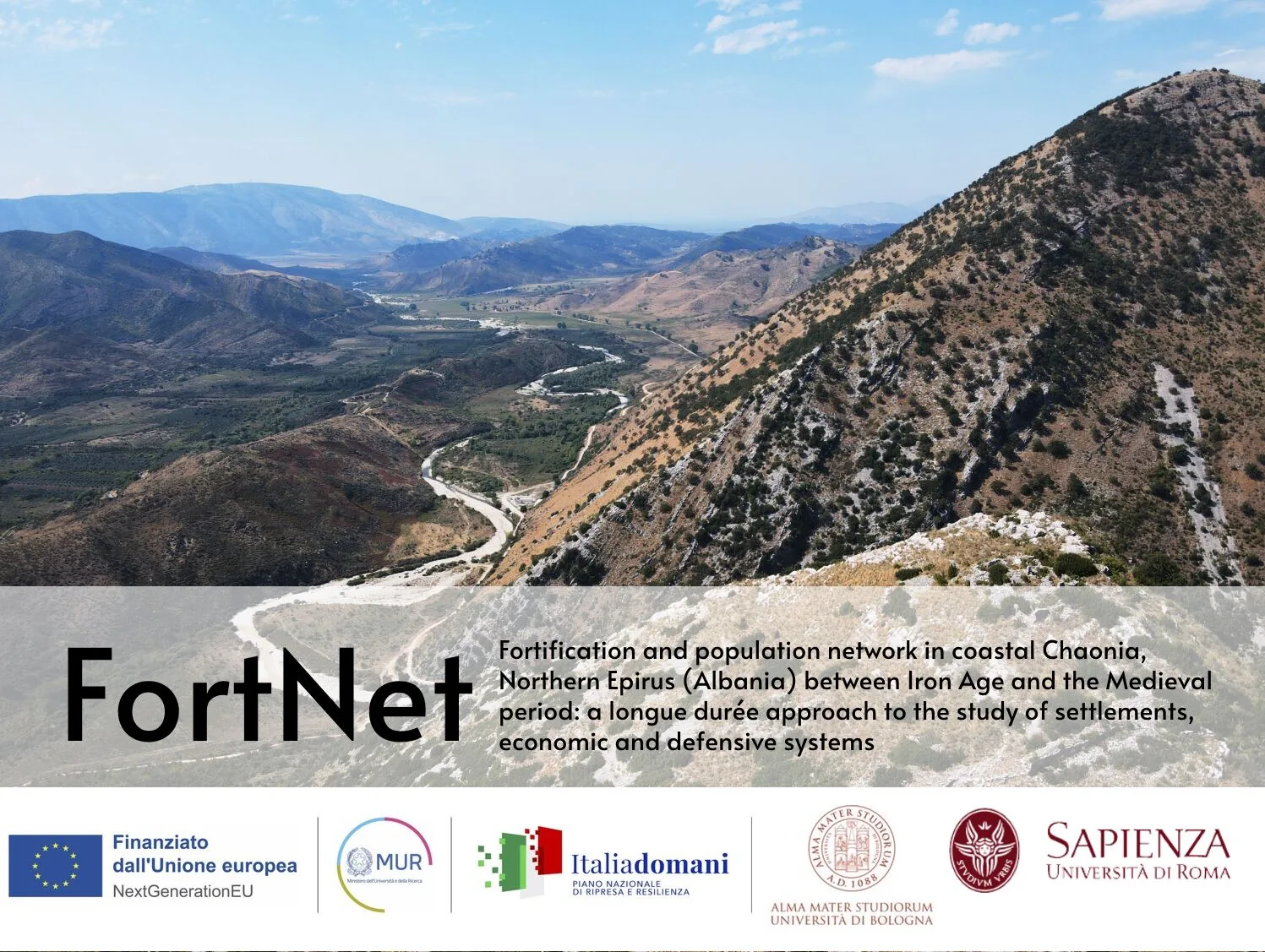
Fortification and population network in coastal Chaonia, Northern Epirus (Albania) between Iron Age and the Medieval period: a longue durée approach to the study of settlements, economic and defensive systems.
Research project details
- P.I.: Enrico Giorgi (University of Bologna)
- Head of the Sapienza Unit: Julian Bogdani (Sapienza University of Rome)
- Funding: PRIN 2022 (European Union – Next Generation EU, Mission 4 Component 1, CUP J53D23000100006)
- Start year: 2023
- Participants:
- Enrico Giorgi, P.I., enrico.giorgi@unibo.it
- Julian Bogdani, Head of the Sapienza Unit, julian.bogdani@uniroma1.it
- Vincenzo Baldoni, Bologna unit
- Federica Boschi, Bologna unit
- Enrico Cirelli, Bologna unit
- Nadia Aleotti, Research Fellow, Sapienza University of Rome
- Federica Carbotti, Research Fellow, University of Bologna
- Giacomo Sigismondo, Research Fellow, University of Bologna
Abstract
The FortNet Project is a collaboration between the University of Bologna and Sapienza University of Rome under the direction of Enrico Giorgi and Julian Bogdani, made possible by PRIN 2022 funding with the support of the European Union’s NextGeneration EU programme, MUR: the Italian Ministry of University and Research, and the “Italia Domani” programme.
FortNet places at the centre of its research the coastal region of ancient Chaonia (southern Albania), an area that remains fairly marginal in current scholarship, which has focused mainly on the main urban centres of Phoinike, Antigonea and Butrint. The coastal region has its own geographical autonomy, isolated to the west by the steep and rugged Ionian coast, with few and difficult landing points. Inland, on the other hand, the Acroceraunian mountain range, to use the ancient toponymy, rises above 2000 metres in altitude, forming a rather significant geographical boundary. Nevertheless, along this ridge runs, today as in antiquity, one of the few possible routes connecting the bay of Saranda with that of Vlora, and the routes inland pass through the narrow canyons of the few torrents that flow into the Ionian Sea. The sea has a double significance for a region traditionally oriented inland, such as Chaonia: it is both a factor of risk and an element of connection. These two elements materialise in the creation of a fairly dense network of small settlements and fortifications of various types occupying the heights overlooking the Ionian Sea. These are, as a rule, sites that have been little or not at all studied, for most of which there is a complete lack of archaeological and topographical documentation, or at best only a sketch or a fairly generic description. The archaeological evidence appears to span, not without gaps, a long period of time ranging from the late Bronze Age to the contemporary era.
For this reason, diachrony represents a necessary research perspective. The FortNet project aims to provide a complete survey of the open and fortified sites in this area, along with highly detailed topographical documentation based on systematic surveys and the use of modern topographical and geophysical technologies, applied to high scientific standards. The archaeological documentation of residential and defensive structures, complemented by a sample study of the surface archaeological material, will populate a shared web-based geodatabase, specifically structured to receive and share information among the members of the research group. The creation of a web portal dedicated to the project is also planned, which will on the one hand disseminate the results of the scientific research and, on the other, provide an open tool for the collaborative publication of in-depth studies on the main documented archaeological and cultural evidence. In this way, the project also aims to foster constructive dialogue with local communities, seeking the difficult balance between the knowledge and protection of cultural heritage on the one hand, and the right to exploit territorial resources on the other, today essentially based on a triangle whose vertices are tourism, agricultural production (olives and citrus fruit) and animal husbandry.
.DuWWJmo2.webp)
.DHxyVbKh.webp)
 (©FortNet Tutti i diritti riservati).9TXCo8Zw.jpg)
.vmSjxNUF.jpg)
.KCFC6Sk_.webp)
.CawK_y6f.webp)
.Tu7HP0xB.webp)
.BCWewas8.webp)
.jpg.Bot5-vO1.webp)
.CiLb6B-k.webp)
.BKKJLTl6.webp)
.BbcnHxlX.webp)
.U9Vj0yoH.webp)
.BWDl-yGb.webp)
.BKdqGo3Y.webp)
.DTGYLAwg.webp)