

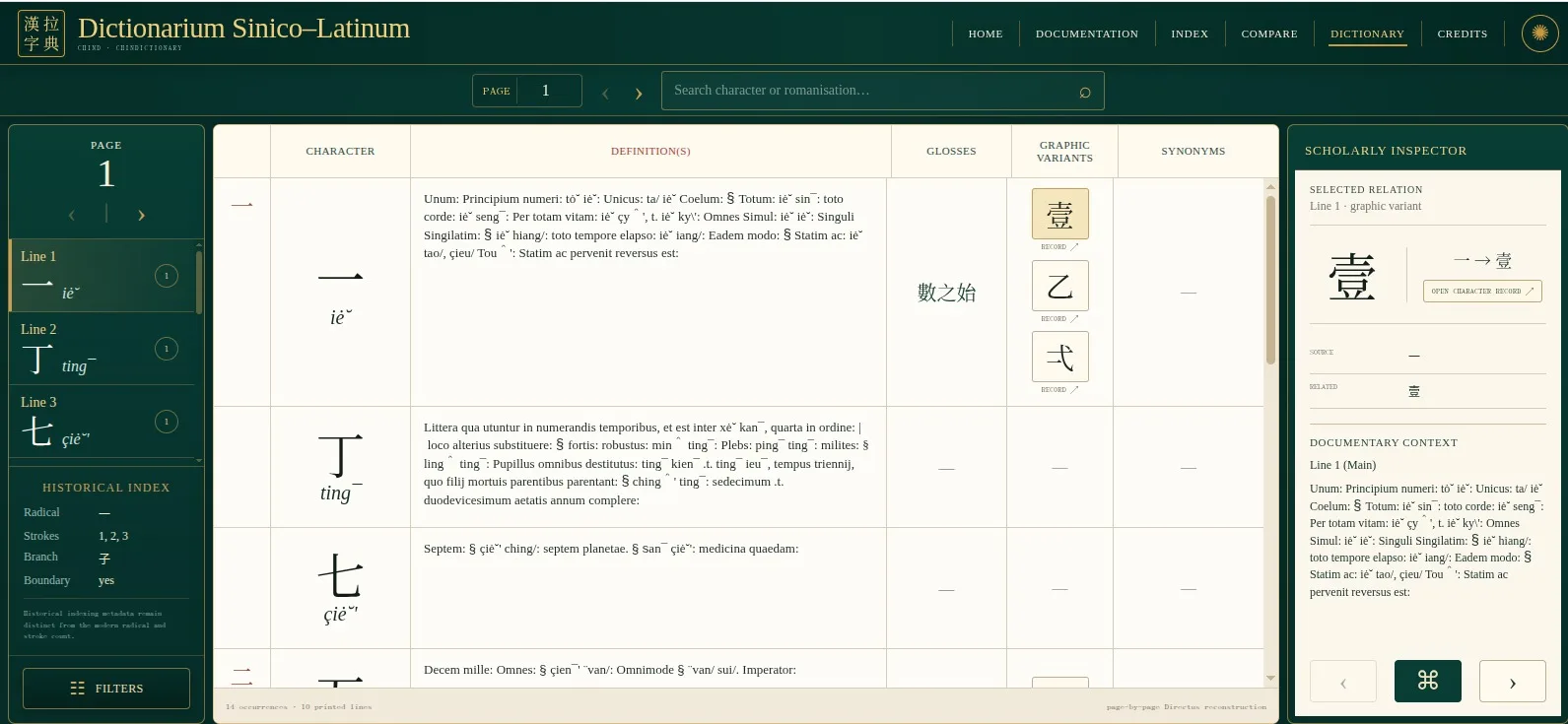
CHIN-DICTIONARY is now online, the digital platform created as part of the PRIN PNRR 2022 project “CHIN-DICTIONARY – Brollo’s Dictionarium sinico-latinum: linguistic innovations, textual connections, and trans-cultural translation.” The project is dedicated to the study and enhancement of the Dictionarium sinico-latinum by Basilio Brollo (1648–1704), a Franciscan missionary and author of one of the most significant Sino-Latin lexicographic works of the historical period. Specifically, the platform provides structured access to the data drawn from the Rinuccini 22 manuscript held at the Biblioteca Medicea Laurenziana, preserving the link between source, dictionary organization, and data interpretation.
The web infrastructure is built on s:CMS 6.1.8, an open-source product developed and maintained by LAD for creating static sites, research portals, and digital publications. Its architecture made it possible to develop CHIN-DICTIONARY by designing components and pages dedicated to lexicographic consultation, drawing on the capabilities of a relational database — hosted, as always, by LAD — managed by a Directus backend. This approach combined the flexibility of a structured database with the advantages of an accessible, lightweight, and easily distributable publication.
The site allows users to consult a 1:1 version of the original dictionary, preserving on the one hand the reference to the manuscript’s original organization, while offering, on the other, an enriched reading of each individual component through search and analysis tools. A character index has thus been developed, allowing the corpus to be explored through the language’s own indexing system — radicals and stroke count — along with detail pages for each individual grapheme, allowing users to explore readings, definitions, documentary attestations, and lexical relationships such as graphic variants, synonyms, and antonyms in detail.
A dedicated tool — Text Comparison — also allows any Chinese text to be compared against the lexical heritage documented in the Dictionarium, letting users assess similarities and discontinuities with the language recorded in the manuscript — directly attested graphic forms, recognized variants, disyllabic compounds recorded in the lexicon — while also providing a contextual inspector for exploring individual results in depth.
Alongside the metadata work and manual review of the data, an automatic extraction process for examples and romanized forms found in the definitions is also underway. This will be implemented in the near future within the database and online portal’s architecture, further expanding the possibilities for querying, comparing, and studying the attestations.
CHIN-DICTIONARY is available at: https://chindictionary.lad-sapienza.it