

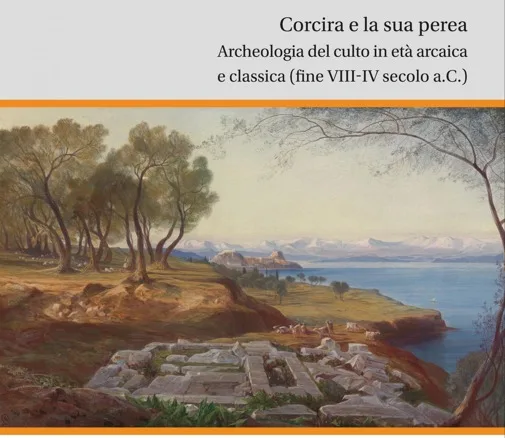
Nadia Aleotti, Corcira e la sua perea. Archeologia del culto in età arcaica e classica (Fine VIII-IV secolo a.C.), Pisa, Edizioni ETS 2025 - ISBN: 9788846772954
Within the framework of the research of the Sapienza Archaeological Mission in Albania, and thanks to funding from the same university’s Progetti per Avvio alla Ricerca scheme, the volume by N. Aleotti, Corcira e la sua perea. Archeologia del culto in età arcaica e classica (Fine VIII-IV secolo a.C.), has been published as part of the Diabaseis series (12).
The volume stems from the need to explore in depth the relations between Epirus and the neighbouring reality of Corcyra, a Corinthian colony on the island of Corfu. Interest in the archaeology of the island developed within the framework of the archaeological missions in Epirus, the mainland region facing the island, where a Corcyrean presence is attested along the coastal strip throughout the Archaic and Classical periods. The term perea refers precisely to that mainland territory subject to the control or influence of an island facing it: in the case of Corcyra, this projection onto the Epirote mainland is documented both by the historical sources and by the archaeological data from the coastal sites, which yield a Corinthian-Corcyrean material culture.
However, the natural comparison of archaeological data from coastal Epirus with that from the Corinthian colony of Corcyra proved very difficult from the outset, owing to the state of archaeological knowledge of the island of Corfu. Despite the wealth of historical and literary sources and the numerous studies devoted to the origins of the Corinthian colony of Corcyra, its foundation (late 8th century BC) and its relations with Corinth, the perea and the sub-colonies, knowledge of the archaeology of Corcyra remains rather patchy. The best-published contexts concern a few sanctuaries (the Artemision, the temple of Kardaki, the sanctuary of Hera), which have, however, been investigated almost exclusively from an architectural standpoint, while the Archaic city and its later phases are documented mostly through rescue excavations known from brief reports and publications of limited circulation.
Within this framework, the research focused on the archaeology of cult for two main reasons. On the one hand, sacred contexts offer a privileged perspective for investigating the relationship between material culture and ideological-religious superstructures, as well as the symbolic value attributed to ritual objects and spaces — aspects that this study sought to explore in depth through the analysis of the archaeological evidence examined; on the other hand, at the outset of the research, the data available from the perea for the Archaic-Classical period came largely from sacred contexts (the acropolis of Butrint, the site of Mastilitsa), making a comparison with the same types of evidence from the island a natural choice.
The volume therefore proposes a systematic review of the cult evidence from the Corinthian colony of Corcyra and from its perea between the 8th and 4th centuries BC — that is, from the colonial foundation to the early Hellenistic period, when Corcyra lost control of its mainland territories. The data are collected in a reasoned catalogue of 58 entries, arranged in five topographic sections, recording all the published cult evidence of the period, excluding funerary contexts. In each entry, the analysis of the finds is not limited to typological, chronological and provenance classification, but attempts to move from the material level to the ritual and symbolic one, proposing, in the most favourable cases, new considerations on chronology, on the nature of the contexts, on urban topography, and on the relationship with the historical events known for the island.
The work is thus configured first and foremost as a reasoned synthesis of the published evidence, but also as a starting point for future research: bringing the available data together into a system makes it possible to put forward new hypotheses on cult identities, on their historical evolution and on their relationship with the perea, while at the same time highlighting the considerable, still untapped potential of the archaeology of Corcyra.
Resources
- Publisher’s page: [https://www.edizioniets.com/scheda.asp?n=9788846772954&from=&fk_s=](https://www.edizioniets.com/scheda.asp?n=9788846772954&from=&fk_s e=)
- Link to download in Open Access and to purchase the print version